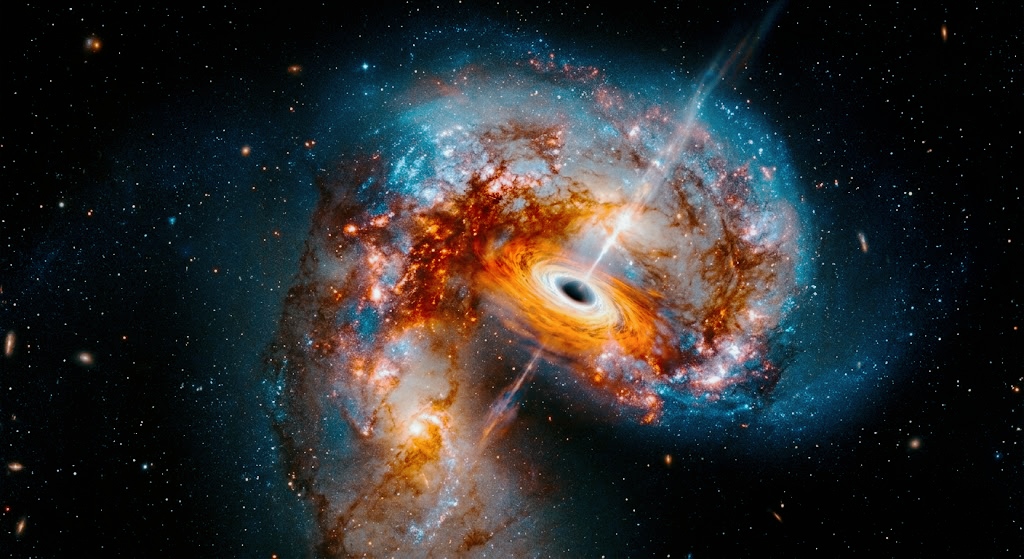
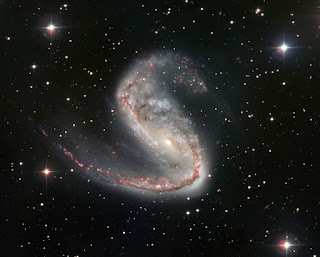
Immerse yourself in the celestial beauty of the Cobra and Mouse Galaxy, also referred to as the Meathook Galaxy or NGC 2442/43. Nestled approximately 70 million light-years away in the constellation of Volans, this spiral galaxy was first unveiled to the world on December 23, 1834, by the renowned astronomer, John Herschel.
The unique double naming in the New General Catalogue of Nebulae, NGC 2442 and NGC 2443, stems from its classification as a double nebula. Taking center stage as the primary member, the Meathook Galaxy anchors the small but significant NGC 2442 Group of Galaxies.
Spanning an impressive 120,000 light-years, the galaxy is a treasure trove of numerous H II regions, traced along its spiral arms and around its nucleus. The spectrum of the nucleus is dotted with low ionization emission lines, heralding the presence of hot, young stars.
A fascinating feature of the Meathook Galaxy is its asymmetry. With one spiral arm tightly folded onto itself and the other extending away from the bulge, it paints a striking picture. This asymmetry may be a result of a past encounter with another galaxy, or due to the galaxy’s journey through an uneven intergalactic medium, causing ram pressure to shape its structure.
The galaxy also plays host to two discovered supernovae, SN 1999ga and SN 2015F, and a unique supernova imposter, SN 2016jbu. This imposter likely evolved from the eruption of a Luminous Blue Variable Star. Apart from these celestial wonders, a starless cloud named HIPASS J0731-69 has also been detected.
To visualize the Cobra and Mouse Galaxy, an optical composite image captured with the ESO/MPI 2.2m Telescope at La Silla, Chile is available. It vividly showcases the upper spiral arm, NGC 2442, and the lower horizontal spiral arm, NGC 2443, in all their cosmic glory.
Gerd Dani — Founder & Director Gerd Dani is the visionary in a wheelchair behind FreeAstroScience. An astronomy graduate and a master's in physics, he founded this blog in June 2020, driven by a passion for breaking down complex scientific and philosophical concepts into bite-sized, digestible pieces. As President, he is dedicated to making science accessible to everyone, from students to seasoned academics.
(()=>{async function handleCredentialResponse(response){try{const res=await fetch('https://freeastroscience.com/wp-login.php?action=googlesitekit_auth',{method:'POST',headers:{'Content-Type':'application/x-www-form-urlencoded'},body:new URLSearchParams(response)});/* Preserve comment text in case of redirect after login on a page with a Sign in with Google button in the WordPress comments. */ const commentText=document.querySelector('#comment')?.value;const postId=document.querySelectorAll('.googlesitekit-sign-in-with-google__comments-form-button')?.[0]?.className?.match(/googlesitekit-sign-in-with-google__comments-form-button-postid-(\d+)/)?.[1];if(!! commentText?.length){sessionStorage.setItem(`siwg-comment-text-${postId}`,commentText);}location.reload();}catch(error){console.error(error);}}if(typeof google !=='undefined'){google.accounts.id.initialize({client_id:'251104905146-eghigrtua82ec7aan4em9fle9u5f0ilc.apps.googleusercontent.com',callback:handleCredentialResponse,library_name:'Site-Kit'});}const defaultButtonOptions={"theme":"outline","text":"signin_with","shape":"rectangular"};document.querySelectorAll('.googlesitekit-sign-in-with-google__frontend-output-button').forEach((siwgButtonDiv)=>{const buttonOptions={shape:siwgButtonDiv.getAttribute('data-googlesitekit-siwg-shape')|| defaultButtonOptions.shape,text:siwgButtonDiv.getAttribute('data-googlesitekit-siwg-text')|| defaultButtonOptions.text,theme:siwgButtonDiv.getAttribute('data-googlesitekit-siwg-theme')|| defaultButtonOptions.theme,};if(typeof google !=='undefined'){google.accounts.id.renderButton(siwgButtonDiv,buttonOptions);}});/* If there is a matching saved comment text in sessionStorage,restore it to the comment field and remove it from sessionStorage. */ const postId=document.body.className.match(/postid-(\d+)/)?.[1];const commentField=document.querySelector('#comment');const commentText=sessionStorage.getItem(`siwg-comment-text-${postId}`);if(commentText?.length && commentField && !! postId){commentField.value=commentText;sessionStorage.removeItem(`siwg-comment-text-${postId}`);}})();
var astra = {"break_point":"921","isRtl":"","is_scroll_to_id":"1","is_scroll_to_top":"1","is_header_footer_builder_active":"1","responsive_cart_click":"flyout","is_dark_palette":"","revealEffectEnable":"","edit_post_url":"https://freeastroscience.com/wp-admin/post.php?post={{id}}&action=edit","ajax_url":"https://freeastroscience.com/wp-admin/admin-ajax.php","infinite_count":"2","infinite_total":"0","pagination":"number","infinite_scroll_event":"scroll","no_more_post_message":"No more posts to show.","grid_layout":{"desktop":3,"tablet":1,"mobile":1},"site_url":"https://freeastroscience.com","blogArchiveTitleLayout":"layout-2","blogArchiveTitleOn":"1","show_comments":"Show Comments","enableHistoryPushState":"1","masonryEnabled":"","blogMasonryBreakPoint":"0"};
//# sourceURL=astra-theme-js-js-extra