
Have you ever wondered why your weight might change slightly depending on where you are on Earth? Or how scientists can peek beneath the Earth’s surface without digging? Welcome to FreeAstroScience, where we unravel complex scientific principles into digestible insights. Today, we’re diving into the fascinating world of Earth’s gravity – a force so ubiquitous yet surprisingly intricate. By the end of this article, you’ll gain a new appreciation for the invisible force that shapes our world and understand how its subtle variations offer valuable clues about our planet’s composition.
The Omnipresent Pull
Earth’s gravity is the most overriding force in human history. It’s so pervasive that we often take it for granted. This invisible force keeps us grounded, quite literally, influencing every aspect of our lives. From the stability of our buildings to the orbit of our moon, gravity is the unseen bond that holds our entire world together.
However, as we at FreeAstroScience often emphasize, nature is full of surprises. While we might assume gravity is constant across the globe, the reality is far more complex and intriguing.
The Challenge of Measurement
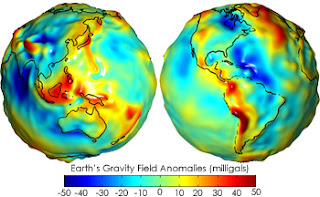
Precisely measuring Earth’s gravity is a surprisingly challenging task. While we have a general understanding of its strength, the force of our planet’s pull varies significantly from one location to another. These variations, though subtle, offer valuable insights into the composition of our planet.
Factors Influencing Gravity
Several factors contribute to the variations in Earth’s gravitational field:
- Earth’s Shape: Our planet isn’t a perfect sphere. It’s slightly flattened at the poles and bulges at the equator due to its rotation. This shape, known as an oblate spheroid, affects the strength of gravity at different latitudes.
- Rotation The Earth’s rotation creates a centrifugal force that slightly counteracts gravity, especially at the equator.
- Underground Composition*: The distribution of rocks and minerals beneath the Earth’s surface is not uniform. Areas with denser materials exert a stronger gravitational pull.
The Equatorial Bulge Effect
One of the most significant factors affecting gravity’s strength is Earth’s equatorial bulge. This phenomenon causes objects at the equator to be farther from the planet’s center compared to objects at the poles. As a result:
- Objects at the equator experience a weaker gravitational pull.
- An object will weigh approximately 0.5% more at the poles than at the equator.
Gravity as a Window to the Underworld
The variations in Earth’s gravity offer geologists and geophysicists a unique tool. By creating detailed gravity maps, scientists can:
- Identify underground structures
- Locate mineral and oil deposits
- Study the Earth’s crust and mantle
These gravity maps are crucial for various applications, from resource exploration to understanding tectonic processes.
Conclusion
As we’ve explored at FreeAstroScience, Earth’s gravity is far from uniform. Its subtle variations across the globe reflect our planet’s complex structure and composition. From the equatorial bulge to underground density differences, these gravitational nuances provide valuable insights into the world beneath our feet. The next time you step on a scale, remember – your weight is telling a story not just about you, but about the ever-changing planet we call home.
Understanding Earth’s gravity in all its complexity reminds us of the intricate balance that governs our world. It’s a testament to the power of scientific inquiry, showing how even the most familiar forces can reveal new secrets when studied closely.
Sources:
- National Oceanic and Atmospheric Administration (NOAA): https://www.noaa.gov/education/resource-collections/ocean-coasts/tides-currents
- NASA Earth Observatory: https://earthobservatory.nasa.gov/features/GRACE/page3.php
- U.S. Geological Survey (USGS): https://www.usgs.gov/faqs/what-geodesy
- National Physical Laboratory (NPL): https://www.npl.co.uk/resources/q-a/does-gravity-vary-over-surface-earth