
The shortest path between two points in a space, known as a geodesic, is a straight line in Euclidean geometry. Commonly taught in schools, Euclidean geometry adheres to the famous five postulates established by Euclid [1]. However, Euclidean geometry isn’t the only possible geometry, and the space-time structure of our universe does not always follow its axioms [2]. So, how does this relate to gravity being a force? The answer lies in the interplay between geometry and gravity.
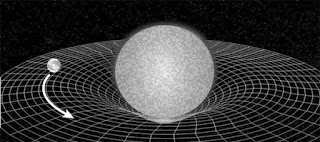
2: The earth traveling along a geodesic in the curved spacetime generated by the sun. Image credit: http://einstein.stanford.edu/.
Euclidean geometry primarily deals with space-like dimensions, neglecting time-type dimensions [2]. However, the theory of special relativity reveals the connection between space and time, necessitating a geometry that incorporates both [2]. In the context of our universe, we must consider one-time type dimension and three space-type dimensions (length, width, and height) [2].
The geometry of space-time is influenced by various factors, as demonstrated by the theory of general relativity [2]. In the vicinity of Earth, the space-time geometry can be approximated by the Schwarzschild geometry, which is determined by Earth’s roughly spherical mass distribution and other factors like rotation speed and electric charge [2].
Newton’s first principle of dynamics states that if a body experiences no external forces, its trajectory will correspond to a geodesic [2]. It is crucial to note that this refers to non-gravitational forces, as gravity is not considered a force in this context [2]. Geodesics in space-time geometry can differ significantly from straight lines, as evidenced by the Moon’s orbit around the Earth [2]. The Moon’s trajectory, a geodesic, appears attracted to Earth due to the curvature caused by our planet [2].
In conclusion, gravity can be described as a force because it acts as one, although it is distinct from other fundamental forces [2]. Gravitational force can be interpreted as a geometric effect, highlighting the remarkable connection between gravity and geometry [2].
References:
[1] Euclid’s Postulates and Some Non-Euclidean Alternatives