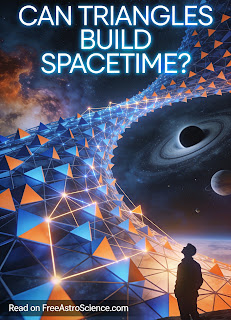

Can a pile of tiny triangles, stitched together by cause and effect, grow into a universe like ours?
Welcome, friend—pull up a seat with us, even if your day feels heavy.
Stay with us to the end, and you’ll see why this idea feels strangely hopeful.
Why is quantum gravity so hard?
Einstein’s general relativity ties gravity to the shape of space and time.
Quantum theory pushes a bolder idea: what we call “shape” behaves like an average over many possible shapes.
Renate Loll says she stopped taking even “3 space + 1 time” for granted after exploring many simulated universes.
Some of us read this on a train, tired and distracted.
So we’ll keep it simple: gravity bends spacetime, and quantum physics refuses to pick one shape.
That clash is the headache people call “quantum gravity.”
What is CDT, in plain words?
Causal Dynamical Triangulations (CDT) is a framework to compute what spacetime geometry can emerge from quantum effects.
The approach tries to use a minimal set of ingredients: geometry, quantum rules, and causal order.
In Loll’s view, that can be enough—no loops, no strings, no extra dimensions are required for the core setup.
Here’s the “everyday” picture we can hold onto.
We chop spacetime into many small building blocks a computer can handle.
The simplest blocks are triangles, glued together to make curved shapes.
We experience spacetime as 3 + 1: three spatial dimensions and one time dimension. That’s the target CDT tries to recover.
Why does “cause before effect” matter?
Loll and Jan Ambjørn suspected older computer approaches struggled since they used “Euclidean” spacetime, which is effectively timeless.
In that Euclidean setting, time becomes just another space direction, and the model loses a built-in arrow of time.
CDT keeps time and causal structure, aiming to avoid strange geometries that would allow time-travel-like causal violations.
If you’ve ever tried to read a story with shuffled pages, you know the feeling.
Events stop making sense when order collapses.
CDT insists the story of the universe keeps its “before” and “after.”
How do triangles become a universe?
CDT approximates curved spacetime by gluing triangles into a lattice that can bend.
Loll gives a simple image: six equilateral triangles around a vertex make a flat patch, while removing one and reconnecting edges creates a cone-like curvature.
By changing how many triangles meet at points, the construction can represent different curvatures.
Then CDT adds quantum rules through the path-integral idea: the observed universe behaves like a “superposition” of possible spacetime shapes.
Summing every possible gluing is impossible, so they approximate by generating many random triangle configurations to see which are most likely.
Loll says they were the first to get this procedure to produce a universe that resembles ours.
For readers searching specific terms: this is the “CDT path integral approach,” built from Lorentzian triangulations that preserve causality.
What did the simulations show in 1998 and 2004?
A preliminary calculation in 1998 showed that keeping causality led to a fundamentally different theory, which encouraged the team to continue.
They progressed to 3D simulations using tetrahedra, then reached 4D simulations in 2004.
To probe “dimension,” they increased the number of 4D triangles—about 50,000, then 100,000, then 200,000—and watched how the overall shape grew.
They report an eye-opening result: the growth matched what you’d expect for a universe with three large spatial dimensions and one time direction.
By contrast, earlier Euclidean attempts produced bizarre outcomes, like crumpled balls or filament-like webs, with no recognizable large spatial structure.
Loll interprets CDT’s result as evidence that an extended 4D universe can emerge from first principles in this setup.
| Year / scale | What they did | Why it mattered |
|---|---|---|
| 1998 | Early calculation tested what changes when causality is enforced. [page:0] | It suggested a fundamentally different theory, giving confidence to continue. [page:0] |
| 3D stage | They advanced to 3D simulations using tetrahedra. [page:0] | It was a stepping stone toward realistic 4D simulations. [page:0] |
| 2004 | They reached 4D simulations, matching our 3 space + 1 time. [page:0] | They could finally test whether large, extended spacetime emerges. [page:0] |
| 50k → 100k → 200k blocks | They increased 4D triangles and tracked how the “flock” grows. [page:0] | The growth behaved like an extended universe with a time direction. [page:0] |
Why might spacetime look 2D at tiny scales?
Loll says CDT makes a prediction: zoom in far enough and spacetime can lose its 4D character.
To study that, they look at a kind of dimension revealed by diffusion, like how a drop of ink spreads differently on a 2D page than in 3D water.
In their 4D simulations, the “ink drop” spread as if it were stuck in roughly 2D for a short time, then returned to normal behavior at larger spread times.
They don’t claim spacetime turns into a literal flat sheet.
Instead, Loll suggests the short-distance structure could resemble a fractal-like wiring: space is filled, yet some regions aren’t immediately accessible.
She calls this a genuine quantum signature, even if we don’t yet know where to look for it.
For searchers: you’ll often see this idea phrased as “spectral dimension drops to two” in discussions of Planck-scale quantum spacetime.
Can we test it, or is it out of reach?
Loll stresses a huge gap between the Planck-scale distances, where quantum spacetime should show up, and the scales we can reach in experiments.
When asked where tiny effects might get amplified, she points to astrophysics as a likely place to search for consequences of CDT.
She also says they’re still trying to understand what those consequences might be.
If you’ve ever felt small next to the universe, this part lands hard.
We want a clean test, a clear signal, a single “click.”
Yet even in particle physics, Loll reminds us that some things may resist that kind of detection.
Why isn’t everyone using CDT?
Loll says one hard sell is the need for numerical methods in quantum gravity.
She notes that general relativity looks mathematically beautiful and compact on paper, and many researchers love analytic control.
She argues that strong-gravity situations won’t yield to simple equations, so numerical triangulations can act as a sanity check on quantum-gravity models.
This is the part we relate to as builders and explainers.
Sometimes the truth hides in computation, not in a single elegant line.
That doesn’t make it less real; it makes it harder-earned.
Are we entering a “post-string, post-loop” mood?
Loll describes a shift in attitude after years dominated by “theory of everything” expectations.
She says string theory produced an “embarrassment of riches,” requiring 11 dimensions and many unknown particles for consistency, while still not delivering a unique quantum-gravity theory.
She senses more humility now, with renewed appreciation for quantum field theory, and she places CDT within that return-to-basics trend.
She also raises a sobering thought about detection.
Citing Freeman Dyson, Loll says it may be impossible to detect single gravitons, since a simple graviton detector could collapse into a black hole first.
Her punchline stings: maybe we ask too much of nature, at least in the “particle click” sense.
Closing thoughts
We’ve walked through CDT as Loll presents it: triangles as building blocks, quantum superposition through the path-integral idea, and causality as a guardrail.
We’ve also seen the headline results she highlights: an extended 4D universe emerging in 2004-era simulations, plus a short-scale diffusion signal that looks roughly 2D for brief moments.
If all this left you wide-eyed, good—wonder keeps the lights on, and we need that light.
Come back to FreeAstroScience.com when you want your curiosity fed, not dulled.
We’ll keep translating big ideas into words you can carry.
And we’ll keep reminding each other: never let your mind fall asleep.