Have you ever wondered what it would look like if we could suddenly see everything hiding in our solar system — every rock, every icy world, every faint speck drifting silently through the dark? What if a single telescope, peering from a mountaintop in Chile, could rewrite our map of the cosmos in just six weeks?

Welcome to FreeAstroScience, where we break down the universe’s biggest stories into language everyone can enjoy. We’re thrilled you’re here. Today, we’re talking about one of the most exciting developments in modern astronomy: the Vera C. Rubin Observatory and its staggering early haul of asteroid discoveries. Whether you’re an astronomy veteran or a curious newcomer, stick with us to the end — this story is just getting started, and what comes next will blow your mind.
—
—
What Is the Vera C. Rubin Observatory — and Why Does It Matter?
High on a Chilean mountaintop at coordinates −30.24°, −70.75°, a new eye is opening on the universe. The Vera C. Rubin Observatory houses the 8.4-meter Simonyi Survey Telescope**, and it’s about to change everything we know about our cosmic neighborhood.
The observatory carries the name of Vera C. Rubin, the American astronomer whose groundbreaking measurements of galaxy rotation curves gave us some of the earliest solid evidence that **dark matter** exists. The telescope itself is named after Charles Simonyi, the philanthropist who championed the project in its early days.
Here’s the big picture: the observatory will run a 10-year survey called the Legacy Survey of Space and Time (LSST). Think of it as a decade-long census of the sky — cataloguing stars, galaxies, asteroids, and fleeting cosmic events we’ve never noticed before.
And the survey hasn’t even officially begun. What Rubin has already accomplished with *preliminary engineering data* is, frankly, breathtaking.
—
How Did Rubin Find 11,000 New Asteroids in Only Six Weeks?
Between April and May 2025, while scientists were still calibrating instruments and running tests, Rubin collected six weeks of preliminary data. In that short window, the observatory identified 11,000 previously unknown asteroids.
Let that sink in.
The International Astronomical Union’s Minor Planet Center (MPC) confirmed the data, calling it the largest single batch of asteroid detections submitted in the past year. And this wasn’t the main act — this was the sound check.
“What used to take years or decades to discover, Rubin will unearth in months,” said Mario Juric, Rubin Solar System Lead Scientist at the University of Washington.
The secret? The world’s largest digital camera ever built, capable of spotting up to 7 million transient events every single night. A test showed it can handle 800,000 events with ease. That’s not just powerful — it’s a paradigm shift.
“Rubin’s unique observing cadence required a whole new software architecture for asteroid discovery,” explained Ari Heinze at the University of Washington. Together with graduate student Jacob Kurlander, Heinze built the detection software from scratch. “We built it, and it works,” he said.
—
Should We Worry About the 33 Near-Earth Objects?
Among those 11,000 new asteroids, 33 are near-Earth objects (NEOs) — space rocks whose orbits bring them close to our planet’s path around the Sun.
Before you reach for the panic button: none of these NEOs pose a danger to Earth. The largest is about 500 meters across (roughly 0.31 miles) . Large, yes. Threatening, no — at least not right now.
But here’s the sobering reality. While astronomers have tracked all the civilization-ending asteroids (think dinosaur-killer size), we’ve found only about 40 percent of the ones big enough to cause regional devastation — those larger than 140 meters . That gap in our knowledge keeps planetary defense scientists up at night.
Rubin is expected to close that gap significantly over its decade of operation.
⚠️ NEO Size vs. Threat Level
The table below gives you a quick sense of what different asteroid sizes mean for our planet — and how much of each category we’ve actually catalogued.
| Diameter | Potential Impact | % Catalogued |
|---|---|---|
| ≥ 1 km | Global catastrophe | ~95% |
| ≥ 140 m | Regional devastation | ~40% |
| ~50 m | City-level destruction | < 10% |
| ≤ 500 m (largest Rubin NEO) | Significant regional damage | Improving |
Source: Data context from Rubin Observatory preliminary findings . Completeness estimates are approximate based on current planetary defense literature.
Rubin will be one of our best tools for finding those missing 60 percent. And that’s not a luxury — it’s a necessity.
—
What About the “Lost” Asteroids Rubin Found Again?
Here’s a detail that doesn’t get enough attention. During those same six weeks, Rubin also spotted more than 80,000 known asteroids — including many that were considered “lost”.
What does “lost” mean in astronomy? These are asteroids that were discovered in the past but whose orbits weren’t measured precisely enough. Over time, they drifted away from their predicted positions and vanished from our tracking systems. They were still out there — we just couldn’t find them anymore.
Thanks to Rubin’s extraordinary sensitivity and sky coverage, many of these wandering rocks have been **rediscovered**, their orbits now pinned down with much greater accuracy.
It’s like finding a misplaced set of keys — except the keys weigh millions of tons and are hurtling through space at thousands of kilometers per hour.
—
What Lurks Beyond Neptune? 380 New Trans-Neptunian Candidates
Rubin isn’t just watching our backyard. It’s also peering into the deepest, coldest fringes of the solar system.
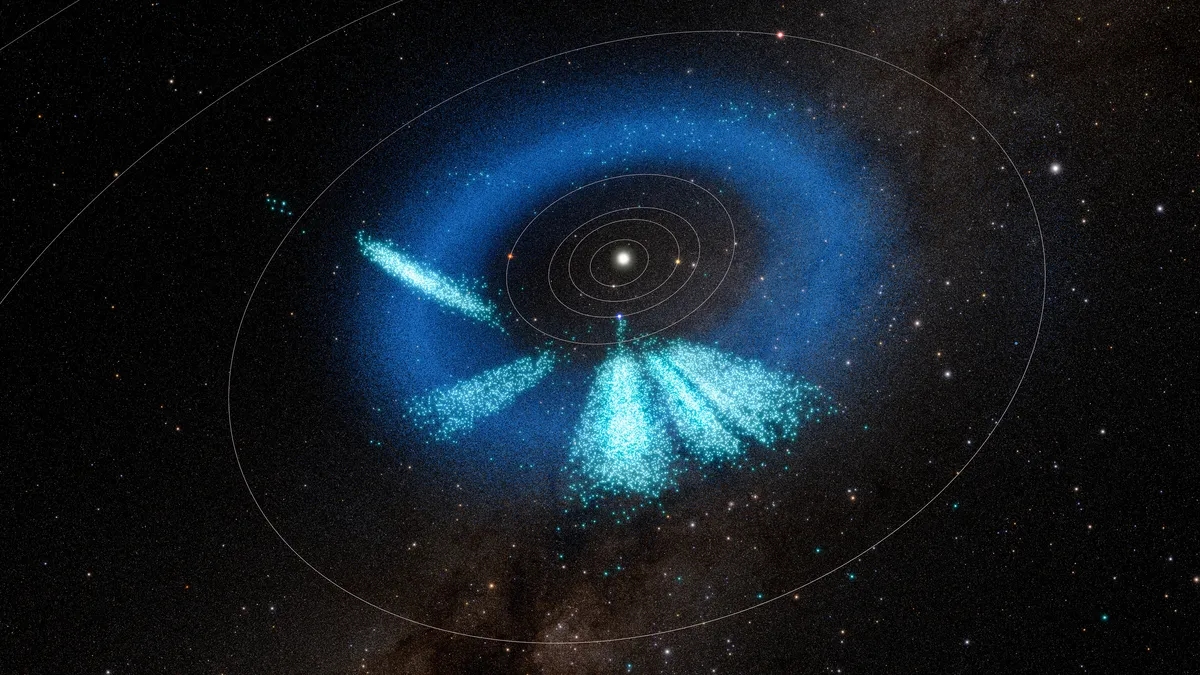
The observatory has identified 380 new trans-Neptunian object (TNO) candidates — icy bodies drifting far beyond Neptune’s orbit. Two of them are especially remarkable.
Provisionally named 2025 LS2 and 2025 MX348, these objects travel on orbits so stretched that at their farthest point from the Sun, they are **1,000 times farther away than Earth is**. That places them among the 30 most distant minor planets known to science.
Finding objects this faint and far away is extraordinarily difficult. “Searching for a TNO is like searching for a needle in a field of haystacks,” said Matthew Holman at the Harvard–Smithsonian Center for Astrophysics . The software had to sift through millions of flickering sources, examining billions of possible combinations to pick out real distant worlds.
Why does this matter? Because these extreme objects carry clues about the solar system’s earliest history.
“Objects like these offer a tantalizing probe of the Solar System’s outermost reaches, from telling us how the planets moved early on… to whether a hitherto undiscovered 9th large planet may still be out there,” said Kevin Napier, also at the Harvard–Smithsonian Center for Astrophysics .
That’s right — the search for Planet Nine isn’t dead. And Rubin might be the instrument that settles the debate once and for all.
—
The Staggering Numbers Behind the Simonyi Survey Telescope
Sometimes the best way to grasp a telescope’s power is to look at the raw data. Let’s do that.
According to the Minor Planet Center’s records for Rubin Observatory station X05, the telescope has already logged 1,813,389 total observations across 39 submissions in its first active year. That works out to an average of roughly 46,497 observations per submission.
📊 Rubin Observatory — Early Performance Snapshot (Station X05)
| Metric | Value |
|---|---|
| Total observations recorded | 1,813,389 |
| Data submissions to MPC | 39 |
| Avg. observations per submission | ~46,497 |
| Active years | 1 |
| Primary mirror diameter | 8.4 m |
| Photometric bands used | Up to 6 |
| Median magnitude (faintest batch) | ~23.4 |
| Nightly transient capacity (design) | Up to 7 million |
Data: Minor Planet Center station X05 records and observatory engineering reports .
Look at that median magnitude column. Some of Rubin’s submission batches have reached a median magnitude of 23.4 — meaning the telescope routinely detects objects so faint that no human eye could ever see them, even with the best backyard telescope money can buy. For context, the faintest stars visible to the naked eye sit around magnitude 6. Every 5 magnitudes represent a 100-fold decrease in brightness.
🔢 Quick Formula: How Astronomers Compare Brightness
The apparent magnitude scale is logarithmic. The brightness ratio between two objects of magnitudes m1 and m2 is:
So an object at magnitude 23.4 (Rubin’s faintest median detections) is roughly 630 million times fainter than a magnitude 1 star like Vega. That’s the kind of sensitivity we’re talking about.
The numbers tell a clear story: even in its warm-up phase, Rubin is performing at a level no other survey telescope has matched.
—
What’s Next for the Legacy Survey of Space and Time?
The full LSST is a 10-year campaign designed to photograph the entire visible southern sky repeatedly. By the time it wraps up, Rubin is expected to more than triple the known population of asteroids — adding an estimated 3 to 4 million new ones to the roughly 1.5 million we currently know about.
That’s not a small improvement. That’s rewriting the textbook.
And the asteroid count is just one slice of the science. The LSST will also:
– Map dark matter** distributions across the sky (a fitting tribute to the observatory’s namesake, Vera Rubin).
– Detect supernovae and other transient events almost in real time.
– Track potentially hazardous asteroids to close the gap in our planetary defense coverage.
– Probe the outer solar system for undiscovered dwarf planets — and maybe, just maybe, Planet Nine.
“We are beginning to deliver on Rubin’s promise to fundamentally reshape our inventory of the Solar System and open the door to discoveries we haven’t yet imagined,” said Mario Juric .
That phrase — *discoveries we haven’t yet imagined* — is the part that gives me chills. We don’t yet know what Rubin’s biggest finding will be. And that uncertainty is the most exciting thing of all.
—
Final Thoughts: The Sleep of Reason Breeds Monsters
Let’s step back and appreciate what just happened.
A telescope that hasn’t officially started its primary mission **discovered 11,000 new asteroids**, **33 near-Earth objects**, and **380 trans-Neptunian candidates** — in six weeks of engineering data . It rediscovered “lost” asteroids by the tens of thousands. It spotted two objects so distant they orbit **1,000 times farther from the Sun than we are** . And it’s already racked up over **1.8 million individual observations**.
This isn’t a gradual improvement over older telescopes. This is a leap.
We at **FreeAstroScience** wrote this article for you — because we believe complex scientific ideas deserve to be explained in simple, honest language. We want to inspire you. We want you to feel that you’re part of this story, because you are. Every new asteroid found, every faint light captured at magnitude 23, every algorithm built to sift needles from haystacks — these achievements belong to all of us.
As Goya once etched: *the sleep of reason breeds monsters*. At FreeAstroScience, we believe the antidote is to **never turn off your mind**. Keep it active. Keep it curious. Keep it looking up.
The universe is vast, and it’s full of things we haven’t seen yet. The Vera C. Rubin Observatory is proof that when we choose to look harder, we find more than we ever expected.
**Come back to [FreeAstroScience.com](https://freeastroscience.com) anytime** — we’ll be here, breaking down the biggest ideas in the cosmos, one clear sentence at a time.
—
div style=”max-width:760px;margin:2.5em auto;font-family:’Segoe UI’,Arial,sans-serif;”>📚 References & Sources
- Minor Planet Center — Simonyi Survey Telescope, Rubin Observatory (Station X05). sbx.dirac.dev/station/X05
- Carpineti, A. (2026). “Over 11,000 New Asteroids, Including 33 Near-Earth Objects, Spotted By Rubin Observatory In Just A Few Weeks.” IFLScience. iflscience.com
- Rubin Observatory / NSF–DOE Vera C. Rubin Observatory / NOIRLab / SLAC / AURA — Rubin Asteroid Discoveries Dashboard. rubinobservatory.org