Can Galaxies Exist Without Dark Matter? A Third Galaxy Says Yes
What happens when the invisible glue that holds a galaxy together simply… isn’t there? For decades, we’ve been told that dark matter is the hidden backbone of every galaxy in the cosmos. Without it, stars should scatter like sparks in the wind. Yet astronomers just found a third galaxy that appears to be missing its dark matter entirely — and it’s rewriting what we thought we knew about how galaxies are born.
Welcome to FreeAstroScience, where we break down complex scientific ideas into language that actually makes sense. Whether you’re a physics enthusiast, a curious student, or someone who just looked up at the sky and wondered what’s really out there, this article is for you. We wrote it with care, because we believe the sleep of reason breeds monsters — and keeping your mind switched on is one of the bravest things you can do.

Grab a coffee. Settle in. Let’s walk through one of the most exciting discoveries in modern astrophysics together — step by step, from start to finish.
📑 Table of Contents
- 1. Why Do We Call Dark Matter the Scaffolding of Galaxies?
- 2. How Did Galaxy DF2 Shake the Foundations in 2018?
- 3. MOND vs. Dark Matter: Which Theory Wins?
- 4. What Is the Trail of Galaxies in the NGC 1052 Field?
- 5. What Does the New Discovery of DF9 Tell Us?
- 6. How Does the “Bullet Dwarf” Collision Theory Work?
- 7. What Do the Numbers Actually Say?
- 8. Why Does This Discovery Matter for All of Us?
- 9. What Comes Next for the NGC 1052 Trail?
Why Do We Call Dark Matter the Scaffolding of Galaxies?
Before we get to the big revelation, let’s talk about why dark matter matters so much.
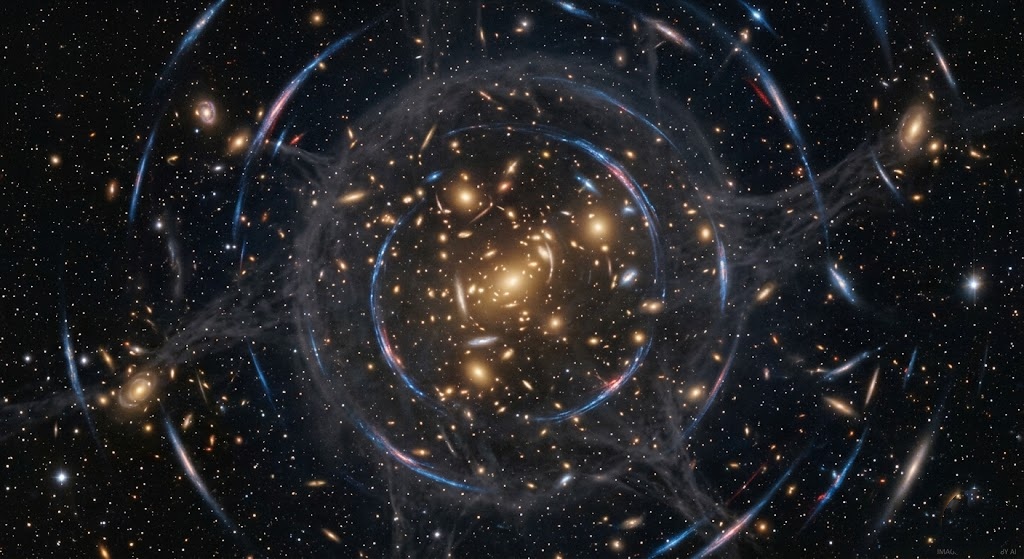
In the standard model of galaxy formation, galaxies are born inside enormous invisible structures called dark matter halos. Gas cools inside those halos, collapses, and forms stars . Think of dark matter as the frame of a house — you can’t see it once the walls are up, but without it, everything falls down.
Nearly every galaxy we’ve ever studied appears to be gravitationally dominated by dark matter. And the smaller the galaxy, the more dark matter seems to control it. Low-mass dwarf galaxies, for example, tend to sit inside dark matter halos that are more than 100 times heavier than all their visible stars combined .
That’s the textbook story. It’s clean. It’s consistent. And it held up beautifully — until a strange, ghostly galaxy showed up in 2018 and started poking holes in it.
How Did Galaxy DF2 Shake the Foundations in 2018?
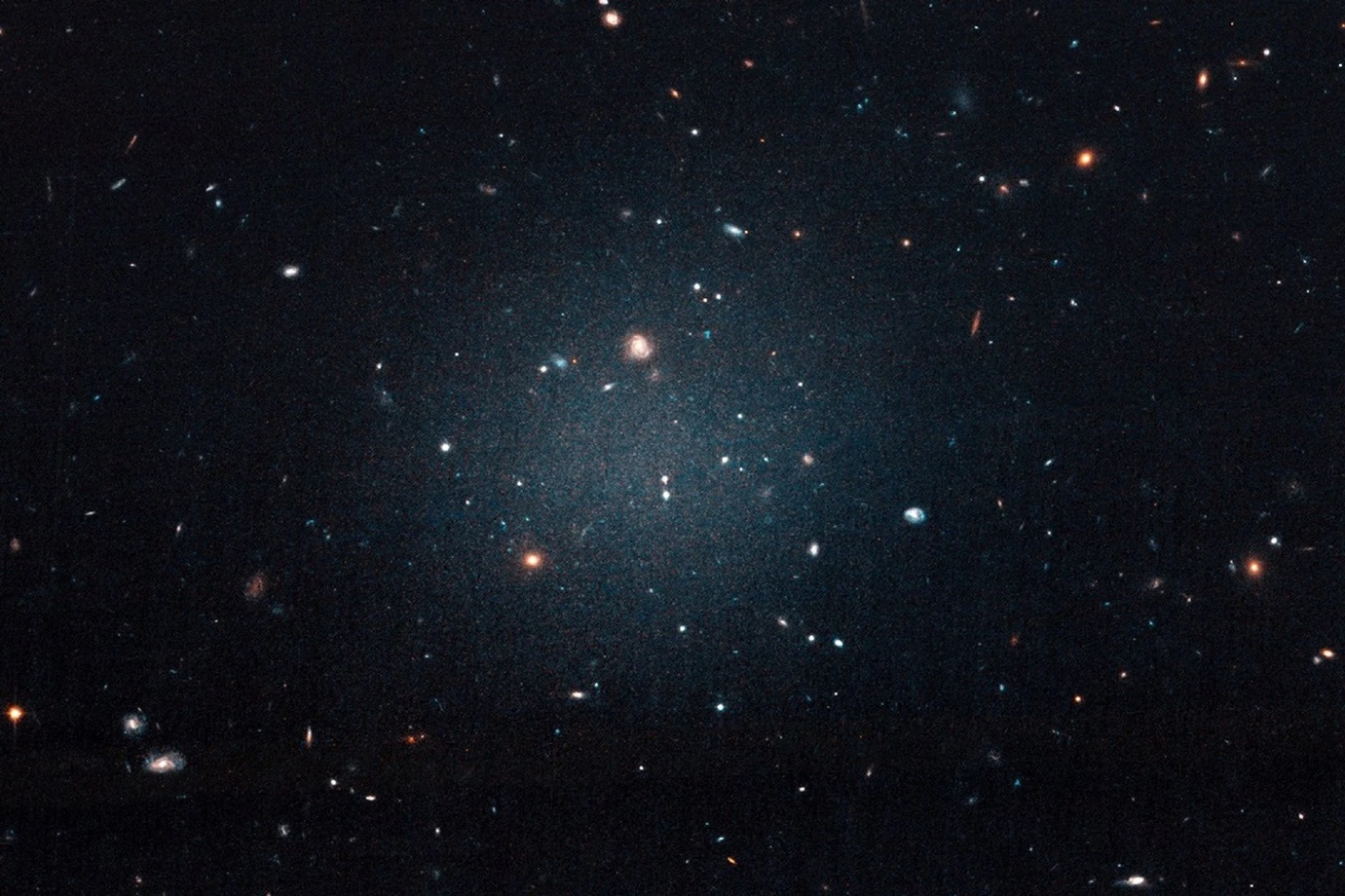
In 2018, Dr. Pieter van Dokkum and his team at Yale published a bombshell paper. They’d found an ultra-diffuse galaxy called NGC 1052-DF2 — DF2, for short — that appeared to contain almost no dark matter at all .
DF2 was roughly the size of our Milky Way, yet it held around 500 times fewer stars . It was so faint, so spread out, that you could literally see distant galaxies shining through it. Imagine looking at a fog bank so thin that the streetlights behind it are barely dimmed.
Here’s what made DF2 truly revolutionary: its total mass, measured through the motions of its stars and star clusters, lined up almost perfectly with the mass of its visible matter alone. There was no room for a giant dark matter halo. The invisible scaffolding just… wasn’t there .
That single observation shook cosmology. Because if dark matter is real — a physical substance that exists independently of ordinary matter — then there should be situations where the two get separated. DF2 was the first solid evidence that this separation can actually happen .
MOND vs. Dark Matter: Which Theory Wins?
Now, here’s where it gets spicy.
For years, there’s been a rival explanation to dark matter called MOND — Modified Newtonian Dynamics. The idea, put simply, is that gravity behaves a little differently at very low accelerations, like those experienced by stars on the outer edges of galaxies . MOND doesn’t need an invisible substance. It just tweaks the rules of gravity.
DF2 turned out to be the perfect laboratory to test both theories against each other.
Under MOND, a diffuse galaxy like DF2 should show that “extra” gravity — its stars should be moving faster than their visible mass can explain. That’s what the modified gravity predicts for low-acceleration environments .
But that’s not what the data showed. DF2’s stars moved at a sluggish pace, perfectly explainable by ordinary Newtonian gravity with no modifications whatsoever .
This created what you might call a fatal paradox for MOND. If modified gravity is a fundamental law of physics, every galaxy must obey it. A galaxy can’t just “opt out” of the laws of nature. The fact that DF2 showed normal gravity — while other galaxies show the “extra” gravity MOND predicts — strongly suggests that the extra gravity comes from a real substance (dark matter), not from a change in the rules .
The debate didn’t end overnight, of course. Several research groups questioned the distance measurements for DF2, arguing that errors might explain the odd behaviour . But then the Hubble Space Telescope confirmed the distance. And something even more astonishing happened: the team found a second dark-matter-free galaxy.
What Is the Trail of Galaxies in the NGC 1052 Field?
That second galaxy was called NGC 1052-DF4 (DF4). And it didn’t just exist in isolation — it formed a tight, linear alignment with DF2 .
In 2022, van Dokkum and colleagues discovered that DF2 and DF4 were part of something much bigger: a string of about a dozen faint galaxies lined up in the NGC 1052 field. Their positions traced a straight line, and their radial velocities increased linearly along that line . A trail like this — so tight, so statistically significant — is unique in all known galaxy catalogs .
Picture a row of pearls on a string. Each pearl is a galaxy. The spacing and the motion of each pearl follow a predictable pattern. That pattern screams: these galaxies were born together, in a single event.
And that event, according to the leading theory, was a cosmic collision of almost unimaginable violence.
What Does the New Discovery of DF9 Tell Us?
This brings us to April 2026 and the discovery that inspired this article.
Michael A. Keim, Pieter van Dokkum, Zili Shen, Shany Danieli, and Imad Pasha — a team spread across Yale, Princeton, and Tel Aviv University — have now measured the dark matter content of a third galaxy on the trail: NGC 1052-DF9 (DF9) .
DF9 is the closest twin to DF2 and DF4 on the trail. It has a similar brightness, a similar size, and a similar population of bright star clusters . The team used the Keck Cosmic Web Imager (KCWI) on Keck II — one of the most powerful spectrographs on Earth — to measure how fast DF9’s stars are moving. Those 10.83 hours of observation time spread across two nights in October 2024 paid off spectacularly .
The result? DF9’s measured stellar velocity dispersion is just 6.4 km/s (with uncertainties of +4.0/−4.3 km/s) . That number is completely consistent with what you’d expect from the galaxy’s stellar mass alone — about 1.4 × 10⁸ solar masses — without any dark matter at all .
If DF9 had a normal dark matter halo, like the kind every textbook says it should, the expected velocity dispersion would be 27 ± 3 km/s . That’s more than four times what was observed. The dark matter simply isn’t there.
How Does the “Bullet Dwarf” Collision Theory Work?
So three galaxies on the same straight line are all missing their dark matter. The question isn’t whether this happened. The question is: how?
The most compelling explanation is called the “Bullet Dwarf” collision scenario, first proposed by astrophysicist Joseph Silk in 2019 . It’s a small-scale version of the famous Bullet Cluster collision, scaled down to dwarf galaxies.
Here’s the picture. Imagine two gas-rich dwarf galaxies hurtling toward each other at extreme speed.
Dark matter only interacts through gravity. It doesn’t collide, doesn’t bounce, doesn’t feel friction. So when the two galaxies meet, their dark matter halos pass straight through each other — like two clouds of ghosts walking through the same doorway .
Normal matter — the gas clouds — behaves very differently. Gas is messy. It crashes, piles up, compresses, and heats. The gas from both galaxies slams together in a violent collision, separating itself from the dark matter that used to hold it .
That stripped, dark-matter-free gas then triggers an intense burst of star formation. And the result is a string of newborn galaxies strung along the collision axis — galaxies made entirely of normal matter, with no dark matter skeleton to speak of .
DF2, DF4, and now DF9 sit on that string like beads on a thread, each one confirming the prediction.
What Do the Numbers Actually Say?
Let’s get into the specifics, because the numbers here tell a beautiful story.
The team calculated DF9’s dynamical mass within its effective half-light radius using the Wolf et al. (2010) equation :
Key Dynamical Mass Formula
Me = 3σ²re,3D / G
Where σ is the stellar velocity dispersion, re,3D ≈ 4/3 × re is the projected circularized half-light radius, and G is Newton’s gravitational constant.
And here’s what that formula revealed:
| Property | DF2 | DF4 | DF9 (new) |
|---|---|---|---|
| Measured σ (km/s) | 6.1+3.7−3.1 | 7.7+2.0−2.4 | 6.4+4.0−4.3 |
| Expected σ from stars alone (km/s) | ~8–9 | ~7–8 | 8.3+0.9−1.4 |
| Expected σ with normal dark matter halo (km/s) | ~27 | ~27 | 27 ± 3 |
| Stellar Mass (M☉) | ~2 × 10⁸ | ~1.5 × 10⁸ | 1.4 × 10⁸ |
| Dark matter required? | No | No | No |
Look at that table for a moment. All three galaxies have measured velocity dispersions that match what their stars alone can explain. And all three fall far below the ~27 km/s you’d expect if they had standard dark matter halos .
The dynamical mass of DF9 within its effective half-light radius works out to about 0.42 × 10⁸ solar masses — entirely consistent with its stellar mass of 0.71 × 10⁸ solar masses within the same radius . No room for dark matter. Not even a little.
What makes this so powerful is the broader context. When we compare DF2, DF4, and DF9 to other dwarf galaxies in the Local Group and the Virgo Cluster, they’re absolute outliers. Galaxies with similar velocity dispersions tend to have 100 times less stellar mass and be 2–6 times smaller in radius. Galaxies with similar stellar masses tend to have dark matter halos that are 100 times more massive .
These three galaxies simply don’t fit the rules — unless they were born through a process that stripped away their dark matter before they even formed.
Why Does This Discovery Matter for All of Us?
You might be thinking: Okay, three faint galaxies are missing something invisible. Why should I care?
Here’s why. This discovery does two things at once, and both of them are profound.
First, it confirms that dark matter is a real physical substance — not just a mathematical trick. If dark matter were just a modification of gravity (as MOND suggests), you couldn’t separate it from normal matter. You can’t peel away a law of nature. But you can separate one physical thing from another. The existence of these dark-matter-free galaxies proves that dark matter and normal matter are distinct things that can be physically torn apart .
Second, it reveals an entirely new way that galaxies can be born. In the standard picture, every galaxy forms inside a dark matter cocoon. The Bullet Dwarf collision scenario shows us a different path — a violent, chaotic one where gravity’s invisible partner gets left behind, and bare gas clouds build galaxies from scratch .
For those of us who lie awake at night wondering how the universe works, this is a moment of genuine clarity. We’re watching science do what science does best: make a prediction, then test it.
What Comes Next for the NGC 1052 Trail?
The team isn’t stopping at three. They want to measure the kinematics of a fourth and fifth galaxy along the trail . The challenge is real: the farther along the trail you go, the fainter the galaxies become. Some are up to 100 times dimmer than DF2 .
Another promising avenue is to map the neutral and ionized gas in the group. If any remaining trail galaxies still contain gas, that gas could provide dynamical constraints — a way to weigh galaxies that are too faint for optical spectroscopy . And if leftover gas from the original collision is still hanging around along the trail, it would be something close to a smoking gun: direct physical evidence of the Bullet Dwarf event itself .
There’s also the tantalizing possibility that studying the gas content of these three galaxies could help distinguish between different dark matter models . In a field where dark matter’s true identity remains one of the biggest open questions in physics, every new data point is gold.
A Moment of Perspective
We live in an age where a team of researchers at Yale, Princeton, and Tel Aviv can point one of the world’s most advanced spectrographs at a galaxy 20.6 million parsecs away, collect light for almost 11 hours, and determine — with confidence — that an invisible substance we’ve never directly detected is absent from that galaxy.
That’s not just science. That’s humanity at its best. Curious, persistent, humble before the data.
And if you’ve read this far — scrolling through formulas and tables and cosmic collisions — you’re part of that same spirit. You chose to think. You chose to pay attention. And that matters more than you know.
Wrapping Up: What We’ve Learned
Let’s step back and gather the threads.
- Dark matter has long been considered the invisible scaffolding of every galaxy. Without it, galaxies shouldn’t hold together.
- In 2018, the discovery of NGC 1052-DF2 showed that galaxies can exist without dark matter — dealing a serious blow to MOND .
- A second galaxy, DF4, and a linear trail of ~12 faint galaxies in the NGC 1052 field confirmed the pattern .
- Now, in 2026, the team led by Michael Keim and Pieter van Dokkum has shown that a third galaxy — DF9 — also lacks dark matter, with a velocity dispersion of just 6.4 km/s, consistent with stars alone .
- The “Bullet Dwarf” collision theory, which predicted this result, explains how high-speed galactic collisions can strip gas away from dark matter, creating a trail of dark-matter-free galaxies .
- The discovery simultaneously supports the existence of dark matter as a physical substance and reveals a brand-new channel of galaxy formation.
Every time we think we understand the cosmos, it shows us something unexpected. That’s not a sign of failure — it’s a sign that the universe is far stranger and more wonderful than any single theory can capture.
We at FreeAstroScience exist to explain these ideas in a way that’s honest, clear, and human. Because science isn’t just for researchers with telescopes and supercomputers. It’s for every person who’s ever looked up at a dark sky and felt both small and astonished.
Never turn off your mind. Keep it awake. Keep it asking questions. The sleep of reason breeds monsters — and a universe this extraordinary deserves your full attention.
Come back to FreeAstroScience.com anytime you want to keep exploring. We’ll be here, turning the complicated into the understandable — one cosmic story at a time.
References & Sources
- Tomaswick, A. (2026, April 2). “Astronomers Find a Third Galaxy Missing Its Dark Matter, Validating a Violent Cosmic Collision Theory.” Universe Today. universetoday.com
- Keim, M. A., van Dokkum, P., Shen, Z., Danieli, S., & Pasha, I. (2026). “A Third Galaxy Missing Dark Matter along a Trail of Galaxies in the NGC 1052 Field.” arXiv preprint, arXiv:2603.15860v1. arxiv.org/abs/2603.15860
- van Dokkum, P. et al. (2018). “A galaxy lacking dark matter.” Nature, 555, 629. doi.org/10.1038/nature25767
- Silk, J. (2019). “Formation of dark-matter-deficient galaxies through galaxy collisions.” MNRAS, 488, L24. doi.org/10.1093/mnrasl/slz090
- Wolf, J. et al. (2010). “Accurate masses for dispersion-supported galaxies.” MNRAS, 406, 1220. doi.org/10.1111/j.1365-2966.2010.16753.x
- van Dokkum, P. et al. (2022). “A trail of dark-matter-free galaxies from a bullet-dwarf collision.” Nature, 605, 435. doi.org/10.1038/s41586-022-04665-6