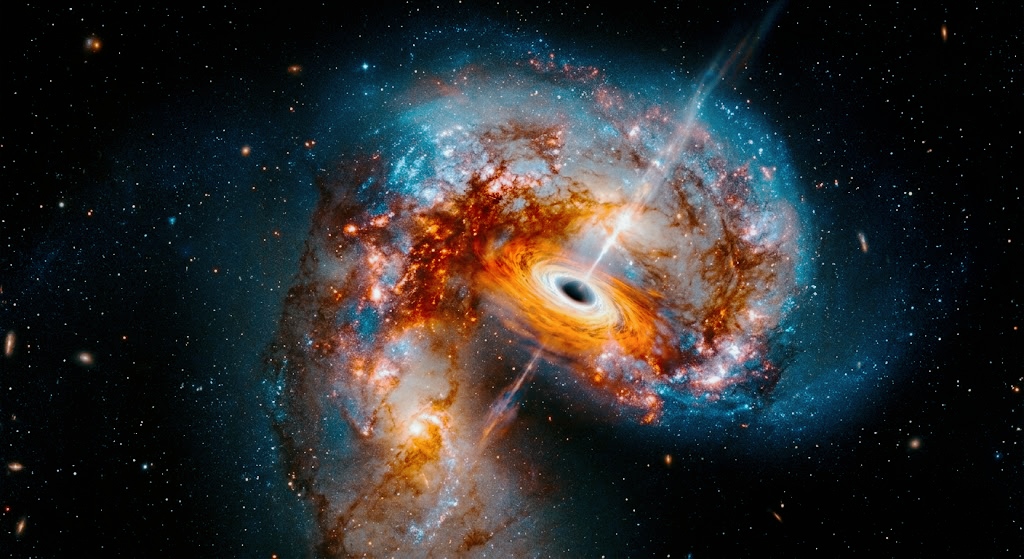

The supermassive black holes identified at the center of most galaxies can be compared to a heart.
They, through the jets they expel, end up injecting energy and material into the galaxy that hosts them. This has important consequences for the entire evolutionary process of galaxies.
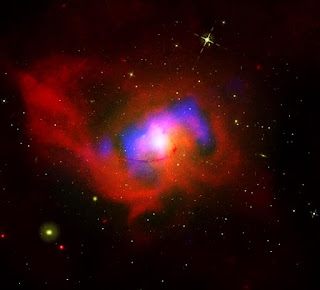
To understand this process, astronomers decided to study the galaxy NGC 4696, located 145 million light-years from Earth and which has a supermassive black hole in its interior.
Astronomers have studied the galaxy and its black hole by observing in detail the X-ray emissions from the galaxy.
This galaxy is a gigantic elliptical galaxy located in the middle of a cluster of galaxies.
By studying the emissions, astronomers have discovered vast cavities in the hot gas that fills the space between the cluster’s galaxies.
The emissions also created shock waves that travel through the cluster.
The heartbeat of the central galaxy happens every 5 or 10 million years, that is, it is as if this galaxy suffered from cardiac arrhythmia.
This study clearly shows that in addition to influencing the evolution of its host galaxy, the supermassive black hole influences the entire cluster.
These cavities in the gas and shock waves carry elements back and forth, enrich certain areas with heavier elements, while others, especially those close to the black hole, are poor in heavy elements but rich in lighter elements.
In addition, the black hole’s emissions heat up the gas, preventing it from cooling, that is, regulating the very process of star formation.
The symbiotic relationship between a supermassive black hole and a galaxy is one of the great mysteries of astrophysics today.
Furthermore, it can be seen that this relationship affects not only the galaxy, but the entire environment where it is inserted and even an entire cluster of galaxies.
Indeed, black holes are intriguing and important figures in the entire evolution process of the universe.