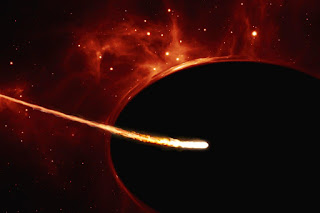
This artist print shows a Sun-like star near a fast-rotating supermassive black hole with a mass about 100 million times the solar mass, situated at the center of a distant galaxy. The huge mass of the black hole bends the radiation emitted by the stars and gas behind it. Despite having much more mass than the star, the black hole has an event horizon only 200 times the size of the star. Its rapid rotation turns it into a flattened sphere.
The gravitational pull of the supermassive black hole shatters the star in an event of disturbance by tidal forces. In the process, the star is “spaghettified” and shocks to the colliding debris as well as heat generated by accretion give rise to an ultra-luminous explosion.
Gerd Dani — Founder & Director Gerd Dani is the visionary in a wheelchair behind FreeAstroScience. An astronomy graduate and a master's in physics, he founded this blog in June 2020, driven by a passion for breaking down complex scientific and philosophical concepts into bite-sized, digestible pieces. As President, he is dedicated to making science accessible to everyone, from students to seasoned academics.
var astra = {"break_point":"921","isRtl":"","is_scroll_to_id":"1","is_scroll_to_top":"1","is_header_footer_builder_active":"1","responsive_cart_click":"flyout","is_dark_palette":"","revealEffectEnable":"","edit_post_url":"https://freeastroscience.com/wp-admin/post.php?post={{id}}&action=edit","ajax_url":"https://freeastroscience.com/wp-admin/admin-ajax.php","infinite_count":"2","infinite_total":"0","pagination":"number","infinite_scroll_event":"scroll","no_more_post_message":"No more posts to show.","grid_layout":{"desktop":3,"tablet":1,"mobile":1},"site_url":"https://freeastroscience.com","blogArchiveTitleLayout":"layout-2","blogArchiveTitleOn":"1","show_comments":"Show Comments","enableHistoryPushState":"1","masonryEnabled":"","blogMasonryBreakPoint":"0"};
//# sourceURL=astra-theme-js-js-extra