
In a few days the first solar eclipse of this year will occur!
Thursday, June 10, in fact, the Moon will be perfectly aligned with the Sun and Earth, thus giving rise to a solar eclipse. However, the angular dimensions of our satellite will not be sufficient to cover the entire solar disk: the eclipse will therefore be annular.
The peak phase of the eclipse will be visible from Greenland and from Canada and Russia, while from North America, Asia and Europe the eclipse will be partial.
The phenomenon will be visible also from the Italian territory, even if in a very marginal way.
Observers in northern Italy will be able to see the solar disk partially obscured from 11.35 in the morning until 13 (the precise times vary slightly from place to place). However, the percentage of darkened solar disk will be very low. Those who are in Milan, for example, will see an obscuration of 3.5% at most, while in Bologna it will be 1.5% and completely invisible for those below the latitude of Florence.
In any case, if you are lucky enough to observe this partial eclipse, remember never to look at the Sun with the naked eye without using the appropriate filters.
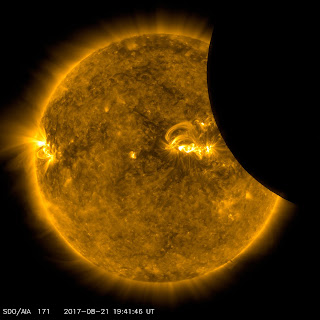
(In the image of partial eclipse del 21 august 2017 taken from SDO probe by NASA.)
Credit: NASA, SDO.