The Search for Aliens: A Mirror Held Up to Humanity
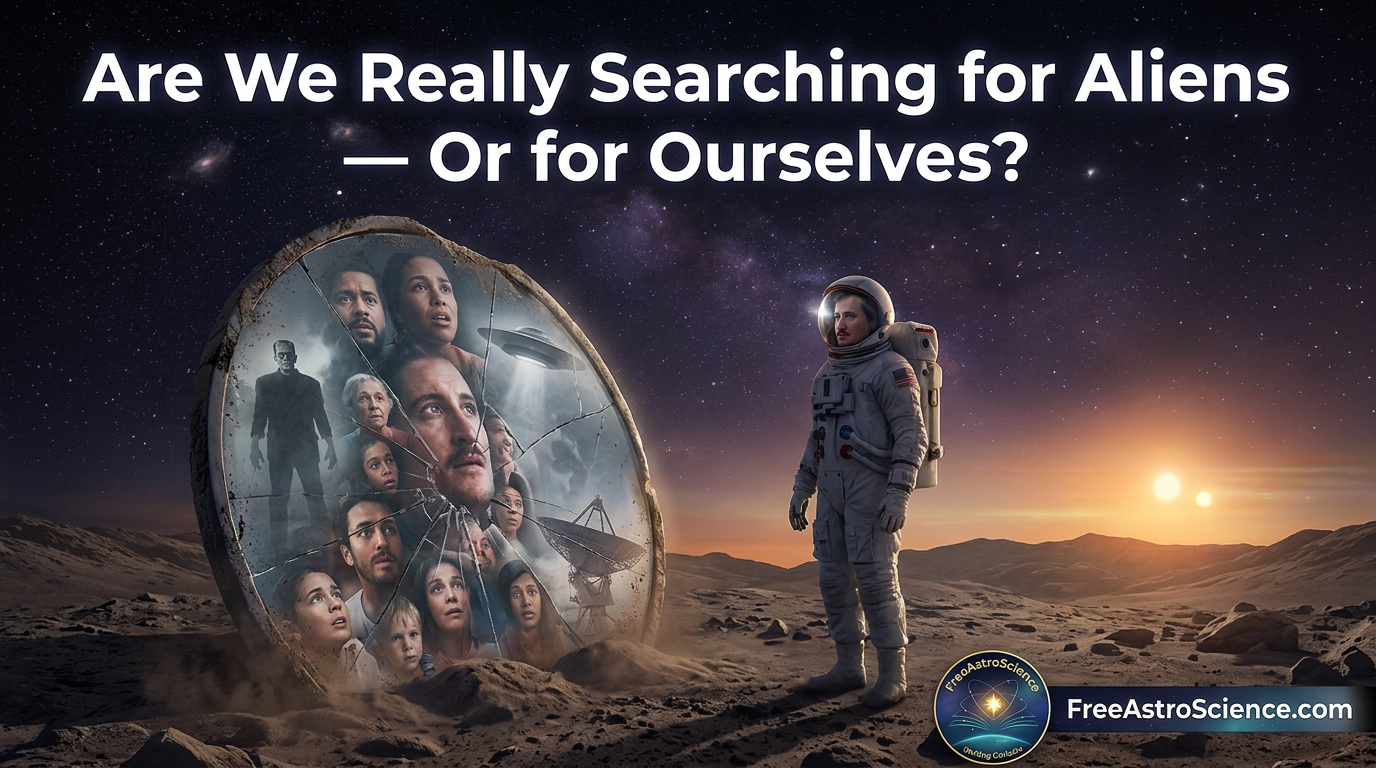
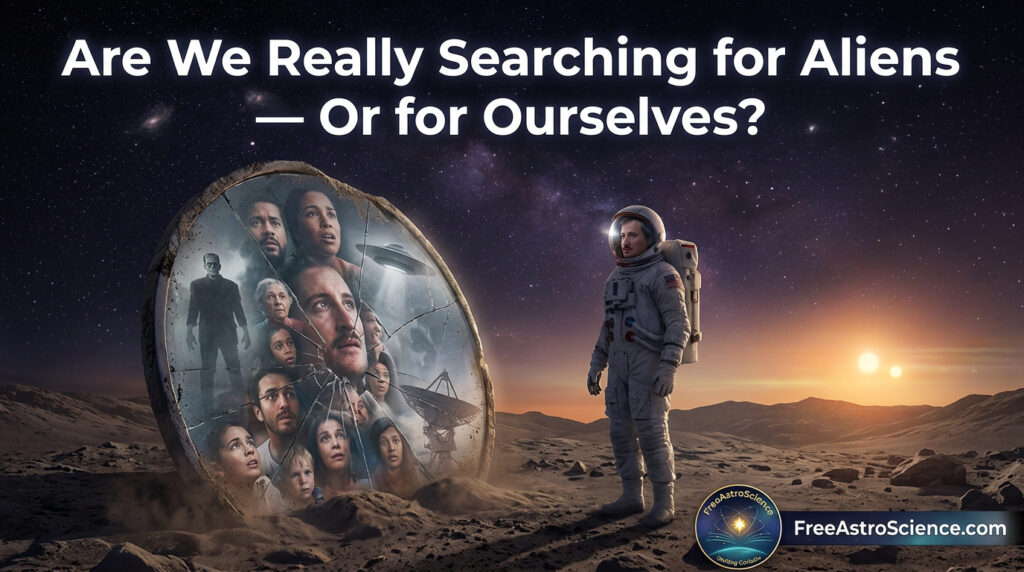
What if the aliens we’ve spent centuries imagining — in telescopes, novels, and blockbuster films — were never really out there at all? What if they’ve always been reflections of us?
Welcome to FreeAstroScience.com, where we break down complex scientific and philosophical ideas into language that anyone can grasp. We’re glad you’re here. Whether you stumbled across this page out of curiosity, or you’ve been pondering extraterrestrial life since childhood, this article was written for you.
Today, we’re going on a journey that stretches far beyond radio signals and distant exoplanets. We’re going to talk about what the alien — as a concept — tells us about being human. About our fears, our loneliness, our art, and the big questions that keep us up at night.
Stick with us to the end. You might just see the cosmos — and yourself — a little differently.
📖 Table of Contents
- Why Do We Search for Aliens?
- Aliens as a Social Dream
- Frankenstein: The First “Alien” Among Us
- How Literature Turned Aliens into Philosophy
- The Big Screen: Fear, Hope, and Everything Between
- What Aliens Tell Us About Society
- The Alien as an Identity Crisis
- Final Thoughts: The Alien in the Mirror
Why Do We Search for Aliens?
The question — are we alone in the universe? — is one of the oldest humans have ever asked. Long before radio telescopes and the SETI program, civilizations looked up and wondered.
Ancient Egyptians believed they could join with “star gods” after death. The first emperor of China, Qin, built an underground necropolis guarded by a terracotta army — an attempt to cheat mortality and transcend into something beyond human . Both civilizations, in their own way, were grappling with the same unsettling thought: there must be something more than this.
That impulse hasn’t changed. We just dress it up differently now. Instead of pyramids, we build space probes. Instead of prayers to the sky, we send radio waves into the void.
But here’s the thing — the search for aliens has never been purely scientific. It’s always been tangled up with something deeper. Something personal.
As Jaime Green, science writer and author of The Possibility of Life, puts it: science fiction helps us work through not only the possibilities of the cosmos but also the nature of humanity itself .
That’s worth sitting with for a moment.
Aliens as a Social Dream
Here’s an idea that might surprise you: aliens are a kind of social dream.
Societies dream just like individuals do. These collective dreams emerge from shared experience — fears, desires, hopes — and they shift over time, sometimes gradually, sometimes in dramatic leaps . The alien, in this framework, isn’t a creature from another planet. It’s a symbol. A vessel for whatever a culture can’t quite say out loud.
During the Cold War, for example, social dreams were haunted by the specter of nuclear annihilation . Films like The Day the Earth Stood Still (1951) gave audiences a messianic alien — Klaatu — who shut down all power on Earth for thirty minutes, just to prove a point. “Join us and live in peace,” he warned, “or pursue your present course and face obliteration” .
That wasn’t really about aliens. It was about us. About our own inability to stop pointing missiles at each other.
And that’s the trick with alien stories. They always circle back to the human condition.
Frankenstein: The First “Alien” Among Us
How Mary Shelley Invented the Modern Outsider
When we think of aliens, we think green skin and flying saucers. But the concept is much older — and much stranger — than that.
Take Frankenstein (1818) by Mary Shelley. The creature stitched together from dead tissue and jolted to life by lightning doesn’t come from another planet. Yet in every meaningful sense, he’s an alien. He exists in a state that isn’t quite human, but isn’t entirely not human either . He can think, feel, and suffer. But the world won’t accept him.
In early literature, aliens were often portrayed as grotesque, monstrous creatures — embodiments of the unknown, designed to evoke fear and awe . Shelley’s creature fits that pattern on the surface. He’s horrifying to look at. People scream and run.
But dig deeper, and the monster becomes something far more interesting: a philosophical thought experiment.
What does it mean to be alive? What obligations does a creator owe its creation? What happens when someone is rejected by the only society they know?
These are not alien questions. They are profoundly, painfully human ones.
The creature in Frankenstein doesn’t want to conquer Earth. He wants a friend. He wants to be seen. And when that basic need is denied — again and again — he becomes violent. Not because he’s evil, but because isolation can break anyone.
That’s why Shelley’s novel still resonates more than 200 years later. The alien isn’t “out there.” The alien is the person sitting alone at the table, wondering why no one will talk to them.
How Literature Turned Aliens into Philosophy
From H.G. Wells to Arthur C. Clarke
Science fiction, at its best, is philosophy wearing a spacesuit.
After Shelley cracked open the door, other writers kicked it wide. H.G. Wells introduced Martians in The War of the Worlds (1898) — not as simple monsters, but as a commentary on British imperialism. What would it feel like, Wells asked, to be colonized by a superior force? His Martians separated the alien further and further from the familiar, creating literary creatures so strange they were impossible to deal with using human standards .
Olaf Stapledon pushed even further. His Star Maker (1937) follows a disembodied English mind traveling across space and time, observing aliens as metaphysical actors in a cosmic drama — and eventually encountering the creator of the universe itself . It’s less a novel and more a meditation on existence.
Then came Arthur C. Clarke’s Childhood’s End (1953), where benevolent aliens oversee human evolution — but look exactly like Satan. Think about that image for a second. Our saviors wear the face of our deepest fear. Clarke wasn’t just telling a story. He was asking: can we trust what we don’t understand?
Robert A. Heinlein’s Starship Troopers (1959) took a different route, pitting humans against intelligent insect species with a super-intelligent queen . On the surface, it’s a war novel. Underneath, it’s a debate about duty, citizenship, and what we’re willing to sacrifice.
And the conversation didn’t stop. Works like Mary Doria Russell’s The Sparrow and Frederik Pohl’s Gateway demonstrate how contact with alien intelligence forces characters to question their most basic assumptions about reality and meaning .
The very possibility of an alien intelligence is an existential provocation — the stuff of identity crisis . Writers have been exploring these implications since the early seventeenth century, expanding and complicating our conception of alien biologies and societies, deploying aliens in critiques of the chauvinistic and parochial assumptions embedded in human culture .
In other words: every alien story is really a human story in disguise.
The Big Screen: Fear, Hope, and Everything Between
Why Alien Movies Are Like Collective Dreams
If literature planted the seeds, cinema grew them into something enormous.
Films are a collective medium — they call on creative collaboration involving the director, the screenwriters, the actors, and the audience . And that collaboration produces something no single person could create alone: a living, breathing social dream.
Consider the spectrum:
| Film | Year | Tone | What It’s Really About |
|---|---|---|---|
| The Day the Earth Stood Still | 1951 | Warning | Nuclear fear, the need for a messiah |
| Alien | 1979 | Horror | Corporate exploitation, bodily violation |
| E.T. the Extra-Terrestrial | 1982 | Fantasy / Fairy tale | Childhood innocence, empathy for the “other” |
| Men in Black | 1997 | Comedy / Mystery | Immigration, hidden identities |
| Star Trek (franchise) | 1966–present | Utopian | Cooperation, diversity, a better future |
The Alien series is essentially a horror movie set in outer space. E.T. is a fairy tale where the “monster” is misunderstood due to physical appearance. Men in Black, despite its comic tone, is really a mystery about hidden identities and undercover agents policing aliens among us .
And then there’s Star Trek — where human and alien crews work side by side. That’s a social dream a society perceives as desirable . A vision of what we could be, if we got past our worst impulses.
The alien threat continues to dominate film science fiction. But not all aliens are malevolent beings who’ve come to seize control of the planet and steal our resources . Sometimes they come in peace. Sometimes they come to teach. And sometimes — as in Arrival (2016) — contact with alien language reshapes human perception of time and causality, challenging everything we thought we knew.
What Aliens Tell Us About Society
Otherness, Immigration, and the Fear of the Unknown
Let’s be honest. The word “alien” doesn’t just describe beings from another galaxy. In everyday language — in legal documents, in political speeches — an “alien” is someone who doesn’t belong.
That’s not a coincidence.
Science fiction writers have spent over a century deploying aliens in critiques of the chauvinistic and parochial assumptions embedded in human culture . When we imagine a terrifying alien invasion, we’re often rehearsing real anxieties: fear of immigration, fear of cultural change, fear of losing control.
Men in Black makes this explicit. The aliens live among us, disguised as ordinary people, carrying fake IDs . It’s played for laughs, but the subtext is unmistakable.
On the flip side, when we imagine friendly aliens — the wise Vulcans of Star Trek, the gentle botanist in E.T. — we’re expressing a hope. A hope that difference doesn’t have to mean danger. That understanding is possible, even across impossible distances.
In the film Contact (1997), based on Carl Sagan’s novel, scientist Ellie Arroway finds the notion of aliens far more appetizing than that of an invisible entity which billions worship on faith alone . That’s a sharp sociological observation: sometimes the alien is easier to accept than the divine, because at least we can imagine talking to it.
The Alien as an Identity Crisis
When the “Other” Turns Out to Be You
Here’s where it gets personal.
The aliens out there turn out to be the aliens in us, too — they reside inside our own human consciousness . We project onto them our desires, our fears, our unspoken questions about what it means to be alive.
Think about Frankenstein’s creature again. He’s rejected because he looks different. He’s denied love because his origin story doesn’t fit the norm. He’s treated as less-than-human — even though he demonstrates more emotional depth than many of the humans around him.
Now think about how often that story plays out in real life.
The alien, in literature and in film, is a stand-in for anyone who’s been made to feel like they don’t belong. The immigrant. The disabled person. The queer kid in a small town. The scientist in a room full of people who’d rather not hear what she has to say.
The SF alien can take the form of a technologically transformed version of the self, as in Frederik Pohl’s Man Plus, or appear as something barely recognizable — “Homo sapiens, that common earthling” reframed and defamiliarized . The point isn’t the specific shape. The point is the question the alien forces us to ask: Who counts as “one of us”?
That question has never stopped being relevant.
Ancient Roots, Modern Echoes
We’ve been telling alien stories for thousands of years. The Egyptians built pyramids to reach their star gods. The Chinese built underground palaces to escape death itself . Both civilizations operated on the belief that immortality — that most alien of conditions — was achievable.
Today, we don’t build tombs. We build movies, novels, and television shows. The medium has changed, but the impulse is identical: we’re still trying to cope with mortality, still trying to define the meaning of life, and still looking beyond ourselves for answers .
The reception of worldviews like the Copernican and Darwinian revolutions, and the effects of cross-cultural contact, have repeatedly reshaped how we imagine alien life . Each new scientific discovery changes the story. Each cultural shift gives it a different flavor.
But the core remains the same. We search for aliens because we’re searching for ourselves.
Final Thoughts: The Alien in the Mirror
So what have we learned?
The search for extraterrestrial life isn’t just a scientific pursuit. It’s a philosophical one, a sociological one, and — if we’re being honest — a deeply emotional one. Every alien story, from Frankenstein to Star Trek, from the pyramids of Giza to the radio dishes of SETI, is really about the same thing: what does it mean to be human in a universe that may not care?
We search for aliens because their existence would answer the gnawing question that has preyed on our minds since Homo sapiens first emerged on the African savannah: are we alone?
And maybe the answer doesn’t matter as much as the asking.
Because in asking, we confront our fears. We examine our prejudices. We imagine better worlds. We hold a mirror up to ourselves and see — sometimes with discomfort, sometimes with wonder — who we really are.
At FreeAstroScience.com, we believe in explaining complex scientific principles in simple terms. We believe in keeping your mind active, alert, and curious — because, as Goya warned us, the sleep of reason breeds monsters.
Don’t let your reason sleep. Come back to FreeAstroScience.com whenever you need a spark, a question, or a new way of seeing the universe. We’ll be here — looking up, and looking inward, right alongside you.
References & Further Reading
- Schlozman, S. (2013). “The Aliens in Us and the Aliens Out There: Science Fiction in the Movies.” PMC / NIH. Read here
- “Science Fiction – Alien Encounters.” Britannica. Read here
- “Captivating Alien Encounters: Exploring Extraterrestrial Themes in Literature.” Alienated Media. Read here
- “Alien Evolutions: Darwinian Influence on the History of SF.” University of Memphis Digital Commons. Read here
- “Objects of Fear and Worship: The Evolution of Aliens in Literature.” The Millions. Read here
- “The Alien as Other: Spiritual, Political, and Cultural Dimensions.” CUNY Academic Works. Read here
- “Alienating Encounters.” DiVA Portal. Read here
- Green, J. “The Best Science Fiction Books About Aliens.” Five Books. Read here
- “Aliens.” The Encyclopedia of Science Fiction (SFE). Read here
- Malmgren, C. D. “Self and Other in SF: Alien Encounters.” University of Kentucky. Read here