
Welcome, fellow cosmic explorers! At FreeAstroScience.com, we’re thrilled to guide you through one of astrophysics’ most captivating enigmas – stars hiding neutron stars in their fiery hearts. These theoretical cosmic hybrids, first proposed nearly half a century ago, continue to challenge our understanding of stellar evolution. Stick with us as we illuminate this stellar paradox, where familiar physics meets extraordinary circumstances.
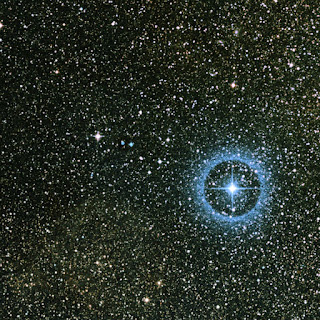
Credit: NASA, ESA, Hubble.
What Are Thorne-Żytkow Objects?
Stellar Russian Dolls
Thorne-Żytkow objects (TŻOs) represent a hypothetical class of stars first theorized in 1977 by Kip Thorne and Anna Żytkow. Picture a cosmic matryoshka doll:
- Outer Layer: A swollen red supergiant hundreds of millions of kilometers wide
- Hidden Core: A city-sized neutron star packing 1-2 solar masses
This improbable pairing could theoretically form through two primary pathways:
- Binary System Evolution: A neutron star gets engulfed by its expanding companion
- Stellar Collisions: Random encounters in dense star clusters
The neutron star’s extreme gravity (10¹² m/s² surface gravity) would fundamentally alter the host star’s internal processes, creating unique nuclear fusion pathways.
Formation Challenges: Why TŻOs Defy Expectations
The Binary Conundrum
Recent 3D simulations of X-ray binary LMC X-4 reveal critical formation barriers:
- Spiraling Death Dance: As the neutron star plunges into its companion, angular momentum transfer creates unstable conditions
- Core Collapse: Neutron star merger with the companion’s core triggers black hole formation within centuries
- Envelope Ejection: 99% of stellar material gets expelled, aborting TŻO development
This explains why candidate systems like LMC X-4 (18 solar mass primary + 1.57 solar mass neutron star) likely end as black holes rather than stable TŻOs.
Alternative Formation Pathways
While traditional models focus on binary systems, new research suggests:
- Common Envelope Evolution: Angular momentum transport during merger phases critically impacts outcomes
- White Dwarf Mergers: Potential formation of rare variable stars with TŻO-like features
Observational Fingerprints: Hunting Cosmic Chimeras
Spectral Signatures
Theoretical models predict TŻOs should exhibit:
- Enhanced Heavy Elements: Rubidium, molybdenum, lithium from neutron-rich nucleosynthesis
- Abnormal Calcium: Potential tidal disruption signature during core merger
- Peculiar Pulsations: Unique vibration patterns from dual energy sources
The HV 2112 Controversy
This Small Magellanic Cloud star sparked excitement in 2014 as a potential TŻO[3]:
| Property | Initial Claim (2014) | Revised Analysis (2018) |
|---|---|---|
| Luminosity (L☉) | >100,000 | ~1,000 |
| Lithium Abundance | Enhanced | Confirmed |
| Heavy Elements | Rb, Mo detected | No excess found[7] |
Despite calcium enrichment persisting in recent studies, the luminosity revision strongly disfavors the TŻO hypothesis[7].
New Horizons in TŻO Research
Emerging Candidate: HV 11417
This SMC star shows tantalizing clues:
- Rubidium enrichment without lithium excess
- Luminosity compatible with asymptotic giant branch stars
- Requires follow-up spectroscopy for confirmation[7]
Simulation Breakthroughs
2025 fluid dynamics modeling reveals:
- TŻO phases (if formed) last <1,000 years before collapse
- Ultra-long gamma-ray bursts may signal failed TŻO formation[2]
- Neutron star accretion rates determine collapse thresholds
Why This Matters: Cosmic Alchemy Redefined
TŻO research impacts multiple astrophysical frontiers:
- Stellar Life Cycles: Challenges binary evolution models
- Element Formation: Proposes new r-process nucleosynthesis sites
- Compact Objects: Links neutron stars/black hole formation channels
As lead researcher Tenley Hutchinson-Smith notes: “Our simulations show nature prefers dramatic gamma-ray finales over stable hybrid stars”.
Conclusion: The Cosmic Verdict
While no confirmed TŻOs exist yet, their theoretical study has already revolutionized our understanding of stellar dynamics. Each failed candidate like HV 2112 eliminates possible formation pathways, steering us toward more plausible scenarios. The hunt continues with improved spectral analysis techniques and next-generation telescopes like the Extremely Large Telescope.
At FreeAstroScience.com, we believe every cosmic dead end illuminates new paths for discovery. What other stellar secrets might emerge from these investigations? Only time – and relentless scientific curiosity – will tell.