James Webb Finds a Black Hole That Came First: Inside Abell2744-QSO1
Written for you by the team at FreeAstroScience.com, where we turn big cosmic ideas into plain language.
What if the seed came before the tree? What if a black hole was already huge before a single star lit up around it?
Welcome, friends. We’re so glad you’re here. Grab a coffee, settle in, and let us walk you through one of the strangest findings to land on our desks this year. The James Webb Space Telescope just spotted a black hole that seems to have existed before its own galaxy. Stay with us to the end. By the last paragraph, you’ll see the early universe in a way you never have.
🔭
What You’ll Find Here
- Why is QSO1 just a “little red dot”?
- How did Webb weigh a black hole 13 billion light-years away?
- What does spinning gas tell us about hidden mass?
- Where did this giant come from?
- QSO1 by the numbers
- Quick answers (FAQ)
A Black Hole Older Than Its Home
For decades, astronomers told a tidy story. A galaxy forms first. Big stars burn out and collapse into black holes. Those black holes feed and merge, growing over billions of years.
That story just hit a wall.
Using Webb’s NASA/ESA/CSA cameras and spectrographs, researchers mapped the gas swirling around a black hole at the heart of Abell2744-QSO1. This tiny galaxy sits more than 13 billion light-years from us. Its black hole weighs about 50 million Suns. And the data hint that this monster came before the galaxy around it. It may have formed within the first second after the Big Bang.
Roberto Maiolino of the University of Cambridge co-authored the work, published in Nature and the Monthly Notices of the Royal Astronomical Society. He called it a paradigm shift, a full rewrite of the classic ideas about how black holes are born and grow.
We don’t say that lightly. Neither does he.
Why Is QSO1 Just a “Little Red Dot”?
Picture the early cosmos. Webb has spotted hundreds of faint, ruddy specks scattered across it. Astronomers nicknamed them Little Red Dots. QSO1 is the poster child of the bunch.
This object is small. Its diameter spans roughly 1,300 light-years. Its light left when the universe was just 700 million years old, around 5% of its current age. We catch it at a cosmological redshift of z = 7.
So how do you study something that faint, that far? You get lucky with cosmic geometry.
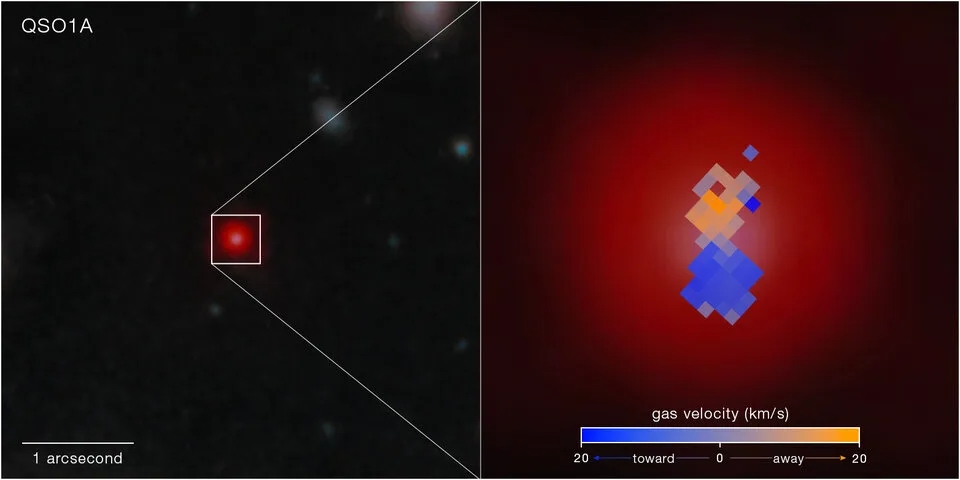
QSO1 sits behind Abell 2744, the giant galaxy cluster also known as Pandora’s Cluster. That cluster bends space-time like a lens. The effect magnifies QSO1 and splits its image into three copies in the sky. The brightest copy, QSO1A, gave the team a clean, zoomed-in view.
Early looks suggested QSO1 was little more than a glowing cloud of hydrogen and helium circling a black hole of maybe 40 million solar masses. The doubt was real. As co-author Francesco D’Eugenio of Cambridge put it, every black hole mass in the early universe had been guessed indirectly, using rules borrowed from nearby galaxies. Nobody knew if those rules held so far away.
The team set out to find a direct answer.
How Did Webb Weigh a Black Hole 13 Billion Light-Years Away?
Here’s the clever part. You can’t put a black hole on a scale. So the team measured the gas instead.
They used the Integral Field Unit (IFU) on Webb’s near-infrared spectrograph, NIRSpec. Think of it as a camera and a spectrograph fused together. In a single shot, the IFU grabs an image plus 900 spectra from a 3-by-3 arcsecond patch of sky. It splits light across thousands of wavelengths, from 0.6 to 5.3 microns.
That detail lets you read the gas like a story.
The motion comes from the Doppler effect. Where gas rushes toward us, its light shifts slightly blue. Where it pulls away, the light shifts red. Map those colors across the dot, and you get a velocity field. A picture of what’s spinning, which way, and how fast.
Ignas Juodžbalis, a Cambridge PhD student, worked with Cosimo Marconcini of the University of Florence to chart the hydrogen gas around the black hole. They plotted rotation speed against distance from the center.
What they found changed everything.
What Does Spinning Gas Tell Us About Hidden Mass?
The gas wasn’t moving randomly. It showed Keplerian rotation. That means it orbits a single central point, exactly the way planets circle our Sun.
Why does that matter so much? Ignas explained it well. If the mass were spread out among many stars, the gas couldn’t settle into such clean, perfect orbits. Smooth Keplerian motion points to one thing: nearly all the mass sits in one tiny spot at the center.
A point that heavy, that small, can only be a black hole.
And Keplerian motion follows simple gravity. So the team could turn orbital speeds straight into a mass. No borrowed assumptions. A direct measurement, which had never been done this early in cosmic history.
The math behind it is short and beautiful:
Mass from orbiting gas
M = v2 · r G
M = mass inside the orbit • v = orbital speed of the gas • r = orbit radius • G = gravitational constant
Feed in the measured speeds and distances, and the answer comes out clear. The black hole holds about 50 million solar masses. That’s roughly two-thirds of QSO1’s entire mass.
Read that again. Two-thirds.
In galaxies near us, a central black hole is a rounding error, a tiny sliver of the whole. Here the proportion is thousands of times larger. The black hole isn’t a guest in the galaxy. It practically is the galaxy.
The composition maps backed up the story. The gas is almost pure hydrogen and helium, with barely a trace of heavier elements like oxygen. Its metallicity sits below 0.5% of the Sun’s. That makes QSO1 one of the most pristine, untouched places we’ve ever measured.
Cosimo called the result phenomenal. It’s the first direct mass measurement of a black hole within the first billion years after the Big Bang, and it lines up with earlier indirect estimates. That agreement carries good news. The old assumptions seem to hold, so
masses of other early black holes probably weren’t overblown.
Where Did This Giant Come From?
Now for the puzzle that keeps us up at night.
A black hole that outweighs its own galaxy two-to-one can’t have crept up slowly. It can’t be the end product of small, star-sized black holes merging and feeding over eons. The math simply won’t stretch that far.
“We seem to have found a black hole with no sizable host galaxy, one that formed before stellar processes,” Ignas said. He sees it as evidence for two long-theorized ideas finally caught in the act: primordial black holes and direct-collapse black holes.
What’s a primordial black hole?
One possibility is a “heavy seed” born in the first second after the Big Bang. No dying star required. The infant universe simply made it.
What’s a direct-collapse black hole?
The other path is a giant gas cloud that skips the star stage entirely and crashes straight into a black hole. Big from birth.
Either way, the conclusion holds. QSO1’s black hole started large. And a galaxy now seems to be assembling around it, rather than the other way around.
The team doesn’t think QSO1 is a freak. Little Red Dots may have been common in the young cosmos. They’re now combing through similar objects to ask a wild question with a straight face: do supermassive black holes routinely come before the galaxies that house them?
We find that thrilling. A little unsettling, too. The right kind of unsettling.
QSO1 by the Numbers
Here’s the whole story in one quick glance, perfect for the train ride home.
| Property | Value |
|---|---|
| Object | Abell2744-QSO1 (a “Little Red Dot”) |
| Black hole mass | ~50 million solar masses |
| Share of total mass | About two-thirds of the whole object |
| Diameter | ~1,300 light-years |
| Redshift | z = 7 |
| Cosmic age of light | ~700 million years after the Big Bang (5% of today) |
| Metallicity | Below 0.5% of the Sun’s — among the most pristine ever measured |
| Gas motion | Keplerian rotation (planet-like orbits) |
| Cosmic helper | Gravitational lensing by Abell 2744 (Pandora’s Cluster), triply imaged |
Why This Discovery Matters
Step back with us for a second.
We grew up on a clean origin myth: stars first, black holes second, galaxies slowly knitting themselves together. QSO1 nudges that myth aside. It suggests some giants were already giant in the universe’s opening act.
A direct mass, measured from spinning gas, in a galaxy whose light is older than almost everything you’ve ever seen. That’s the kind of measurement that earns trust. It checks the old guesses and finds them sound.
We don’t yet know how many QSO1-like objects exist. The team is honest about that, and so are we. One clear case isn’t a complete theory. But it’s a doorway, and Webb just kicked it open.
Here at FreeAstroScience.com, we wrote this for you because we believe one thing above all. Never switch off your mind. Keep it lit, keep it curious, keep it questioning. The sleep of reason breeds monsters, and the cure is simple: keep wondering.
So the next time you look up, remember the little red dot. A black hole that may have come first, waiting in the dark for its galaxy to catch up.
Come back to FreeAstroScience.com whenever you want to sharpen what you know. We’ll keep the cosmos in plain language, and we’ll keep the lights on for you.
Frequently Asked Questions
Can a black hole really form before its galaxy?
Webb’s data on Abell2744-QSO1 point that way. The black hole holds about two-thirds of the object’s total mass, far more than any galaxy nearby. That lopsided split suggests it didn’t grow from small black holes inside an older galaxy. It seems to have started big and now has a galaxy forming around it. What is a “Little Red Dot”?
It’s the nickname for hundreds of tiny, faint, reddish infrared specks Webb found in the early universe. QSO1 is a prototype. Each one packs a compact, glowing core, and at least some hide a surprisingly heavy central black hole. How did scientists measure the black hole’s mass?
They used Webb’s NIRSpec IFU to track gas speeds via the Doppler effect. The gas showed clean Keplerian orbits, like planets around a star. Simple gravity then turns those speeds into a direct mass of roughly 50 million Suns, the first such direct measurement this early in cosmic time. Why is gravitational lensing important here?
QSO1 sits behind Abell 2744, the Pandora’s Cluster. The cluster’s gravity bends space-time and acts like a lens. It magnifies QSO1 and splits its image into three copies, giving researchers a brighter, clearer target than they’d ever get on their own. What are primordial and direct-collapse black holes?
A primordial black hole could have formed in the first second after the Big Bang, with no star involved. A direct-collapse black hole forms when a huge gas cloud crashes straight into a black hole, skipping the star stage. QSO1 may finally give real evidence for these long-theorized objects.
Sources & Further Reading
- Research published in Nature and the Monthly Notices of the Royal Astronomical Society (May 2026). Co-authors include R. Maiolino, F. D’Eugenio, I. Juodžbalis (University of Cambridge) and C. Marconcini (University of Florence).
- NASA / ESA / CSA James Webb Space Telescope — official mission site: nasa.gov/mission/webb
- ESA Webb — instrument and image archive: esawebb.org
- Adapted from reporting by Amici della Scienza, “Webb rivela un buco nero formatosi prima della sua galassia,” 28 May 2026.
Thanks for spending this time with us. Keep your mind awake, keep looking up, and visit FreeAstroScience.com again soon.