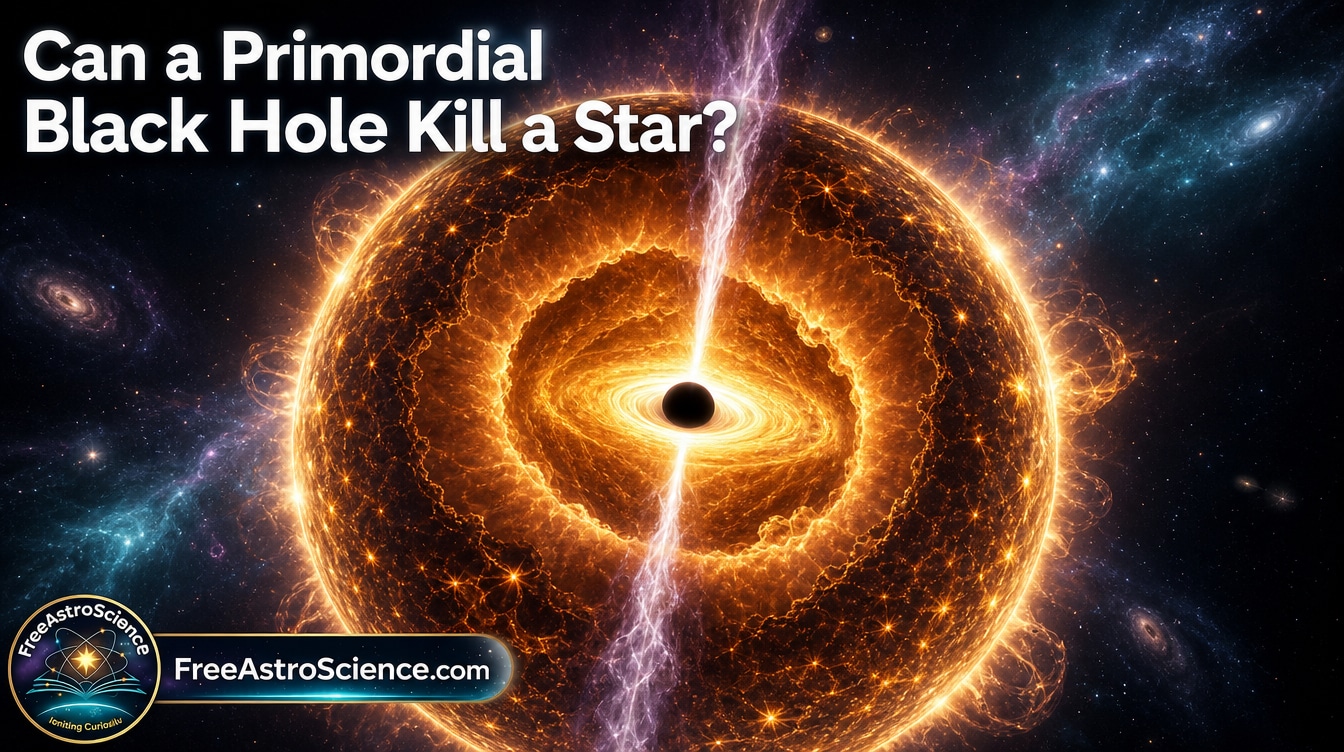
What if the thing devouring a star from the inside out wasn’t fire, but a speck of darkness older than the first galaxy?
Welcome, friends. We’re so glad you’re here. Whether you teach physics, study the night sky as a hobby, or simply love a good cosmic mystery, this story was written for you by FreeAstroScience.com, where we turn hard science into plain language without dumbing it down. Stick with us all the way to the end. A brand-new study, posted to arXiv in June 2026, reshapes how we picture dark matter, dying stars, and the quiet monsters that might be hiding inside our galactic neighbors. By the last paragraph, you’ll understand a phenomenon most professional astronomers learned about only weeks ago.📜 What we’ll cover
In this article, we will explore the fascinating concept of a primordial black hole, its origins, and its potential effects on the cosmos.
- What is a primordial black hole, and why should you care?
- How does a star even catch a black hole?
- What exactly is a “Hawking star”?
- Why do these stars face two completely different deaths?
- What flips the switch between explosion and silence?
- How loud is the violent death, and can we see it?
- What do these black holes leave behind?
- Why does this rewrite the dark-matter hunt?
What Happens When a Star Swallows a Primordial Black Hole?
Most stars die in ways we know well. They run out of fuel, swell up, shed their skins, or detonate as supernovae. A team of astrophysicists from MIT, the Flatiron Institute, Princeton, NYU, and Stanford just described a far stranger ending. Their paper, led by Ore Gottlieb, follows a star that has trapped a tiny black hole at its heart. The verdict is dramatic: such a star can either be torn apart in minutes or be eaten alive in silence over billions of years. Two fates, one seed. Let’s walk through it together.
What is a primordial black hole, and why should you care?
A primordial black hole, or PBH, is a unique entity that didn’t form from a collapsing star. Instead, it emerged during the chaotic early Universe, likely from dense ripples caused by cosmic inflation. Some of these primordial black holes could be surprisingly small, weighing between 1017 and 1023 grams, equivalent to the mass of an asteroid packed into a volume smaller than an atom.
Here’s why that matters to all of us. This particular mass range is a stubborn blind spot. Lighter black holes would have evaporated by now through Hawking radiation. Heavier ones would bend starlight or disturb star clusters in ways we’d already have spotted. The asteroid-mass window slips between every net we’ve cast. And inside that window, PBHs could make up a big slice of the dark matter that holds galaxies together.
| PBH mass | What rules it out (or doesn’t) | Status |
|---|---|---|
| < 1015 g | Hawking evaporation would have erased them | Excluded |
| 1015–1017 g | Would flood us with extra gamma rays and cosmic rays | Tightly limited |
| 1017–1023 g | Too small to lens starlight, too light to shake star clusters | Open window |
| > stellar mass | Microlensing and wide-binary surveys catch them | Tightly limited |
So if dark matter hides as asteroid-mass black holes, where do we look? The authors offer a bold answer: inside stars.
How does a star even catch a black hole?
You might picture a black hole punching through a star and getting stuck. That almost never happens. A single pass loses far too little energy to drag friction, so the black hole sails right back out. The team reran that math and confirmed it. One-shot capture is, in their words, negligibly rare.
Primordial black holes are theorized to have unique properties that could challenge existing notions in astrophysics.
The real trick needs a third player. When a star carries a planetary or stellar companion, a Jupiter-like world can act as a gravitational slingshot. It nudges a passing black hole onto a bound orbit that keeps crossing the star. Each crossing bleeds off a little energy. Crossing after crossing, the orbit shrinks, and the black hole spirals down toward the core.
For a Sun-like star with a Jupiter analog out at 5.2 astronomical units, the math sets a clear floor. The black hole must weigh more than about 1022 grams to finish that inward spiral within a star’s main-sequence life.
Critical capture mass (three-body channel) Mcrit ≈ 1022 g × ap5 AU3/2 × (M⋆ / M☉)1/2
Lighter black holes can still be caught, but only by stars with companions on very tight orbits. The takeaway is sobering and beautiful at once: capturing a PBH is a fluke. It demands the right black hole, the right companion, and a touch of cosmic luck. Across the galaxy, only a small minority of stars will ever pull it off.
The existence of primordial black holes could redefine our understanding of dark matter and cosmic structures.
What exactly is a “Hawking star”?
Once the black hole settles at the center, the star earns a name: a Hawking star. The idea traces back to Stephen Hawking’s 1971 suggestion that stars might form around primordial black holes. Now we can model what follows.
At the core, the black hole starts feeding on stellar gas. At first it does so the slow way, through what physicists call quasi-spherical Bondi accretion. The feeding zone is astonishingly tiny. For a black hole of 1020 grams, the Bondi radius is just a few thousandths of a centimeter across.
Bondi radius (the feeding zone) RB = 2 G MBHcs2 ≈ 4 × 10⁻³ cm
This early phase is gentle. Radiation barely escapes, and the energy of infalling gas vanishes past the horizon. The team finds the efficiency stays near 1%, well below the value earlier studies assumed. Low efficiency has a surprising effect. With little feedback to push back, the black hole grows faster than anyone expected. The star, meanwhile, looks almost normal from the outside. A monster sits in its belly, hidden and quiet.
What comes next splits into two roads.
Why do these stars face two completely different deaths?
Everything hinges on one event: whether a spinning accretion disk forms before the black hole simply eats the whole star. Think of it as a coin flip decided by physics, not chance.
As the black hole grows, its feeding zone widens. Gas falling in carries more and more spin. At some point the inflow can’t drop straight onto the black hole anymore. It swirls into a disk, like water circling a drain. The researchers call this moment the point of no return.
Road one: the explosive death
Understanding primordial black holes is crucial because they might account for a significant portion of the dark matter that binds galaxies together.
If the disk forms while the star still has plenty of mass, the system erupts. Magnetic fields in the disk power ferocious winds and relativistic jets. We’re talking outflows of 1045 to 1050 ergs per second. That energy floods the star from within, inflates a hot cocoon, and rips the whole thing apart in minutes. Not millions of years. Minutes.
Road two: the quiet death
If the disk never forms in time, the black hole keeps feeding spherically and consumes the star from the inside with no fireworks. The star fades. What’s left is a black hole with a mass close to the star it swallowed, a slow and silent ending.
The fork, in one line: disk forms in time → violent explosion in minutes. Disk forms too late, or never → quiet consumption over eons. The disk is the switch.
What flips the switch between explosion and silence?
Three things decide it: the black hole’s starting mass, the host star’s mass, and how fast the star spins. Young, rapidly spinning stars feed their black holes plenty of swirling gas, so disks form readily. Older, slow-spinning stars like our present-day Sun would force the black hole to eat most of the star before any disk could appear.
One result here is genuinely elegant. When a disk does form, the black hole’s spin lands on a near-universal value, no matter how it started.
Spin at disk formation (a fixed point of the Kerr metric) a∗ ≈ 0.8
The team confirmed this with three tools working together: MESA stellar-evolution models, 3D general-relativistic magnetohydrodynamic (GRMHD) simulations, and Monte Carlo population studies. Their simulated stars reach disk formation in about 70 million years for a heavier seed, or roughly 9 billion years for the lightest one. The spin always settles near 0.8.
So how often does each ending win? The Monte Carlo runs give us numbers.
| Seed mass | Explosive death | Quiet death | No endpoint yet |
|---|---|---|---|
| 10-13 M☉ | 25.9% (⟨Mf⟩ = 0.085 M☉) | 73.6% (⟨Mf⟩ = 0.452 M☉) | 0.5% |
| 10-16 M☉ | 52.2% (⟨Mf⟩ = 0.058 M☉) | 44.8% (⟨Mf⟩ = 0.168 M☉) | 3.0% |
Both fates claim a real share of the population. Final black-hole masses land between 0.01 and 1 solar mass. That detail will matter greatly in a moment.
How loud is the violent death, and can we see it?
Once the disk lights up, the star’s last act is a multi-part light show. The jet power follows a clean rule, set by the black hole’s spin and the magnetic flux threading it.
Two-sided jet power (Blandford–Znajek mechanism) P = ηa ηφ ṀBH c2
Because the black hole spins near 0.8, it extracts rotational energy with brutal efficiency. What does an observer on Earth see? Several signals, stacked in time. A brief, hard flash from the shock breaking out of the star. A fast ultraviolet-and-blue glow lasting about a day. If a jet escapes, an X-ray flash or low-luminosity gamma-ray burst. And a radio afterglow that ripples outward for days.
| Signal | Peak brightness | Duration | Band |
|---|---|---|---|
| Prompt jet emission | ~2 × 1049 erg/s | ≲ minutes | soft γ / hard X-ray |
| Shock breakout | ~5 × 1045 erg/s | ≲ 1 s | soft γ / hard X-ray |
| Cooling emission | ~2 × 1041 erg/s | ~1 day | UV / blue optical |
| Radio afterglow | ~200 µJy at 1 Gpc | days | radio |
Which telescopes could catch it? The fast hard-X-ray flashes suit Fermi/GBM, Swift/BAT, and the Einstein Probe. The day-long UV glow is tailor-made for ULTRASAT, with ZTF and the Vera Rubin Observatory chasing the optical. The VLA and MeerKAT can confirm the radio echo. These events don’t look like ordinary supernovae. They’re faster, fainter in optical, and carry no radioactive nickel tail. That mismatch is exactly what makes them identifiable.
We’ll be honest with you, as the authors are with their readers. A clean detection is hard. Light from electromagnetic signals alone may flag strong candidates rather than nail down a verdict. Other exotic engines can mimic parts of the pattern. Science rarely hands us certainty on the first try.
What do these black holes leave behind?
This is the part that gives us goosebumps. The explosive branch leaves a low-mass, fast-spinning black hole, somewhere between 0.01 and 1 solar mass, with that signature spin near 0.8.
Why is that special? Standard stellar evolution simply doesn’t make black holes lighter than the Sun. A black hole that small shouldn’t exist by the usual rules. So if gravitational-wave detectors like LIGO, Virgo, KAGRA, Cosmic Explorer, or the Einstein Telescope ever spot a merging binary with a sub-solar, rapidly spinning member, that would be a fingerprint of a non-standard origin. A Hawking star offers one concrete way to forge such an object.
The catch is real. The remnant must end up in a tight binary that merges within the age of the Universe, which trims the expected rate. Gravitational waves give us a precious clue here, not a flood of events.
Why does this rewrite the dark-matter hunt?
Step back and see the whole picture. If asteroid-mass PBHs make up dark matter, a few unlucky stars will trap them. Those stars then branch into loud explosions or quiet deaths. Count the explosions, weigh the leftover black holes, and you start to constrain how much dark matter hides in this form.
At the optimistic end, the explosion rate could rival that of low-luminosity gamma-ray bursts, around 100 events per cubic gigaparsec per year. At the same time, the rarity of capture means PBHs probably don’t distort stellar populations much, which softens some older constraints. Every channel here teaches us something, whether it fires or stays dark.
The big idea: stars become detectors for the one kind of dark matter we couldn’t otherwise see. Their deaths, loud or silent, write the data for us.
Where does this leave us?
We started with a question about darkness eating a star. We end with a roadmap. A tiny black hole, older than the stars themselves, can be caught by a lucky stellar system, spiral into the core, and decide its host’s fate based on a single physical switch: does a spinning disk form in time? If yes, the star dies in a brilliant, minute-long convulsion and leaves a strange light-weight black hole spinning at 0.8. If no, the star fades into a silent grave. Both endings carry the same gift, a fresh way to probe the dark matter that fills our Universe.
Ultimately, the study of primordial black holes provides insights into the fundamental workings of the universe.
We encourage readers to share their thoughts on the implications of primordial black holes in the comments below.
Sit with that for a moment. The same cosmic ingredients can produce an explosion you might see from across the Universe, or a death so quiet no telescope would ever notice. The difference comes down to spin, timing, and a planet’s gravitational nudge. That’s the kind of subtlety the cosmos hides in plain sight, waiting for a curious mind to find it.
At FreeAstroScience.com, we believe in one promise above all: never switch off your mind, and keep it awake at every hour. The sleep of reason breeds monsters. Come back and keep learning with us, because the Universe rewards the curious.
Frequently asked questions
What is a Hawking star in simple terms?
A Hawking star is an ordinary main-sequence star that has captured a primordial black hole at its center. The black hole feeds on stellar gas from the inside, slowly reshaping the star’s life and eventual death. Could the Sun secretly host a primordial black hole?
It’s extremely unlikely. Capturing a PBH needs a tightly bound companion and a slow-moving black hole, and the Milky Way’s dark-matter halo moves too fast for easy capture. The authors describe the Sun’s capture probability as vanishingly small. How fast does an exploding Hawking star actually die?
As we conclude, it is essential to reflect on how primordial black holes could reshape our understanding of stellar evolution and cosmic history.
Astonishingly fast. Once a spinning accretion disk forms, jets and winds disrupt the star within minutes to about an hour, far quicker than the star’s natural billion-year lifespan. Why is a sub-solar black hole such a big deal?
Normal stars can’t collapse into black holes lighter than the Sun. Finding one in a gravitational-wave signal, especially spinning near 0.8, would point to a non-standard origin like a primordial black hole grown inside a star. Which telescopes might detect these events?
Fermi/GBM, Swift/BAT, and the Einstein Probe could catch the fast X-ray flashes. ULTRASAT, ZTF, and the Vera Rubin Observatory suit the UV/blue glow. The VLA and MeerKAT can confirm the radio afterglow, while LIGO/Virgo/KAGRA look for remnant mergers.
Sources & further reading
- Gottlieb, O., Cantiello, M., Norton, C., Van Tilburg, K., & Kleban, M. (2026). The Life and Death of Stars That Capture Primordial Black Holes. arXiv:2606.02700v1. arxiv.org/abs/2606.02700
- Meloni, D. (10 June 2026). Buco nero primordiale: i 2 destini della stella catturata. Reccom Network. reccom.org