Have you ever stopped, looked up at the night sky, and felt that strange tug in your chest, the one that whispers we’re part of something much bigger than ourselves? Welcome, dear reader, to FreeAstroScience.com. Tonight, the cosmos is throwing a small party right above our rooftops, and we want you to have a front-row seat. Stay with us until the end. We promise you’ll walk away knowing exactly when to step outside, where to look, and why this moment matters more than a quick glance at your phone screen.
📑 Table of Contents
What’s Actually Happening on June 9, 2026?
Picture two of the brightest lights in our night sky drifting toward each other for weeks. Then, on a single evening, they almost touch. That’s what astronomers call a conjunction: two celestial bodies appearing extremely close together from our point of view, separated by just a tiny angular distance.
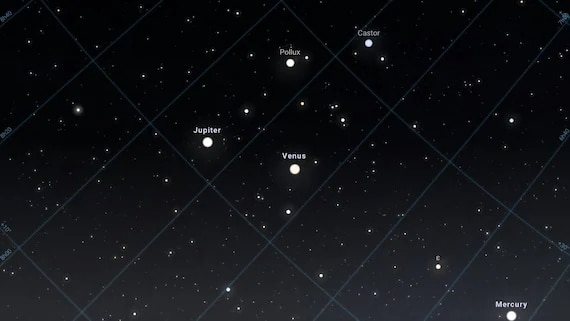
On the evening of June 9, 2026, Venus and Jupiter will sit just over 1° apart in the sky. That’s roughly the width of your little finger held at arm’s length. Romantic types call it a “celestial kiss.” We just call it stunning.
What Time Should You Step Outside?
Here’s the practical answer you came for. Set a reminder for around 9:00 PM Italian time. The Sun sets at 8:44 PM in Rome, and right after, Venus and Jupiter pop into view above the west-northwest horizon at about 27–28 degrees of altitude .
The peak moment, when the two planets reach their minimum angular separation of just 1°36′, hits at 9:47 PM Italian time. From there, the show winds down as both planets slip below the horizon between 10:30 PM and 11:00 PM .
Where Do You Point Your Eyes?
Face west-northwest. Find an open spot away from tall buildings, a park, a balcony with a clear horizon, even a quiet street. The two brightest “stars” you see in that direction won’t be stars at all. They’ll be Jupiter and Venus, hanging close together like old friends sharing a secret.
Do You Need a Telescope?
Nope. The whole point of this event is that it’s visible to the naked eye from anywhere in Italy . A pair of binoculars adds a fun bonus, you might catch some of Jupiter’s moons, but they’re not required. Just step outside and look up.
Why Are These Two Planets So Easy to Spot?
Brightness in astronomy is measured by something called magnitude. Here’s the twist: the lower the number, the brighter the object. Negative numbers mean very, very bright.
✨ Apparent Magnitudes on June 9, 2026
- 🪐 Jupiter: magnitude −1.8
- ♀ Venus: magnitude −4.0
For comparison, the brightest star in the night sky, Sirius, sits at about −1.46.
With these values, both planets shine like beacons in the twilight, easy to find even from cities with bright lights nearby .
Who Else Is Joining the Party?
Jupiter and Venus won’t be alone. Look slightly down and to the right, and you might spot Mercury, the swift little planet that usually hides in the Sun’s glare.
Here’s something cool: Mercury is the closest planet to the Sun, so it almost never strays far from our star in the sky. Most of the time, it’s drowned out by sunset or sunrise light. Catching it on June 9 is a rare bonus .
And to the right of all three planets? You’ll see Castor and Pollux, the two bright stars marking the heads of the twins in the constellation Gemini*. It’s a full cast of cosmic characters.
What Comes Next on June 15?
If you miss June 9 or just want more, mark June 15, 2026 on your calendar. That evening, Mercury reaches its maximum angular distance from the Sun, giving us a true three-planet alignment with Jupiter and Venus.
You’ll have roughly two hours to enjoy all three planets together along the west/southwest horizon .
A Small Request Before You Go Outside
This article was written specifically for you by FreeAstroScience.com, where we break down complex scientific principles into simple, human language. We do this because we believe in something simple but powerful: never turn off your mind, never stop questioning, because the sleep of reason breeds monsters.
Tomorrow night, when you tilt your head back and find those two bright dots almost touching, you’re not just seeing planets. You’re seeing physics in motion, light that left Jupiter about 35 minutes ago and Venus only a few minutes ago, all reaching your eyes at the same instant. That’s worth a pause. That’s worth wonder.
So step outside on June 9. Bring someone you love. Don’t film it, don’t post it, just look. The universe is putting on a show, and the ticket is free. Come back to FreeAstroScience.com after, and let’s keep growing your knowledge of the cosmos together. We’ll be here, ready for the next celestial kiss.
❓ Frequently Asked Questions
At what exact time will Jupiter and Venus be closest on June 9, 2026?
Maximum closeness happens at 9:47 PM Italian time, when the two planets sit just 1°36′ apart .
Can I see the conjunction without a telescope?
Yes. Both planets are extremely bright (Venus at magnitude −4.0, Jupiter at −1.8), so they’re easily visible to the naked eye throughout Italy .
Where in the sky should I look?
Face west-northwest right after sunset (around 8:44 PM in Rome). The planets will sit at about 27–28 degrees above the horizon .
Will other planets or stars be visible too?
Yes. Mercury appears below and to the right of Jupiter and Venus, while the bright stars Castor and Pollux from Gemini sit further to the right .
When does the show end?
Jupiter and Venus set between 10:30 PM and 11:00 PM Italian time, so you have roughly two hours to enjoy them .
📚 Sources & References
- 🔭 EduINAF — Italian National Institute for Astrophysics (Educational)
- 🌌 Unione Astrofili Italiani (UAI)
- ⭐ Starwalk — Astronomical Event Predictions
- 📰 Source article: “Congiunzione tra Giove e Venere il 9 giugno” — Geopop, by Sara Brugnoni