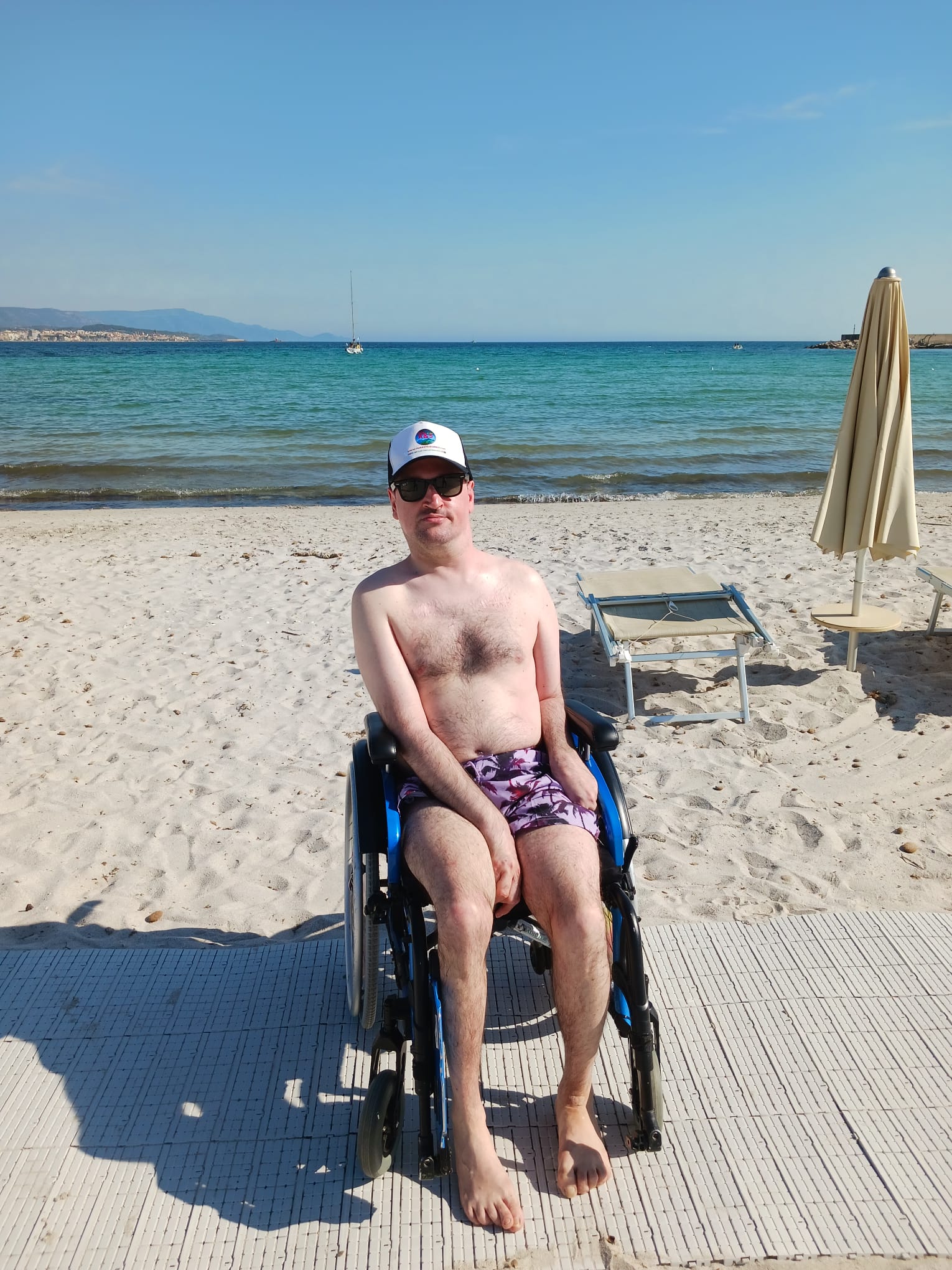
Postcards From Fertilia: Where the Sea Teaches You to Slow Down
A wheelchair, a glass of mirto, and the quiet science of being happy
Reader’s note: I’ve simplified a few scientific ideas in this piece so they slip into the conversation as easily as the Sardinian sun slips below the horizon. Stay with me.
A Postcard, Not a Lecture
The sea here doesn’t ask anything of you.
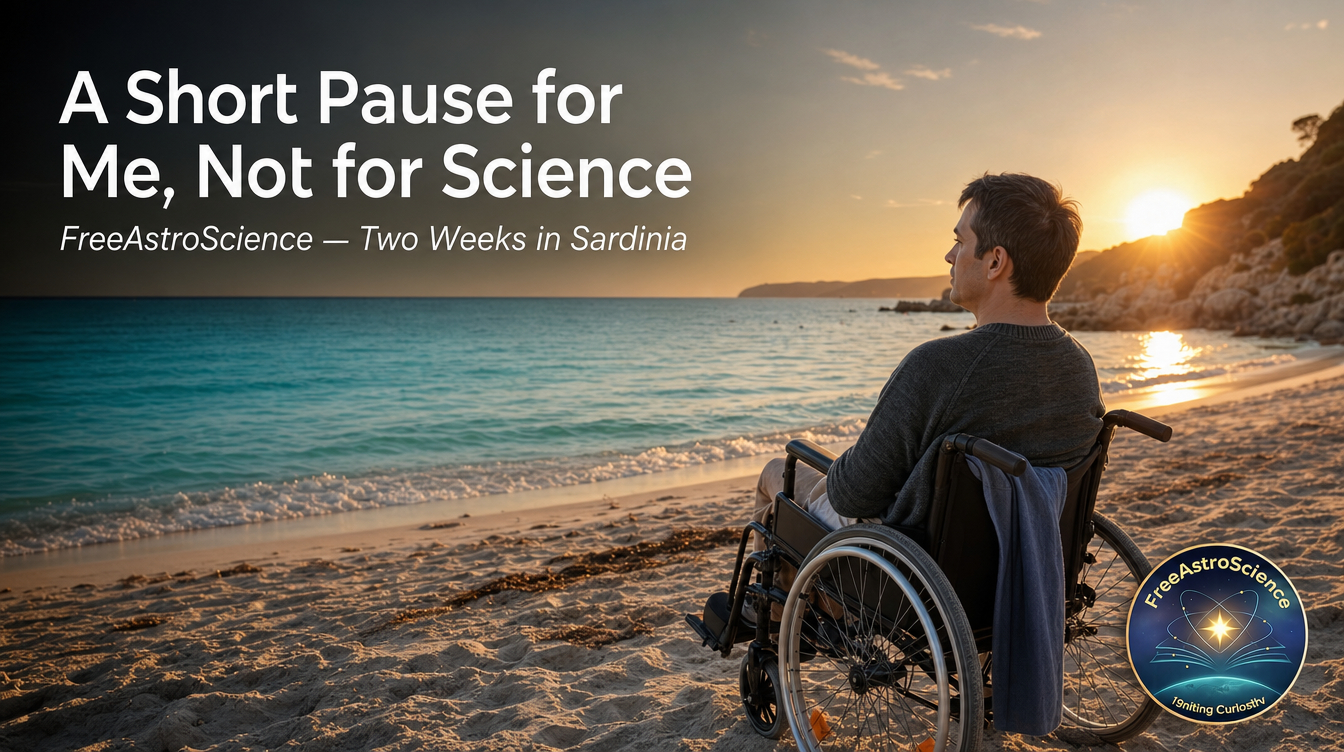
I’m writing from Valmarì, on the Fertilia waterfront, and the only thing demanding my attention right now is a salt-stained breeze and the faint clink of ice against glass. The skin on my arms has gone two shades darker. My hair smells of sunscreen and seaweed. If happiness had a postcode, today it would be 07041.
So this isn’t really an article. It’s more of a love letter — to a small Sardinian village, to the people who push my wheelchair through warm sand, and to anyone reading this from a grey office somewhere, wondering if slowing down is allowed.
It is. I promise.
Where I Am, Exactly
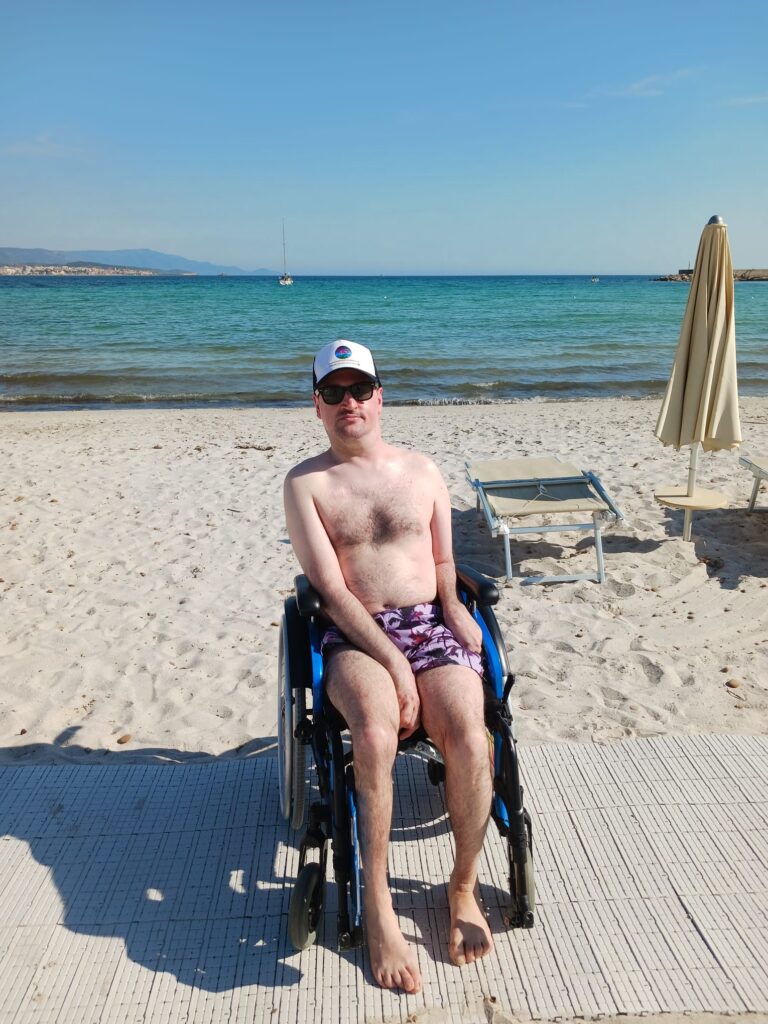
Fertilia is a small village of around two thousand people, sitting quietly in the Province of Sassari, in the north-west of Sardinia . It’s the kind of place that doesn’t shout. It doesn’t have to.
For most of its life, Fertilia has lived off the land and the sea — a purely agricultural and maritime economy that’s only recently turned its face towards tourism, mostly thanks to the airport just five kilometres away . You feel that history when you walk (or roll) along the waterfront. The bones of a fishing village are still here, under a thin layer of holiday gloss.
The beach itself is gentle — wide, shallow, lined with beach resorts, the sort of place a parent doesn’t have to panic about . For me, in a wheelchair, “gentle” is everything. Gentle means I can get close to the water. Gentle means the sea is a friend, not a negotiation.
The Crystal Sea, and What It Does to Your Brain
I’ve been swimming every day.
There’s a strange thing that happens when you immerse a tense body in cool, clear seawater: your nervous system, the chatty over-worked thing that runs you, finally shuts up for a minute. The cold triggers what physiologists call the mammalian dive response — heart rate slows, blood vessels constrict at the surface, the brain gets a sudden hush. It’s biology doing meditation for you, no app required.
For someone who lives with dystonia, this hush is gold. My muscles, which usually hold a private argument with my will all day long, briefly agree to a ceasefire. The sea is the only therapist who never sends a bill.
And the colour of the water? That clarity isn’t romance, it’s physics. Shallow Mediterranean water over light sandy bottoms scatters short wavelengths — the blues and turquoises — back at your eyes, while the longer red wavelengths get absorbed quickly. So when people say “the sea is unbelievably blue here,” what they really mean is “the sea is unbelievably honest here.” It shows you exactly what light is made of.
Mirto, or the Taste of an Island
Late afternoon, the sun loses its sting.
That’s mirto hour. Mirto is a Sardinian liqueur made from the berries of the myrtle plant, dark purple, almost black, with a flavour somewhere between juniper, blackberry, and the smell of the macchia mediterranea after rain. You don’t sip it fast. You let the cold glass sweat into your palm while you look at the boats.
I’m not a drinker, really. But there’s something about a small ritual — the ice, the dark liquid, the long shadow of the chair on the pavement — that makes the day feel finished in a good way. Not exhausted. Just complete.
If you ever come to Fertilia, sit at one of the small places along the front and order it. The town has plenty of spots to eat and drink, and the locals are generous with recommendations. Ask twice, the second answer is usually better.
What Travel Looks Like From a Wheelchair
I won’t pretend everything is smooth.
Sardinian villages were not designed in 1700 with ramps in mind. There are kerbs, cobbles, and the occasional restaurant where the bathroom requires a small expedition. But Fertilia, being relatively young (it was actually founded in the 1930s), has wider streets and a flatter waterfront than most of the island’s historic centres. For a guy who travels on four small wheels, that’s the difference between holiday and homework.
I think a lot, on days like this, about how disability sharpens your eye for design. You notice the slope of a pavement, the kindness of a waiter who simply asks “where would you like to sit?” instead of staring, the way a beach resort lays a wooden walkway right to the water . These things aren’t small. They’re the architecture of dignity.
And every time I get into the sea here, I remember the version of me who couldn’t, the years between 2011 and 2018 spent in and out of operating theatres. The boy who thought crystal-clear water was just a phrase from travel brochures.
It isn’t. It’s a place. It’s this place.
The Quiet Lesson of a Small Village
Here’s what Fertilia keeps whispering to me.
You don’t need a grand stage to live a meaningful day. A two-thousand-person village , a borrowed slice of sun, a glass of something local, a body that — whatever shape it’s in — is here, breathing salt air. That’s a full life compressed into eight hours.
Science, for all the cosmology I’ve studied at Bologna and the physics I chewed through in Milan, keeps coming back to the same humble conclusion: the universe is mostly empty, and the rare warm pockets where atoms organise themselves into laughter and dinner and sea swims are statistically miraculous. We are, all of us, an unlikely afternoon in the history of matter.
So if you’re reading this from somewhere cold and tired, hear me out. Find your Fertilia. It doesn’t have to be Sardinia. It can be a park bench, a balcony, a bathtub with the lights off. The point isn’t the postcode. The point is the pause.
Looking Ahead
Tomorrow I’ll swim again. The mirto bottle has a few more sunsets in it. There’s an airport five kilometres away that will, eventually, take me home — but not yet, not yet.
And the message I want to leave you with, from this small chair on this small waterfront, is the one I keep stitched into everything I write at FreeAstroScience: never give up. Not on your body, not on your curiosity, not on the idea that the sea is still out there, somewhere, waiting to be honest with you.
I’ll save you a seat. Bring your own glass.
— Gerd, from the Fertilia waterfront