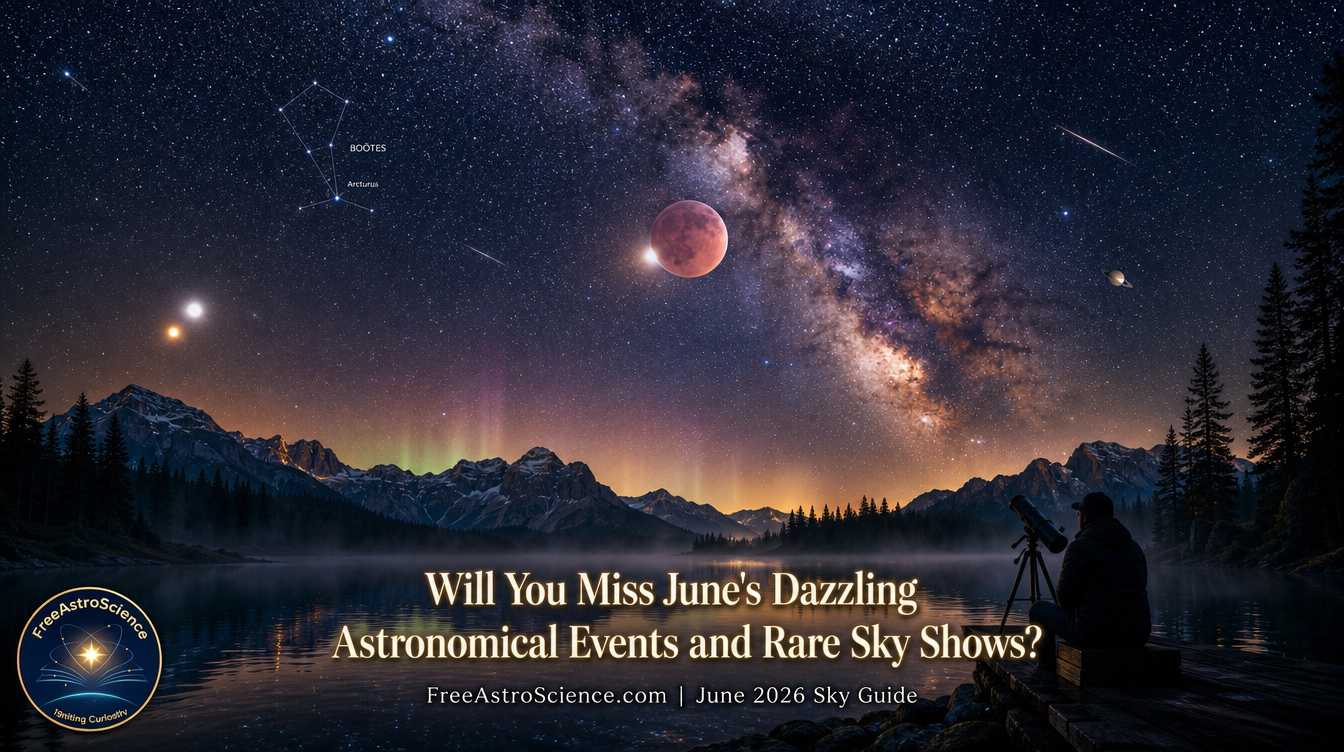
June 2026 Sky Guide: Every Astronomical Event You Can’t Miss
What Will You See If You Look Up This June?
Have you ever wondered what secrets the night sky holds in June 2026? Whether you’re a seasoned stargazer, a curious beginner, or just someone who needs a little cosmic comfort, this month’s sky is packed with rare alignments, glowing nebulae, and moments that remind us we’re all part of something bigger.
Welcome to FreeAstroScience.com, where we believe science should be for everyone. I’m Gerd Dani—astronomer, physicist, and your guide for this journey. Let’s explore the wonders above us, together. Stick with us to the end, and you’ll know exactly what to watch for, when to look, and why these moments matter. Ready to keep your mind awake and your eyes on the stars? Let’s dive in.
Table of Contents
- When Does Summer Begin? The June Solstice
- What’s Up With the Moon? Phases & the Strawberry Micromoon
- Which Planets Will Steal the Show?
- Will the Moon Hide Any Stars or Planets?
- Are There Meteor Showers to Watch?
- What Deep Sky Wonders Await?
- Is This Milky Way Core Season?
- Quick Reference: All Key Events in June 2026
- Math Corner: How Do Astronomers Measure the Sky?
- Final Thoughts: Why We Keep Looking Up
June 2026: A Month of Celestial Surprises
When Does Summer Begin? The June Solstice
Let’s start with the Sun. On June 21, 2026, at 08:24 UTC, the summer solstice arrives for the Northern Hemisphere. This is the moment when the Sun stands highest in the sky, shining directly overhead at the Tropic of Cancer (23.44°N). It’s the longest day and shortest night for those north of the equator. For our friends in the Southern Hemisphere, it’s the start of winter and the longest night of the year.
Why does this happen? Earth’s axis is tilted about 23.5° from vertical. As we orbit the Sun, this tilt means the Sun’s path climbs higher or lower in our sky, depending on the season. On the solstice, the Sun’s rays hit the Northern Hemisphere most directly. Ancient cultures built monuments to mark this day. Today, we might just celebrate with a late sunset walk or a midnight stargazing session.
What’s Up With the Moon? Phases & the Strawberry Micromoon
The Moon’s dance through its phases is a rhythm older than civilization. Here’s what to expect in June 2026 (all times UTC):
- Last Quarter: June 8, 09:56
- New Moon: June 15, 20:38
- First Quarter: June 21, 01:09
- Full Moon (Strawberry Micromoon): June 29, 11:55
The June Full Moon is called the Strawberry Moon—a name given by the Algonquin tribes, who knew it marked the time to gather ripening strawberries. This year, it’s also a Micromoon, meaning the Moon is near its farthest point from Earth (apogee) and looks a bit smaller and dimmer than usual. Don’t expect a pink Moon; the color comes from tradition, not physics.
Which Planets Will Steal the Show?
June 2026 is a blockbuster for planetary fans. Here’s what you shouldn’t miss:
Venus-Jupiter Conjunction: The Sky’s Brightest Pair
On June 9, at 12:35 UTC, Venus and Jupiter will appear just 1°38′ apart in the constellation Cancer. Venus shines at magnitude -4.0, Jupiter at -1.8. Look west after sunset—these two will be the brightest “stars” in the sky, close enough to fit in a single binocular view. This is one of the most photogenic planetary pairings of the decade, visible worldwide.
Mercury at Greatest Eastern Elongation
Mercury, the elusive innermost planet, reaches its best evening appearance on June 15 at 20:00 UTC. It’ll be 25° east of the Sun, about 38% illuminated, and shining at magnitude 0 in Gemini. Look low in the west about 30 minutes after sunset. You’ll have about an hour before it sets.
Saturn at Opposition
Saturn reaches opposition on June 10. That means it’s opposite the Sun in our sky, rising at sunset and shining all night. This is the best time to see Saturn’s rings and moons—grab a telescope if you can.
Three-Planet Alignment: Mercury, Venus, Jupiter
From June 12–17, Mercury, Venus, and Jupiter cluster within about 10° in Gemini and Cancer. The crescent Moon joins the party on June 16–17, forming a stunning tableau just after sunset.
Other Notable Pairings
- Moon-Saturn Conjunction: June 10, 11:41 UTC
- Moon-Mars Conjunction: June 12, 21:16 UTC
- Moon-Mercury Conjunction: June 16, 19:33 UTC (thin crescent Moon forms triangle with Jupiter and Mercury)
- Moon-Jupiter Close Approach: June 17, 06:52 UTC (2°27′ apart in Gemini)
- Moon-Venus Close Approach: June 17, 20:20 UTC (just 17 arcminutes apart in Cancer—stunning naked eye or binocular view)
- Mars Near Pleiades: June 28, in Taurus, best with binoculars or a small telescope
- Jupiter enters Cancer: June 22
- Saturn moves from Cetus into Pisces: June 3 onward
Will the Moon Hide Any Stars or Planets?
The Big One: Lunar Occultation of Venus (June 17)
This is the showstopper. On June 17, the Moon will pass directly in front of Venus, blocking it from view—a rare event called an occultation. It happens in broad daylight (around 19:45 UTC / 3:45 PM EDT), visible across most of the contiguous US, Canada, Brazil, and Venezuela. In New York City, Venus disappears behind the Moon at 15:54 EDT and reappears at 17:12 EDT. The whole event lasts about 90 minutes.
Both the Moon and Venus are bright enough to spot with the naked eye or binoculars—even in daylight. Occultations like this, visible over such a wide area, happen only a few times per decade. Scientists use them to measure the Moon’s edge and Venus’s apparent size.
Other Occultations
- Regulus (Leo’s brightest star): June 19, visible from parts of southern Africa
- Antares (Alpha Scorpii): June 27, visible from the southern Indian Ocean, Antarctica, and the southern tip of South America (starts 13:06 UTC, closest at 15:10 UTC, ends 17:21 UTC)
Are There Meteor Showers to Watch?
Daytime Arietids
Active from May 22 to July 3, peaking June 7–10. The Arietids are the strongest daytime meteor shower, with a ZHR (Zenithal Hourly Rate) of 60 (radar up to 200). The radiant is in Aries, about 30° west of the Sun. Most meteors are lost in daylight, but you might catch a few bright ones in the last dark hour before dawn, facing east. The Moon is about 63% illuminated at the peak, so try to block it from view.
June Bootids
Active June 22–July 2, peaking the night of June 21–22 around 01:00 GMT. The ZHR is usually low (1–2), but rare outbursts can be spectacular. The radiant is in Boötes, near Arcturus. The Moon is at first quarter and sets around midnight, so the second half of the night is best for viewing.
Minor Showers
- Tau Herculids: Peak June 2, ZHR ~15
- Psi Andromedids: Peak June 2, ZHR <2
- June Epsilon Cygnids: Peak June 13, ZHR <2
- June Rho Cygnids: Peak June 15, ZHR <2
- Delta Piscids: Peak June 22, ZHR <2
- June Iota Pegasids: Peak June 26, ZHR <2
- Phi Piscids: Peak June 30, ZHR <2
Sporadic meteors add about 5–8 per hour in the last hour before dawn from dark locations.
What Deep Sky Wonders Await?
June is prime time for deep sky observing, especially during the new moon window (June 10–18). Here are some must-see objects, with coordinates and tips:
| Object | Constellation | RA | Dec | Mag | Best Time | Equipment |
|---|---|---|---|---|---|---|
| M8 Lagoon Nebula | Sagittarius | 18h 03m | -24°23′ | 6.0 | Midnight–3AM | Binoculars/4″+ |
| M20 Trifid Nebula | Sagittarius | 18h 02m | -23°02′ | 6.3 | Midnight–3AM | 4″+ |
| M17 Omega/Swan Nebula | Sagittarius | 18h 20m | -16°11′ | 5.9 | Midnight–4AM | Binoculars |
| M24 Star Cloud | Sagittarius | 18h 17m | -18°29′ | 2.5 | Midnight–4AM | Binoculars/Wide-field |
| M13 Hercules Cluster | Hercules | 16h 41m | +36°28′ | 5.8 | 10PM–2AM | 4″+ |
| M22 Sagittarius Cluster | Sagittarius | 18h 36m | -23°54′ | 5.1 | Midnight–4AM | Binoculars |
| M27 Dumbbell Nebula | Vulpecula | 19h 59m | +22°43′ | 7.5 | 1AM–Dawn | 4″+ |
| M57 Ring Nebula | Lyra | 18h 53m | +33°02′ | 8.8 | 11PM–3AM | 4″+ |
| NGC 6334 Cat’s Paw | Scorpius | 17h 20m | -35°54′ | ~10 | 1AM–Dawn | 4″+, South |
| IC 4592 Blue Horsehead | Scorpius | 16h 10m | -25°10′ | — | Midnight–4AM | Astrophotography |
| Rho Ophiuchi Complex | Ophiuchus | 16h 25m | -23°26′ | 4.6 | Midnight–4AM | Wide-field |
| M44 Beehive Cluster | Cancer | 08h 40m | +19°59′ | 3.7 | Early Evenings | Binoculars |
| M31 Andromeda Galaxy | Andromeda | 00h 42m | +41°16′ | 3.4 | Pre-dawn | Binoculars |
Prominent constellations include Boötes (with orange giant Arcturus), the Summer Triangle (Vega, Deneb, Altair), Scorpius, Sagittarius, Ursa Major/Minor, and Hercules.
Is This Milky Way Core Season?
Yes! June marks the start of Milky Way core season. The galaxy’s center, about 26,000 light-years away, rises in Sagittarius and Scorpius after midnight. In the Northern Hemisphere, it stretches from southeast to southwest. In the Southern Hemisphere, it passes nearly overhead. The best window is during the new moon (June 10–18). From a dark site, the Milky Way looks like a glowing river of light—one of the most awe-inspiring sights in all of nature.
Quick Reference: All Key Events in June 2026
| Date/Range (UTC) | Event | Description & Visibility |
|---|---|---|
| June 8, 09:56 | Last Quarter Moon | Half Moon, left side lit (Northern Hemisphere) |
| June 9, 12:35 | Venus-Jupiter Conjunction | 1°38′ apart in Cancer, both bright, west after sunset, visible worldwide |
| June 10 | Saturn at Opposition | Brightest, closest, visible all night, best for rings/moons |
| June 10, 11:41 | Moon-Saturn Conjunction | Early morning, visible with binoculars/telescope |
| June 12, 21:16 | Moon-Mars Conjunction | Evening, Mars faint, close to Moon |
| June 12–17 | Three-Planet Alignment | Mercury, Venus, Jupiter within 10°, best 30 min after sunset |
| June 15, 20:00 | Mercury Greatest Eastern Elongation | 25° east of Sun, mag 0, low in west after sunset |
| June 15, 20:38 | New Moon | Darkest skies, best for deep sky observing |
| June 16, 19:33 | Moon-Mercury Conjunction | Crescent Moon forms triangle with Jupiter and Mercury |
| June 17, 06:52 | Moon-Jupiter Close Approach | 2°27′ apart in Gemini, evening sky |
| June 17, 19:45 | Lunar Occultation of Venus | Moon blocks Venus, visible daylight US/Canada/Brazil/Venezuela |
| June 17, 20:20 | Moon-Venus Close Approach | 17′ apart in Cancer, naked eye/binoculars |
| June 19 | Lunar Occultation of Regulus | Visible from southern Africa |
| June 21, 01:09 | First Quarter Moon | Half Moon, right side lit (Northern Hemisphere) |
| June 21, 08:24 | June Solstice | Longest day (North), Sun overhead Tropic of Cancer |
| June 21–22 | June Bootids Meteor Shower Peak | Radiant in Boötes, variable ZHR, best after midnight |
| June 22 | Jupiter enters Cancer | Planetary motion milestone |
| June 27, 13:06–17:21 | Lunar Occultation of Antares | Visible southern Indian Ocean, Antarctica, S. South America |
| June 28 | Mars near Pleiades | Morning sky, best with binoculars/telescope |
| June 29, 11:55 | Full Moon (Strawberry Micromoon) | Smallest Full Moon, traditional name, visible worldwide |
Math Corner: How Do Astronomers Measure the Sky?
Let’s get a little technical—don’t worry, we’ll keep it simple.
1. Angular Separation
When we say Venus and Jupiter are 1°38′ apart, we mean the angle between them in the sky. Here’s the formula:
θ = arccos[ sin(δ₁)·sin(δ₂) + cos(δ₁)·cos(δ₂)·cos(α₁ – α₂) ]
where α = right ascension, δ = declination (in radians)
2. Magnitude Scale
The brightness of stars and planets is measured in magnitudes. Lower numbers mean brighter objects. Each step is about 2.5 times brighter than the next.
<div style="background:#f1f5f9;padding:1em;border-radius:8px;max-width:500px;margin:1em auto;">
  <strong>Magnitude Difference Formula:</strong><br>
  <span style="font-size:1.2em;">
    m₂ - m₁ = -2.5 · log₁₀(F₂ / F₁)
  </span><br>
  <small>
    where F = flux (brightness), m = magnitude
  </small>
</div>
3. Meteor Shower ZHR
ZHR (Zenithal Hourly Rate) is the number of meteors you’d see under perfect conditions.
<div style="background:#f1f5f9;padding:1em;border-radius:8px;max-width:500px;margin:1em auto;">
  <strong>ZHR Formula:</strong><br>
  <span style="font-size:1.2em;">
    ZHR = (N / (Teff · r^(-6.5·(LM-6.5)))) · F
  </span><br>
  <small>
    N = number of meteors seen, Teff = effective observing time, r = population index, LM = limiting magnitude, F = correction factor
  </small>
</div>
4. Solstice Declination
The Sun’s declination at the solstice:
<div style="background:#f1f5f9;padding:1em;border-radius:8px;max-width:500px;margin:1em auto;">
  <strong>Sun’s Declination at Solstice:</strong><br>
  <span style="font-size:1.2em;">
    δ = +23.44°
  </span>
</div>
Final Thoughts: Why We Keep Looking Up
June 2026 isn’t just another month—it’s a reminder that the universe is always moving, always changing, and always inviting us to pay attention. From the longest day of the year to the rare moment when the Moon hides Venus in broad daylight, these events connect us to ancient rhythms and future possibilities.
At FreeAstroScience.com, we believe that understanding the sky helps us understand ourselves. We explain complex science in simple words, so you never have to turn off your mind. Remember: the sleep of reason breeds monsters. Stay curious, keep looking up, and come back soon for more guides, stories, and cosmic inspiration.
References & Further Reading
- TimeandDate.com – Astronomical Events 2026
- NASA Eclipse Web Site
- EarthSky – Astronomy Essentials
- Sky & Telescope – Sky at a Glance
- American Meteor Society – Meteor Shower Calendar
- NASA – June 2026 Night Sky Highlights
- FreeAstroScience.com – Science for Everyone
Written for you by Gerd Dani, President of Free Astroscienceder the stars!