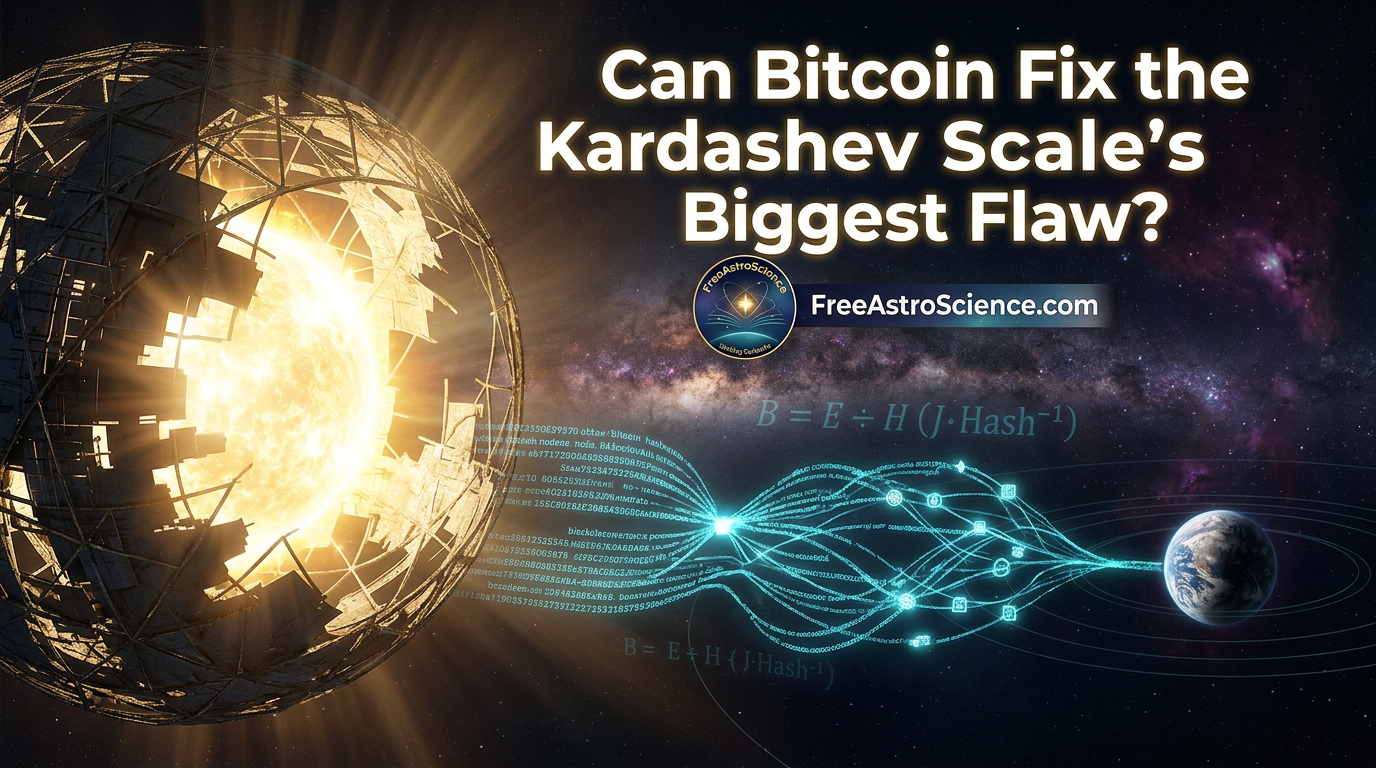
The KarNak Unit: How Bitcoin’s Hashrate Rewrites the Search for Alien Civilizations
What if everything we thought we knew about ranking alien civilizations was off by a factor of one quadrillion years? Welcome, dear reader. We’re so glad you stopped by FreeAstroScience today. We’ve prepared this piece for you carefully, because the question we’re about to tackle sits right at the crossroads of astronomy, information theory, and (yes) cryptocurrency. Stay with us until the very last line — by the end, you’ll see the night sky, the Drake Equation, and even your phone’s chip in a fresh light. We promise it’s worth the ride.
What is the Kardashev Scale, really?
Back in 1964, Soviet astrophysicist Nikolai Kardashev wrote a now-famous paper titled “Transmission of Information by Extraterrestrial Civilizations.” He wanted to know what kind of radio signals SETI scientists should hunt for. To answer that, he needed a yardstick for measuring how advanced any civilization (ours included) might be .
His idea was beautifully simple: rank civilizations by the energy they can harness. Three rungs on the ladder, three orders of cosmic ambition.
| Type | Scope | Power harnessed |
|---|---|---|
| Type I | Planetary | ≈ 4 × 10¹⁹ erg/s (~1016 W) |
| Type II | Stellar (think Dyson Sphere) | ≈ 4 × 1033 erg/s |
| Type III | Galactic | ≈ 4 × 1044 erg/s |
Assuming a modest 1% yearly growth in energy use, Kardashev predicted humanity would hit Type II in about 3,200 years and Type III in roughly 5,800 years . Tidy numbers. Hopeful, even. But there’s a problem.
Why does Kardashev’s original maths fall apart?
Sebastian Gurovich, an adjunct researcher and assistant professor, put Kardashev’s 1% exponential growth model on trial. He used six decades of real-world energy data (1965–2024) from the Our World in Data dataset . Then he ran Markov Chain Monte Carlo (MCMC) inference and Bayesian model comparison.
The verdict? The exponential model is a poor fit. The 1% value sits well outside the 95% credible interval . Worse, the year-over-year energy jumps aren’t even Gaussian — crisis events like the 2008 financial crash and the 2020 pandemic left clear scars in the data, breaking the independence required for clean exponential growth .
So Gurovich tried a linear Ordinary Least-Squares (OLS) fit instead. It hugged the data beautifully. Then he extrapolated it to the Type II threshold (the Sun’s full luminosity) and got a transition time of 1.6 × 10¹⁶ years — that’s 1.6 quadrillion years .
For context: that’s millions of times longer than the age of the universe. By then, our Sun will have ballooned into a red giant and swallowed Earth several times over. The number is physically absurd .
This is what Gurovich calls Kardashev’s Conundrum: no curve fitted to energy alone can be both statistically honest and physically sensible at the same time.
What did Sagan say was missing?
Carl Sagan and Joseph Shklovsky spotted the gap decades ago in their book The Cosmic Connection: An Extraterrestrial Perspective. They argued an advanced civilization should also be ranked by what it does with its energy — its “information mastery” .
Here’s the painful truth Gurovich highlights: a civilization that flares its energy into useless heat scores identically on the Kardashev scale to one that channels the same wattage into sophisticated computation . Power in watts captures quantity. It says nothing about quality.
Think about it this way. The Antikythera mechanism, fished from a 1st-century BC Greek shipwreck in 1901, ran on a hand crank. With bronze gears it predicted eclipses, planetary positions, and even the Olympic calendar . That’s mechanical energy turned into rich astronomical information. Compare it to a coal furnace that produces a million times more energy and zero insight. Which one feels more “advanced”?
How does the Kardashev–Sagan–Nakamoto model work?
Gurovich’s fix is elegant. Take Kardashev’s energy variable and divide it by something that measures global computational work. The result is the Kardashev–Sagan–Nakamoto (KSN) model .
The “Nakamoto” part isn’t a typo. Satoshi Nakamoto’s 2009 Bitcoin whitepaper gave the world something genuinely new: a publicly auditable, unforgeable, continuously updated global measure of proof-of-work computation . The Bitcoin network’s annual average hashrate (how many cryptographic guesses the network performs per second) is the perfect denominator. It needs no extra free parameters and it’s been tracked since day one .
Why Bitcoin and not Google or AWS?
Corporate data centers don’t publish their work in a verifiable, open ledger. Bitcoin’s hashrate is the one number on Earth that anyone, anywhere, can independently audit in real time . That makes it a uniquely honest yardstick — exactly what science demands.
What’s the Landauer limit, and why does it matter?
Rolf Landauer proved in 1961 that erasing a single bit of information costs a minimum amount of energy: roughly kT ln(2) joules, set by thermodynamics itself . This is the floor. No computer, no civilization, no alien empire can ever go below it.
That gives the KSN model a hard physical anchor. As civilizations get better at squeezing computation out of every joule, they march toward this fundamental limit .
What on Earth is a KarNak unit?
Gurovich names the new state variable B, measured in joules per hash (J Hash-1). He calls this the KarNak unit — a tribute to Kardashev and Nakamoto in one breath .
Here’s the jaw-dropper. Between 2009 and 2024, the KSN variable spans 14 orders of magnitude . Read that again. In just 15 years, the energy cost per hash has plunged by a factor of 100,000,000,000,000. That’s the kind of efficiency curve Kardashev’s flat-energy view could never see.
What do the numbers actually say?
| Model | Fit to data | Predicted time to Type II |
|---|---|---|
| Kardashev exponential (1% / yr) | Poor — outside 95% credible interval | ~3,200 years |
| Linear OLS (best statistical fit) | Excellent | ~1.6 × 10¹⁶ years (absurd) |
| KSN-ASIC (energy ÷ hashrate) | Statistically + physically coherent | To be computed in future work |
Gurovich notes that since 1964, global energy production has risen by more than 3.5 times, while consumption has roughly tripled, growing 1–2% per year . That’s the “waste-blind” view. The KSN view, by contrast, has improved 14 orders of magnitude in 15 years . The story isn’t that we’re burning more — it’s that we’re computing more per joule at a breathtaking rate.
The Application-Specific Integrated Circuits (ASICs) doing the heavy lifting on the Bitcoin network are the same family of chips inside your smartphone, your car’s autopilot, and modern medical scanners . So this isn’t an obscure crypto curiosity — it’s a measure of where civilization’s actual cleverness lives.
What does this mean for SETI and the Drake Equation?
Frank Drake’s famous equation tries to estimate how many communicating alien civilizations might be out there. Its most uncertain term is L — the longevity of a civilization . Do they self-destruct? Do they reach long-term stability?
The KSN model reframes Type II as the moment B (joules per hash) approaches the Landauer limit. That’s not just an energy milestone — it’s an information-thermodynamic one . As Gurovich puts it, whether L is large or small may hinge on whether civilizations reach this efficiency threshold before exhausting or destabilizing their energy resources .
That’s a sobering thought, especially with the Doomsday Clock currently set at 85 seconds to midnight — closer to self-destruction than ever before . The race isn’t to burn more fuel. The race is to compute smarter, faster than we can poison ourselves.
Why should you care about any of this?
Because the question hiding inside this dense paper is your question too: are we actually getting smarter, or just hungrier? The KSN model gives us, for the first time, a way to tell those two apart with hard numbers .
It’s also a reminder that science doesn’t move forward by burning down old ideas. It moves forward by spotting the missing piece. Kardashev was right that energy matters. Sagan was right that information matters. Nakamoto, perhaps without meaning to, gave us the global measuring stick that ties them together .
Closing thoughts: from bronze gears to blockchains
We started this journey with a Greek shipwreck and ended it with cryptographic chips humming in data centres around the world. The thread connecting them is simple: every step forward in human history has lowered the energy cost of producing meaningful information .
The KSN model and the KarNak unit don’t just patch up an old scale. They hand us a new way of asking what “advanced” really means. It’s not about the size of our furnace. It’s about how cleverly we turn fire into thought.
This article was written for you by FreeAstroScience.com, where we translate complex scientific principles into clear, plain language. Our mission is to help you keep your mind switched on, always — because, as Goya warned us, the sleep of reason breeds monsters. Come back to FreeAstroScience.com whenever you want to sharpen your thinking and see the cosmos a little more clearly. We’ll be here, telescope ready, kettle on. 🚀