Ultrafast lasers produce incredibly short bursts of light, lasting trillionths of a second, that are vital for eye surgery, imaging, and precision manufacturing. To make them more reliable, scientists study how these pulses behave inside the laser.
Inside the laser cavity, pulses can form stable shapes called solitons that maintain their form as they travel. Normally, solitons are steady and regular, like a heartbeat. But in a “breather” laser, they grow and shrink in cycles, resembling a breathing pattern. This means the laser output is constantly changing rather than staying fixed.
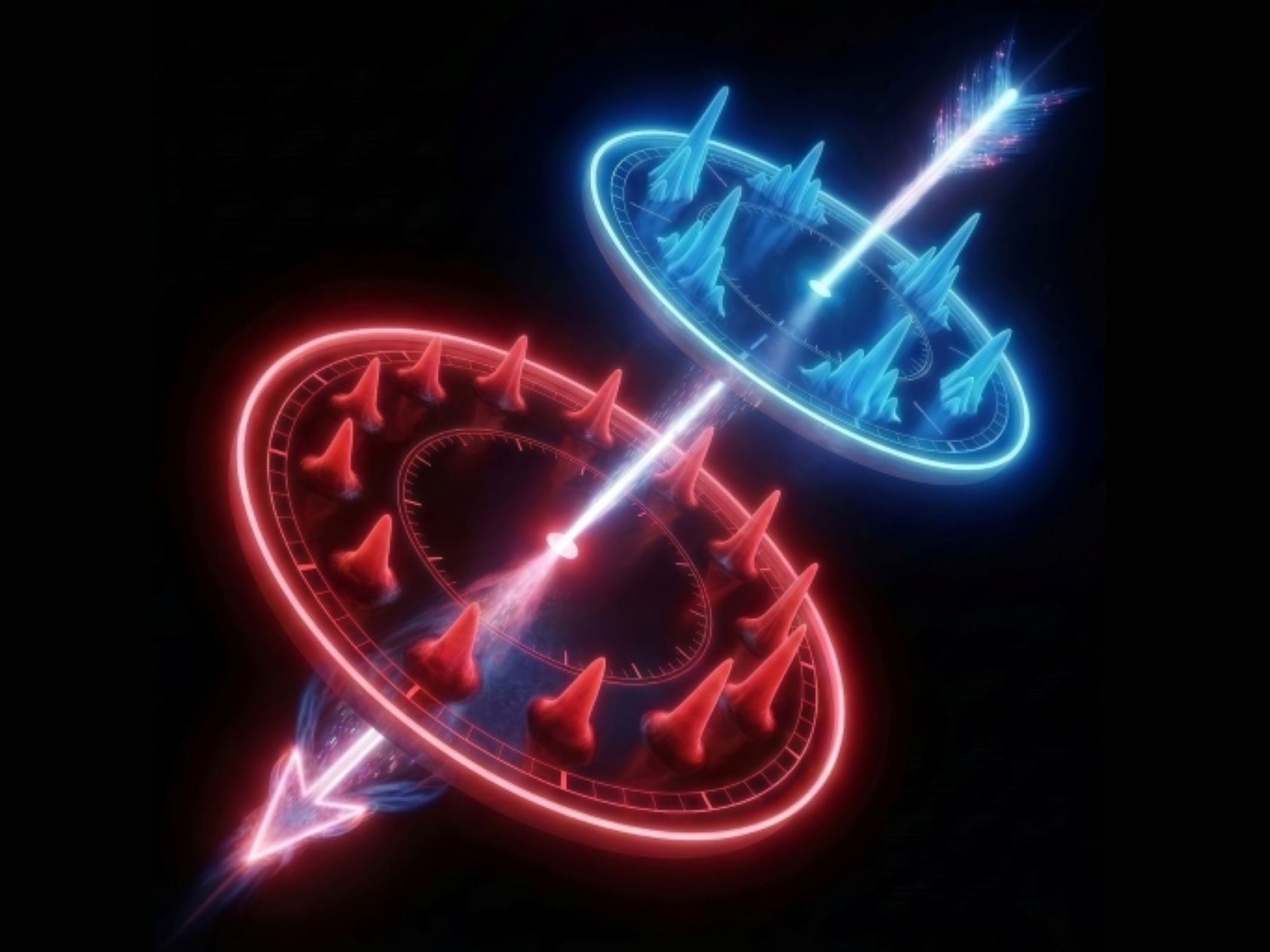
Experiments show two types of breathing: Above the threshold power, solitons breathe quickly, repeating in just a few cycles. Below the threshold, they breathe slowly, taking hundreds or thousands of cycles. Until now, scientists needed two separate mathematical models to explain these very different behaviors.
An international team of researchers, including a scientist from Aston University, has solved a long‑standing puzzle about “breather” laser pulses. For the first time, they created a single mathematical model that explains two very different behaviors of these pulses.
The new unified model combines the fast changes in light as it circulates inside the laser cavity with the slower shifts in the laser’s energy supply. This shows that the two behaviors aren’t separate mysteries at all; they are simply two sides of the same coin.
Dr. Sonia Boscolo from the Aston Institute of Photonic Technologies said, “Above- and below-threshold breathing solitons show markedly different behaviors. Above-threshold breathers oscillate rapidly and can lock to the cavity, producing comb-like radiofrequency spectra and higher-order frequency-locked states, with characteristic sidebands in their optical spectrum.”
Below the threshold, breathing solitons evolve much more slowly. They produce dense clusters in the radiofrequency spectrum without neat spacing and show no optical sidebands.
The new simulation captures both the fast breathing cycles above threshold and the slow ones below threshold within a single framework, something previously thought impossible with a single model.
The new model combines the slow changes in the laser’s energy source with the detailed behavior of light inside the cavity. This unified framework successfully reproduces all the breathing patterns seen in experiments.
It explains that below the threshold, breathing arises from Q-switching combined with soliton shaping, while above the threshold, it is mainly driven by Kerr nonlinearity and dispersion.
“This discovery closes a long-standing gap in laser science and provides a vital tool for designing the next generation of light-based technologies.”