
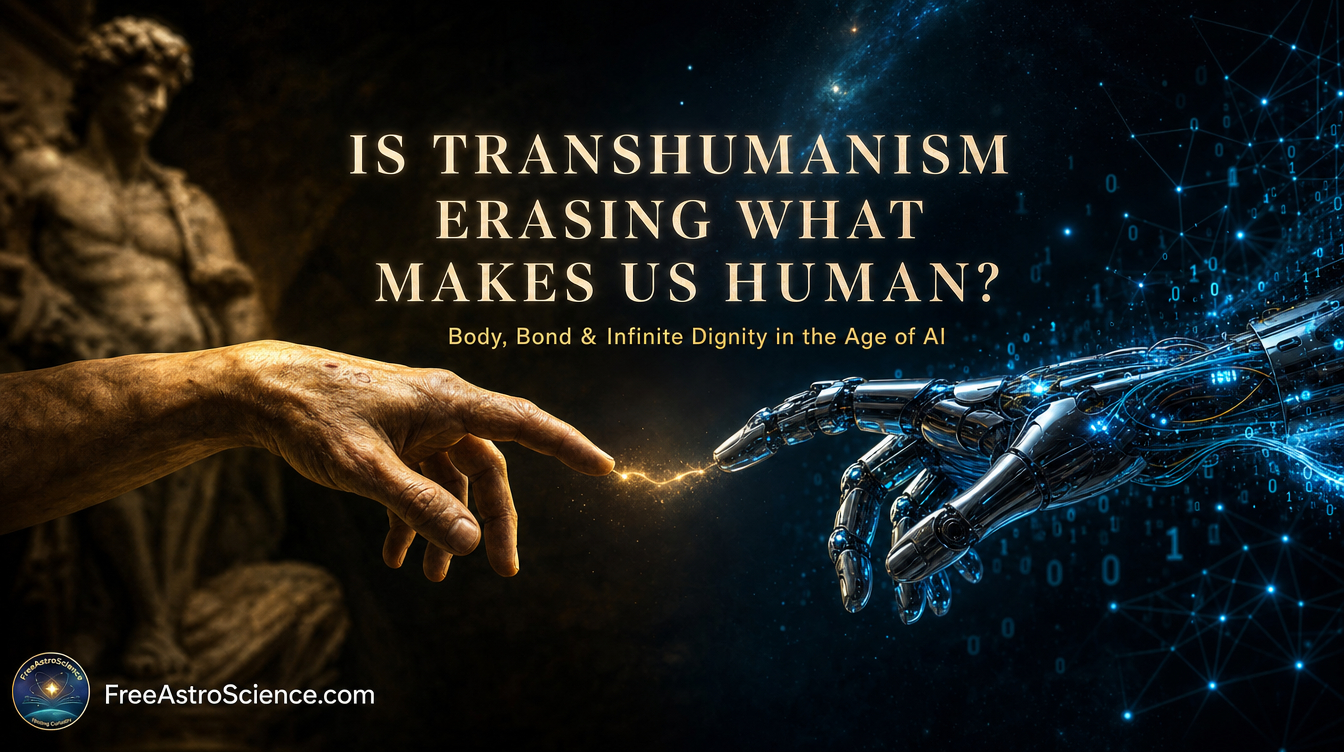
What if the very thing transhumanists want to escape—your fragile, aching, limited body—is actually the only place where infinite dignity can live?
Welcome, dear reader. We’re glad you’ve found your way here to FreeAstroScience.com, where we take the hardest ideas in science, philosophy, and ethics and translate them into language you can actually use. Today we’re tackling a question that touches every one of us, whether we know it or not: what happens to “the human” when technology promises to remove every limit we have?
Stay with us until the end. We promise that by the last paragraph, you’ll see your own body, your relationships, and even your scrolling habits in a completely new light. This piece was written for you, and it deserves your full attention.
—
—
The Person Beyond Function: Body, Bond, and the Search for Meaning
The question we’re asking is simple but radical. Are you the sum of your data, or are you something a machine will never read?
A recent essay by Markus Krienke (May 17, 2026), published in *MagIA – Magazine Intelligenza Artificiale*, picks up the Vatican’s International Theological Commission document Quo vadis, humanitas?* (QVH) and uses it to dissect transhumanism with surgical care. We want to walk you through its main ideas, in plain English, with our own commentary along the way.
Why is transhumanism the new gnosticism?
Transhumanism is the project that wants to push human intellectual, physical, and psychological capacities past the limits set by biology . Sounds exciting, right? Cure every disease. Upload your mind. Live forever.
Here’s the catch. To make that promise work, transhumanism has to **delete fragility and limit** from the picture of what a human is. QVH calls this out at paragraph 1: the program censors “natural fragility and limit,” the very things the document considers essential expressions of our **infinite dignity** (n. 2) .
That sounds contradictory at first. How can a *limit* express something *infinite*? Hold that thought. We’ll come back to it.
Krienke argues that transhumanism is best understood as a **neo-gnosticism. Ancient gnostics believed matter was a prison and the body was a mistake made by a lesser god. Salvation meant escape into pure knowledge. Today’s version flips the same coin in a digital wrapper:
- “Light” becomes knowledge (data, information, AI).
- “Darkness” becomes ignorance (the messy, slow, biological body).
- The “demiurge” who got it wrong is now biology itself.
- The new creator is us, with our machines.
The body is no longer the home of the person. It becomes an “envelope” to be optimized, hacked, and eventually replaced with a cyborg shell. As Krienke puts it bluntly: in the transhuman vision, the body is reduced to **arsenal, instrument, function — and that is something even the most body-hostile currents in Christian history never claimed.
A small but sharp side-note from Yuval Noah Harari’s *Homo Deus*, quoted in the article: data religion teaches that “experiences are worthless if they are not shared, and that we don’t need to — in fact we can’t — find meaning within ourselves” . Read that twice. It explains a lot about how we live online.
> If we keep going down this road, the proper title for a future encyclical writes itself. Just as Leo XIII called socialism a “false remedy” in *Rerum novarum* (May 15, 1891), Krienke suggests a chapter heading for our age: “Transhumanism, false remedy.”
What does “infinite dignity” really mean today?
Let’s get personal for a second. Have you ever felt that strange, exhausting pressure to **always be your most authentic self**? To curate, to perform, to optimize? You’re not imagining it.
Krienke leans on Chiara Giaccardi, Mauro Magatti, and the Korean-German philosopher Byung-Chul Han to describe what happens to a self locked in this loop :
- The individual becomes a “celibate machine” — moving constantly through a cloud of incoherent signs and images.
- The “imperative of authenticity” produces a narcissistic compulsion that is “blind to the other.”
- Social life splinters. Symbols collapse. Violence becomes thinkable again.
Han’s diagnosis lands hard: “The omnipervasive digital network and total digital communication don’t make encounter with others easier. They serve to find the Same and those who share our opinion, leaving aside the different and the other”.
Hannah Arendt warned us decades ago about where this leads. Her line, quoted in the article from *The Origins of Totalitarianism*, deserves a frame: “The ideal subject of totalitarian rule is not the convinced Nazi or the convinced communist, but the person for whom the distinction between fact and fiction, true and false, no longer exists”.
QVH connects the dots. Without an ethic, a culture, and a spirituality strong enough to set a limit and contain it, technoscience starts running on a “paradigm of power” that conditions our lives and our societies (n. 30).
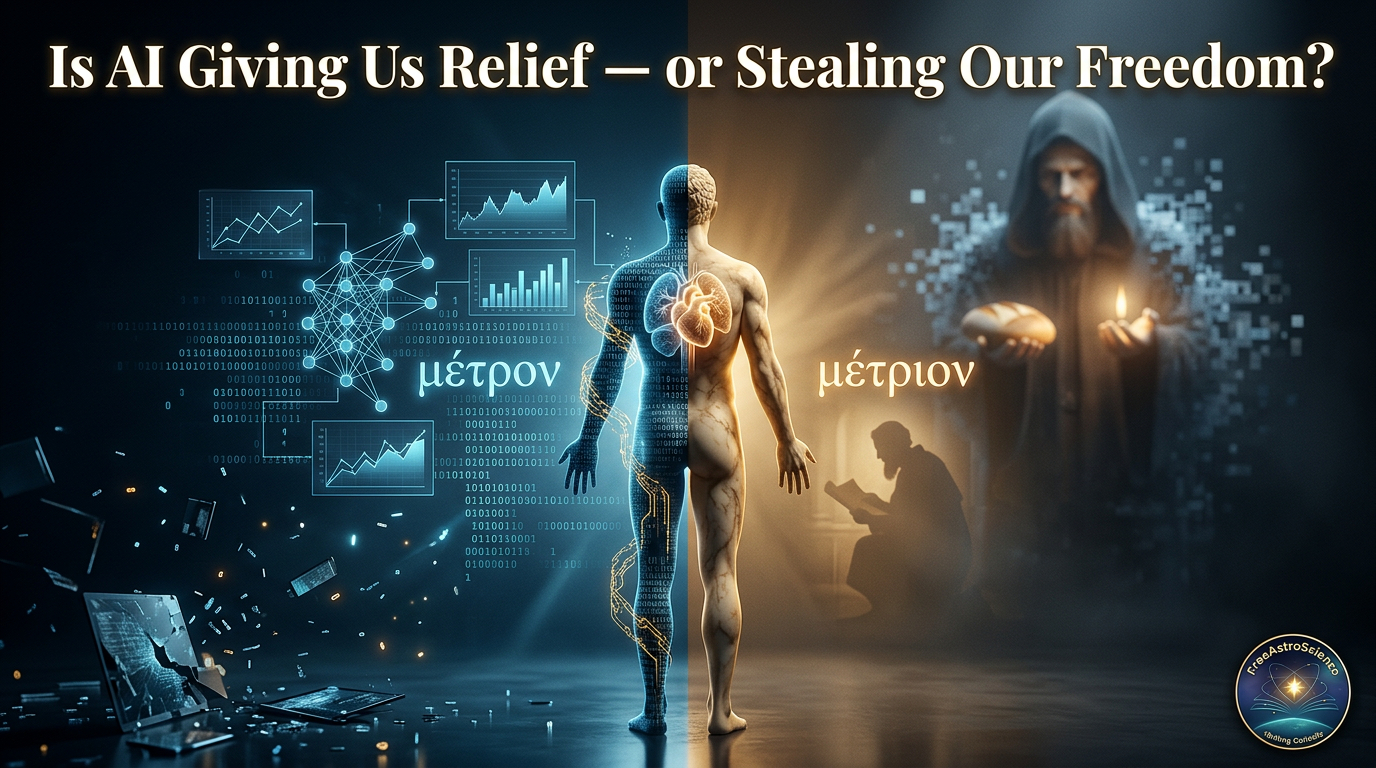
| Dimension | Transhuman View | Christian/Relational View |
|---|---|---|
| The body | Disposable envelope, instrument, function | Symbol of infinite dignity, place of encounter |
| The limit | An obstacle to be removed by tech | The condition that makes self-realization possible |
| Identity | Profile generated by data | Singular, irreplaceable, born in relation |
| The Other | The “Same” — those who agree with us | An irreducible face that calls us out of ourselves |
| Salvation | Technological singularity | Vicarious representation in Christ (Stellvertretung) |
| Moral compass | Shame, external control, transparency | Conscience, inner discernment of good and evil |

This is an excellent blog post with clear logic and professional analysis. Every key point is well explained, every example is appropriate, and all the advice is easy to follow and implement. It’s really helpful for my personal growth.
Very helpful content, learned a lot from this. User Requests documents lessons learned from actual projects.