What if the universe we thought we understood is mostly a polite fiction?
Welcome, dear reader. We’re glad you stopped by FreeAstroScience.com today, because we want to walk you through something genuinely big. A survey of more than 1,600 physicists, published on May 12, 2026 in Physics Magazine, just shook a few foundations . We promise: stay with us to the end, and you’ll see the cosmos with sharper, more honest eyes. This piece was written for you, by us, where hard science gets translated into plain language. Because at FreeAstroScience we believe one thing above all: never switch off your mind. The sleep of reason breeds monsters.
📖 Table of Contents
- What did the largest physics survey actually ask?
- Is the Big Bang still the beginning of everything?
- Why is the WIMP losing the dark matter race?
- Is dark energy really constant?
- Multiverse, God, or just brute facts?
- A century later, do we understand quantum mechanics?
- What happens inside a black hole?
- Does string theory still lead the race?
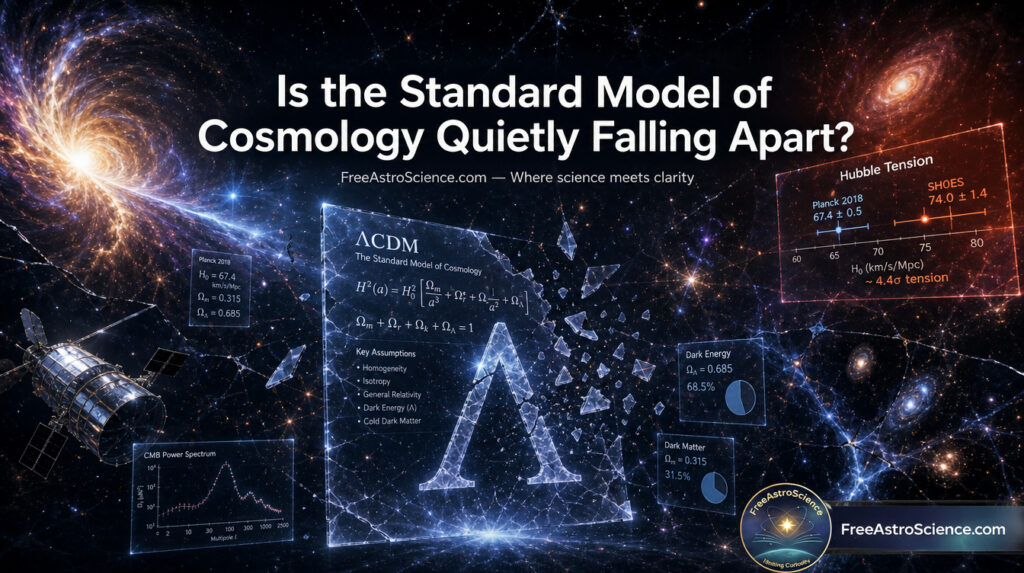
- Why does the Hubble tension matter so much?
- Is a paradigm shift coming?
Cracks in the Cosmos: When 1,600 Physicists Disagree About Reality
What did the largest physics survey actually ask?
Last summer, Physics Magazine ran a ten-question poll on the biggest open problems in cosmology, particle physics, and general relativity. More than 1,600 people answered. To the authors’ knowledge, that makes it the largest physics survey ever conducted.
Who took part? A mixed crowd. Just over 20% called themselves “science enthusiasts.” The rest were researchers split across gravity (10%), astrophysics (12%), particle physics (18%), and other sciences (30%) .
The team behind it: Niayesh Afshordi (University of Waterloo and Perimeter Institute), science communicator Phil Halper, and Physics Magazine editors Matteo Rini and Michael Schirber. Their full results sit in an arXiv preprint (2605.11058) .
Here’s what struck us most: on almost every question, there is no majority answer. The “standard” textbook view often grabs only a minority of votes .
Is the Big Bang still the beginning of everything?
This was the one question where physicists nearly agreed. About 70% described the Big Bang as a hot, dense state without claiming it marked the absolute start of time .
Read that again. The Big Bang, in the eyes of most respondents, is no longer the beginning of the universe. It’s a phase. A snapshot. Something came before, or at least, something might have .
That’s a quiet revolution dressed in a familiar name.
Why is the WIMP losing the dark matter race?
For thirty years, the Weakly Interacting Massive Particle (WIMP) was the textbook answer for what dark matter is made of. Big experiments were built to find it. So how popular is the WIMP today among physicists?
Just 10% .
The crowd has scattered. Here’s how the votes broke down:
| Candidate | % of votes |
|---|---|
| WIMP (heavy particle) | ~10% |
| Light particle (e.g., axion) | ~17% |
| Modified gravity (MOND or quantum gravity) | ~22% |
| Hybrid combination of the above | ~21% |
Notice something? The “less mainstream” options now beat the textbook one . The dark matter story we’ve been told for decades is, frankly, in trouble.
Is dark energy really constant?
The picture is just as messy here. The cosmological constant Λ, the headline ingredient of the standard ΛCDM model, picked up only about 25% of votes . It’s running neck and neck with a time-varying scalar field, while a third option, gravity modification, takes much of the rest .
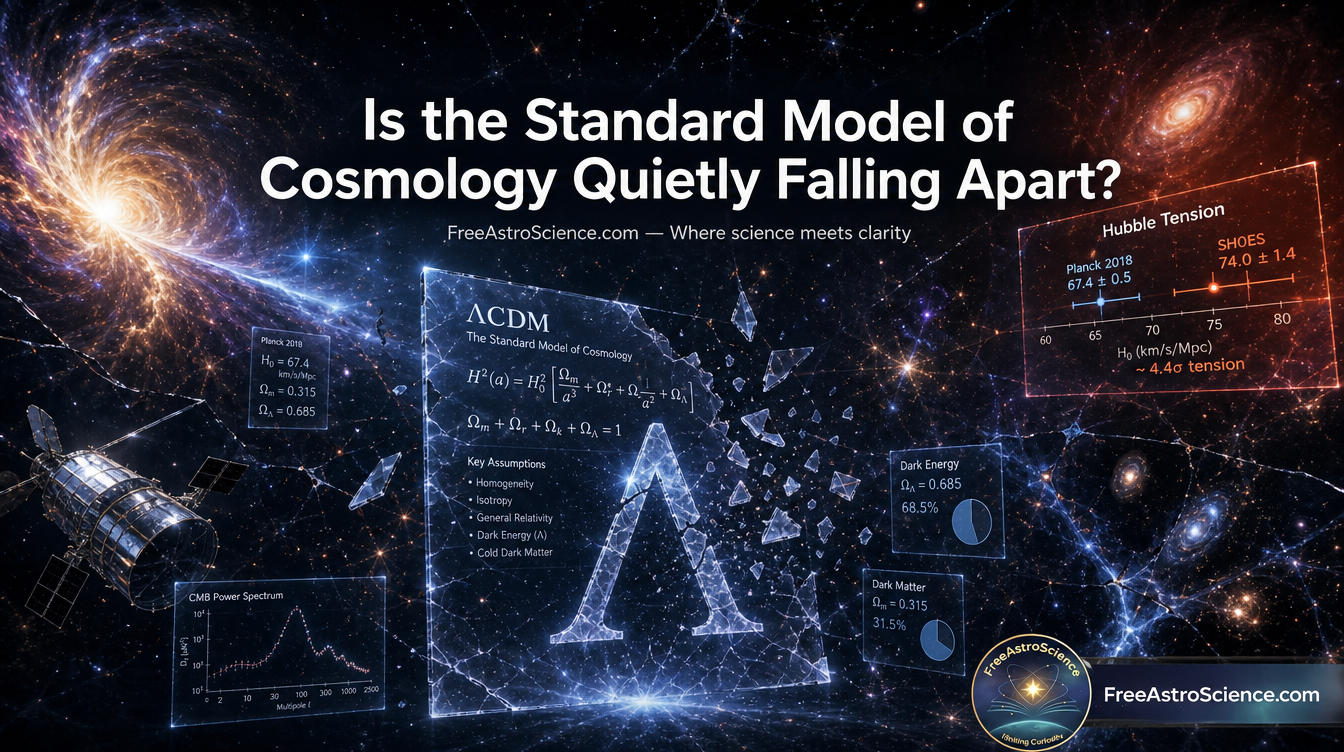
Why does this matter? Because recent observations from DESI and the Dark Energy Survey hint that dark energy may not be constant after all . If those hints firm up, ΛCDM isn’t necessarily wrong. It’s just incomplete, the way Newton wasn’t wrong but missed something deeper .
The dark sector, in numbers:
Quick math of the universe (per ΛCDM):
Dark energy ≈ 68% Dark matter ≈ 27% Ordinary matter ≈ 5% Roughly 95% of the universe is stuff we don’t really understand — and physicists now disagree on what most of it is.
Put together, the dark matter and dark energy results tell us one thing clearly: the standard model of cosmology has far less support than its name suggests .
Multiverse, God, or just brute facts?
The constants of nature look weirdly fine-tuned for life. Pop science usually frames the choice as: a multiverse (we live in the one universe where things worked out) or an intelligent designer.
The survey said: neither.
The single most popular answer was that the constants are simply “brute facts” that need no further explanation. No cosmic lottery. No designer. Just: that’s how the numbers are.
Honest? Maybe. Satisfying? Not really. But that’s where the community sits.
A century later, do we understand quantum mechanics?
A hundred years after its birth, quantum mechanics still has no agreed-upon meaning. The Copenhagen interpretation leads with over 35% of votes — a plurality, not a majority . Many-worlds, pilot waves, and other camps share the rest.
It’s strange and a little beautiful. The most successful theory in physics is also the one we argue about the most.
What happens inside a black hole?
About 40% of respondents stuck with the textbook answer: matter falling in gets crushed into a singularity . The other 60% prefer something else entirely — fuzzballs, regular interiors, who knows.
On the famous black hole information paradox, more than half believe information is ultimately preserved, either in Hawking radiation or in some kind of remnant. Just under 20% disagreed . So even Hawking’s puzzle isn’t fully closed.
Does string theory still lead the race?
For a quantum theory of gravity, string theory remains the front-runner — but with under 20% support . The most-picked answer? “No opinion” . That alone tells you how unsettled this field is.
Here’s a fun pattern the authors flagged: about 5% of respondents picked quantum gravity as the answer to early-universe cosmology, dark matter, dark energy, and the Hubble tension — all at once . That correlation is 3–4 times higher than chance . A small but committed faction thinks one new idea solves everything. Bold move.
Why does the Hubble tension matter so much?
The Hubble tension is one of cosmology’s loudest headaches . Different ways of measuring how fast the universe expands keep giving incompatible answers, no matter how precise the instruments get .
Physics doesn’t move forward when everything fits. It moves forward when reality stubbornly refuses to match the elegant equations we built . That’s exactly where we are now.
Is a paradigm shift coming?
Look at the trail of breadcrumbs:
- The Big Bang isn’t the beginning for most physicists .
- The WIMP, once king, gets 10% .
- The cosmological constant gets only 25% .
- DESI and the Dark Energy Survey suggest dark energy might evolve over time .
- The Hubble tension won’t go away .
- “No opinion” leads the quantum gravity race .
Is this failure? We don’t think so. Fragmentation in expert opinion often comes right before a real breakthrough — the way it did before quantum mechanics, before relativity, before modern physics itself .
ΛCDM is still the best model we’ve got . But in the history of science, “best” has never meant “final” . The universe seems to enjoy demolishing human certainties .
So, where does this leave us?
We started with a question: is the standard model of cosmology falling apart? The honest answer is — not collapsing, but cracking. The community has stopped speaking with one voice on dark matter, dark energy, the meaning of quantum mechanics, the inside of black holes, and the road to quantum gravity . That fragmentation isn’t a crisis. It’s the sound a paradigm makes when new data starts pressing on old assumptions .
We wrote this piece for you, here at FreeAstroScience.com, because we believe complex science belongs to everyone — not locked behind jargon. We translate it. You think about it. That’s the deal. Keep your mind awake, always. The sleep of reason breeds monsters. Come back soon — there’s more universe to puzzle over together.
— Gerd Dani, President, Free AstroScience
📚 References
- Afshordi, N., Halper, P., Rini, M., & Schirber, M. (2026). Far from Settled: Respondents at Odds over Greatest Physics Mysteries. Physics Magazine, 19, 34. physics.aps.org
- Afshordi, N. et al. (2026). Big Mysteries Survey: Physicists’ views on cosmology, black holes, quantum mechanics, and quantum gravity. arXiv:2605.11058. arxiv.org/abs/2605.11058
- Retemedia. (2026, May 13). I fisici stanno iniziando a dubitare del modello standard della cosmologia.