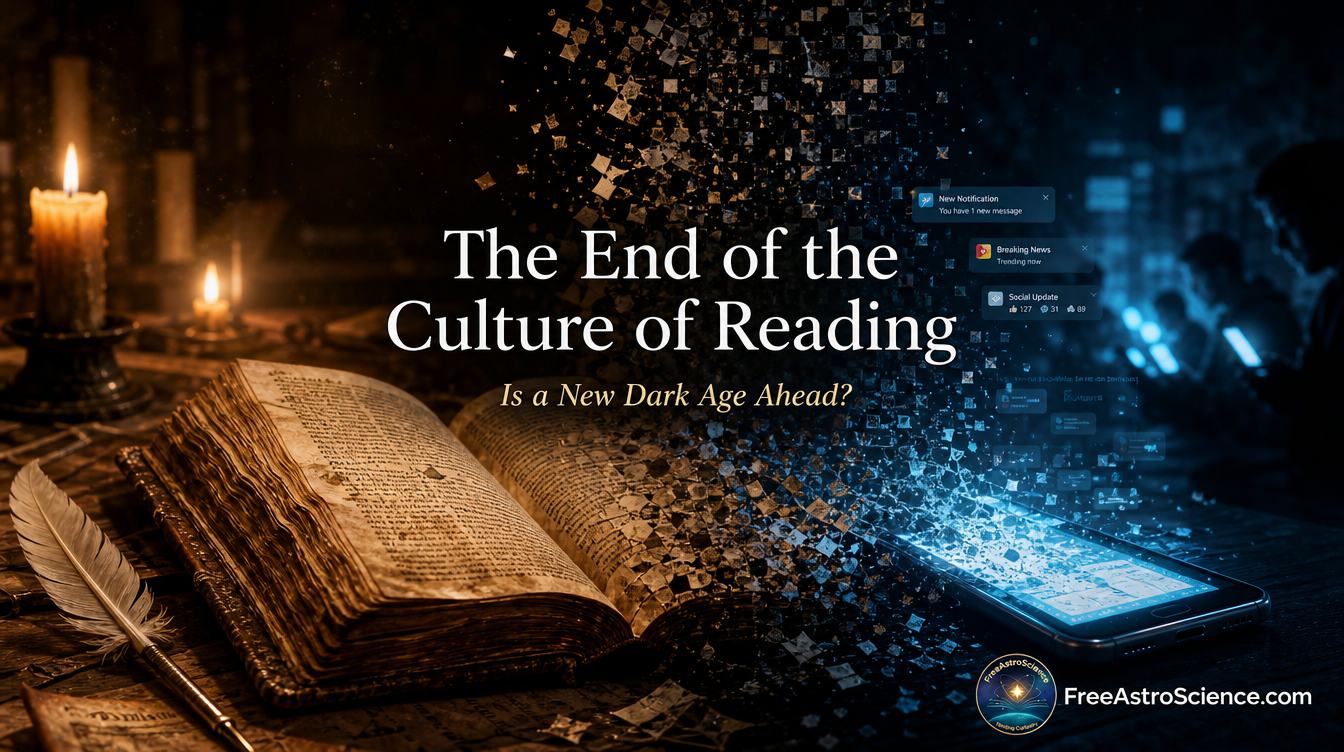
-• Let me say it plainly. We are losing the ability to read.
Not the alphabet, not the road signs, not the captions sliding across our screens. We’re losing something deeper, something quieter, something that once shaped the very architecture of our minds. From my desk in Rimini, with the Adriatic murmuring outside the window and a stack of dog-eared books to my left, I want to talk to you about what’s slipping through our fingers — and what comes next if we don’t notice.
A small note before we begin: I’ll simplify some of the neuroscience here so it stays human. The story matters more than the jargon.
Two Events, One Strange Thread
January 2007. Steve Jobs holds up the first iPhone, and the world squints at the future. Just under a decade later, a television personality is sworn in as President of the United States . Coincidence? The American historian and political scientist Adam Garfinkle, now studying neuroscience in retirement, says no — and his argument is uncomfortable enough that I think we should sit with it .
To understand why, we need a brief detour through the 18th century.
The Quiet Revolution Nobody Filmed
Something extraordinary happened in the 1700s. Ordinary people — not just monks and aristocrats — started reading. Books, pamphlets, scandalous novels, philosophical tracts. Contemporaries called it a fever, an epidemic, “an explosion of madness” . The numbers are staggering: Britain went from roughly 6,000 books published at the start of the century to 56,000 by its end. Germany alone produced half a million .
Out of this paper storm came Diderot’s Encyclopédie, Adam Smith’s Wealth of Nations, Kant’s Critique of Pure Reason, and Sterne’s wonderfully bonkers Tristram Shandy . And out of those came something even bigger — capitalism, democracy, the anti-slavery movement, feminism. The whole package we lazily label “liberal modernity” was midwifed by readers .
Reading didn’t just inform people. It rewired them.
Your Brain Is Not a Block of Concrete
Neuroscientists now agree on something poets always suspected: the brain behaves more like a muscle than a stone. Neural networks stay malleable through life, especially in early childhood, but even adult brains keep being reshaped by whatever the world throws at them .
And reading — real reading — throws a lot.
When you sink into a long book, you have to hold details in memory, weave connections, keep the bigger picture humming in the background. The English call it “deep reading” . It’s an entirely different beast from scanning a shopping list. Researchers have shown that during deep reading, the body itself joins in: read a chase scene, and your leg muscles quietly tense, as if you might need to run .
That’s the smell of old paper, the soft creak of a chair, a body that’s forgotten where it is. That’s reading.
The Saber-Toothed Tiger in Your Pocket
Here’s the catch. Deep reading fights against everything our Stone Age brain wants to do. Our default setting is distraction — that rustle in the bushes might be a tiger, a lover, or dinner . Tuning out the world to follow Dickens for three hundred pages is unnatural. Beautiful, but unnatural.
The smartphone has crashed straight into this fragile habit and shattered it.
We no longer have the patience for long texts. Our finger twitches toward the next swipe, the next saber-toothed tiger, the next snack of mental fast food. A study found that American students could no longer understand the opening chapter of Dickens’s Bleak House — a novel that, a century ago, was considered children’s literature. Let that sit for a moment.
A Country Quietly Going Illiterate
The numbers from the United States are bleak. Around 20 percent of Americans are functionally illiterate — they struggle even with a medication leaflet that reads “instill into the eyes twice a day” . Roughly 130 million Americans could not read a book to their children if they wanted to. More than half couldn’t follow a newspaper article like the one you’re reading.
Only 12 percent are still capable of deep reading, and that number is dropping fast.
American kids who devour fat novels for fun? A vanishing minority.
Populism as the Theatre of Distracted Minds
This is where Garfinkle’s argument bites. He defines populism as “mass mobilization in an election-based democracy when the capacity for deep reading has fallen below a certain threshold”. When citizens can’t sustain attention long enough to follow an argument, only one thing still works on them: spectacle .
And the perfect form of spectacle is the magic trick. The magician throws a sheet over the elephant, whips it away — abracadabra — and the elephant is gone. Of course it isn’t really gone. But our eyes insist otherwise, and we cannot look away . That tension between what we know and what we see is the whole engine of the show.
Garfinkle argues that Donald Trump’s superpower is precisely this: producing one grotesque, attention-grabbing spectacle after another . Take the presidential debate with Kamala Harris, where Trump claimed Haitian immigrants were “eating dogs and cats.” Most commentators called it the moment he lost the debate. Garfinkle says it was the moment he won it — he had produced a vivid, unforgettable image suggesting dark-skinned immigrants were savages unworthy of empathy .
The lie didn’t need to be believed. It just needed to be seen.
An Army of Lonely Men
Hannah Arendt, studying the rise of 20th-century dictatorships, kept circling back to one ingredient: loneliness . Tyrants are followed by isolated people who find a crowd to belong to. Garfinkle sees something similar in America today — an army of loners, mostly men, glued to screens. Unemployed Americans average 7.7 hours a day on their smartphones, four hours more than those who work .
Brains marinated for years in pornography, conspiracy theories, and curated outrage. Is it any wonder empathy is shrinking? That patience for complexity is wilting?
I think about this often, as someone whose body forces me to slow down, to sit, to read. The wheelchair I use has, oddly, given me one of the great gifts of my life: time. Time to finish chapters. Time to think. I worry about a generation that has lost both.
Cold Pages, Hot Screens
The brain emits different waves depending on what it’s doing. Alpha waves — relaxed wakefulness. Beta waves — focused attention. Gamma waves — high-level thinking. Theta waves — light sleep, meditation, prayer, a child at play .
People hypnotised by their phones drift in alpha territory. It’s pleasant. It’s anesthetic .
Newspapers, Garfinkle says, are a “cold” medium: they require beta waves, the work of focused attention. Screens are “hot” — they trigger immediate emotion . Reading about a murder gives you space to wonder how it happened. A TikTok video of the same event hands you horror, rage, and a thirst for revenge before your prefrontal cortex even shows up to work .
It’s the old fable of the hare and the hedgehog. The moderate explains, qualifies, footnotes. The populist grins and says, “I’m already here!” — phone in hand .
What We Are Doing to Children
Here’s the line that stopped me cold. Garfinkle calls exposing infants and young children to screens “simply tantamount to child abuse” . The infant brain, knocked from its natural theta state into a flooded alpha state, responds by laying down myelin in regions tied to language, reading, and cognitive control — a kind of scarring .
A recent study suggests this damage is hard to undo. Children overloaded by screens grow into teenagers with poor impulse control, chronic stress, and shaky concentration . The hope that such teenagers will mature into thoughtful citizens of a representative democracy starts to look, in Garfinkle’s blunt phrasing, “ridiculous” .
I won’t tell you what to do with your kids. I’ll just say: hand them a book once in a while. Watch what happens to their face.
A New Middle Ages?
We like to think our crisis is unprecedented. It isn’t.
In the Roman Empire, historians estimate that 30 to 40 percent of adults could read — including many slaves . Then in 476 AD, the Western Empire fell, the Germanic tribes swept in, and across Europe literacy collapsed below 5 percent . The Middle Ages weren’t the cartoon darkness Enlightenment thinkers painted — windmills were invented, cathedrals rose, cities were founded — but the golden thread of written transmission was nearly cut, and it took more than a thousand years to splice back together .
So the question isn’t whether a dark age is possible. It’s how long the next one will last .
Why I Refuse to Despair
I won’t end this on a funeral note. I run FreeAstroScience because I believe science and culture are still our best tools for becoming more human, not less. Every reader who finishes a long article — yes, including this one — is a small act of resistance against the spectacle. Every parent who reads aloud at bedtime is rebuilding a neural pathway that markets are working hard to dismantle.
Reading is a muscle. Muscles can be retrained. Brains can be rewired in the right direction too — that’s the same neuroplasticity that got us into this mess.
So put the phone face-down. Pick up something long. Get bored for twenty minutes. Notice the rustling stop.
If a new dark age is coming, let’s at least be the monks copying manuscripts by candlelight — stubborn, patient, ridiculous, and absolutely refusing to give up.
Because we never give up. Not on books. Not on each other. Not on the strange, fragile miracle of a mind that can lose itself in a sentence and come back changed.
Written from Rimini with too much espresso and a stack of unfinished novels. — Gerd, FreeAstroScience