When Gravity Calls: How We Land on Earth, Mars, and Venus
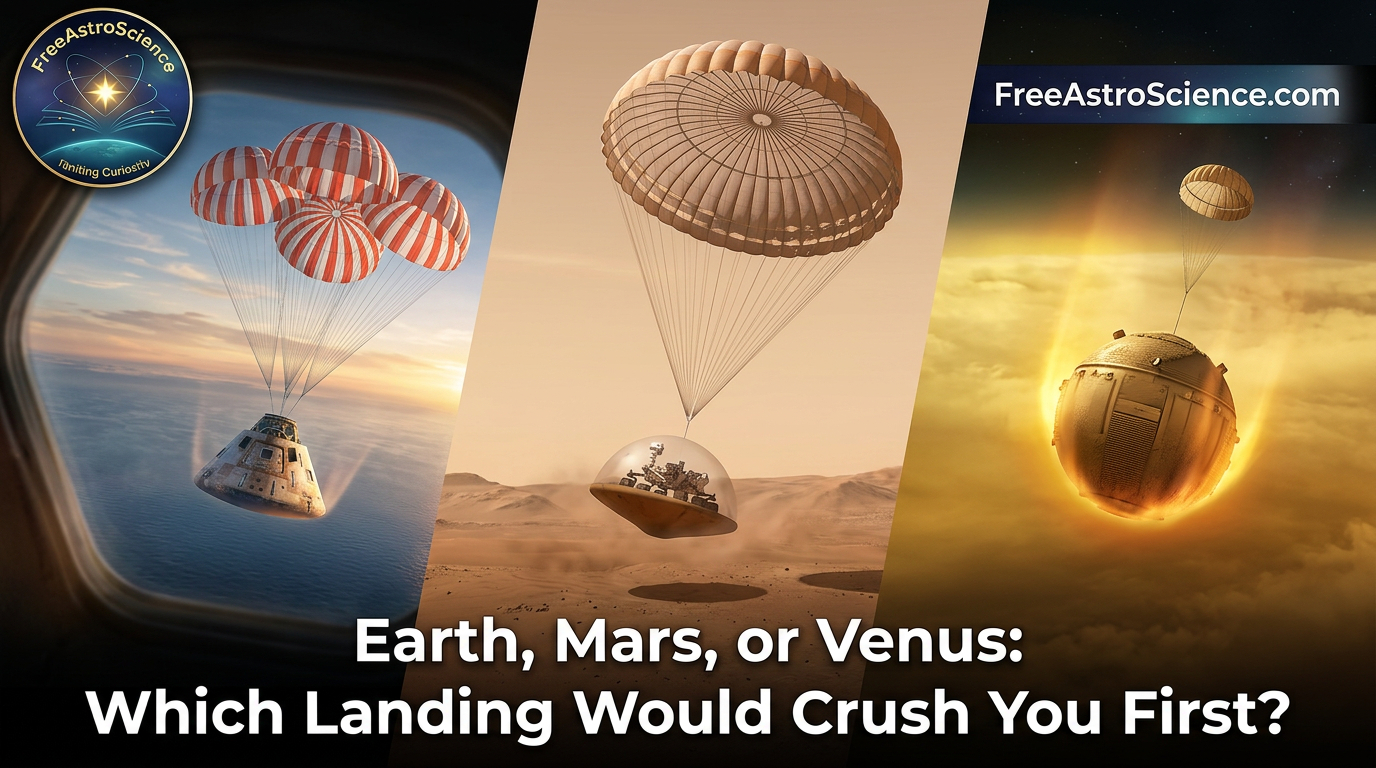
Have you ever wondered what it feels like to fall through the skies of another planet? Imagine the rush of air, the pull of gravity, and the hope that a thin sheet of fabric will slow your descent—whether you’re plunging through the blue of Earth, the rusty haze of Mars, or the crushing clouds of Venus. Welcome to FreeAstroScience.com, where we break down the wildest science into words you can feel. Here, we believe that the sleep of reason breeds monsters, so we keep our minds sharp and our curiosity alive. Stay with us to the end, and you’ll see how parachutes—those humble heroes—change the story of every landing, on every world.
Table of Contents
- How Do Earth, Mars, and Venus Stack Up?
- What Makes a Parachute Work on Different Planets?
- How Do We Land on Earth?
- Why Is Mars Landing So Hard?
- What Happens When You Fall Through Venus?
- How Do Parachute Strategies Compare?
- What Can We Learn from Falling?
How Do Earth, Mars, and Venus Stack Up?
Before we talk parachutes, let’s see what kind of air we’re falling through. The atmosphere shapes every landing. Here’s a side-by-side look at the numbers that matter most:
| Parameter | Earth | Mars | Venus |
|---|---|---|---|
| Surface Pressure | 101,325 Pa (1.013 bar) | 610 Pa (0.006 bar) | 9,200,000 Pa (92 bar) |
| Surface Density | 1.225 kg/m³ | 0.015–0.020 kg/m³ | ~65 kg/m³ |
| Surface Temperature | 288 K (15°C) | 210–215 K (−63°C) | 731 K (458°C) |
| Main Constituents | N₂ (78%), O₂ (21%), Ar, CO₂ | CO₂ (95%), N₂ (2.7%), Ar | CO₂ (96.5%), N₂ (3.5%), SO₂ |
| Scale Height | 8.5 km | 11.1 km | 15.9 km |
| Gravity | 9.81 m/s² | 3.71 m/s² | 8.87 m/s² |
| Speed of Sound (surface) | 340 m/s | 228 m/s | 421 m/s |
Earth feels familiar—thick air, comfy temperatures, and a gentle gravity. Mars is cold, thin, and barely pushes back when you fall. Venus? It’s like sinking through hot soup, with air so dense it can crush steel and temperatures that melt lead.
What Makes a Parachute Work on Different Planets?
Parachutes are simple in theory: they catch air and slow you down. But the air itself changes everything. Let’s look at the math that rules every fall.
Drag Force Equation:
FD = ½ × ρ × v² × CD × A
Terminal Velocity:
vt = √(2mg / (ρ × CD × A))
Where:
- FD = Drag force (N)
- ρ = Atmospheric density (kg/m³)
- v = Velocity (m/s)
- CD = Drag coefficient (dimensionless, 0.7–1.5 for round canopies, 0.5–0.7 for DGB at supersonic)
- A = Parachute area (m²)
- m = Mass of the object (kg)
- g = Gravity (m/s²)
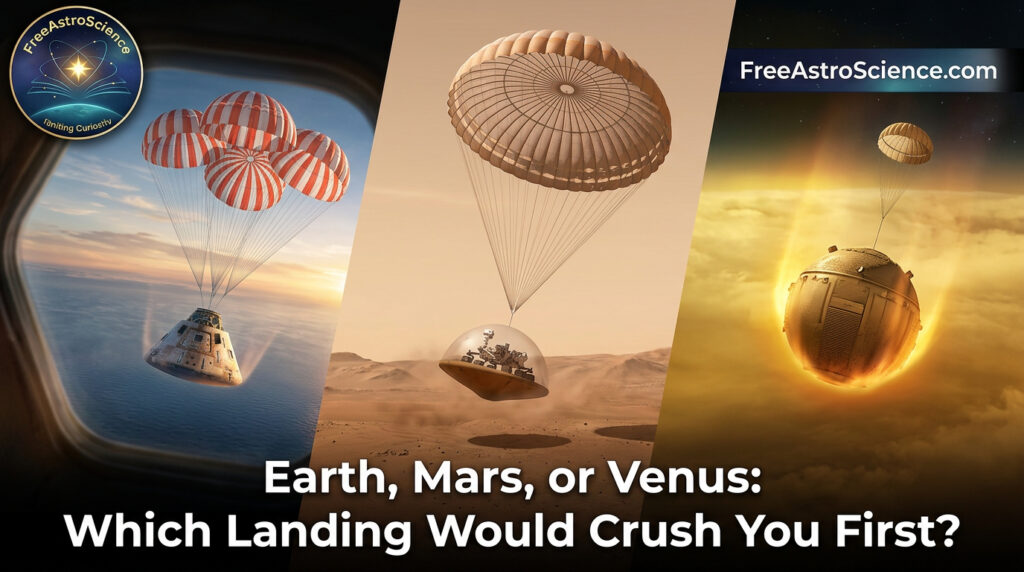
The key player here is atmospheric density (ρ). On Mars, ρ is about 0.015 kg/m³—just 1% of Earth’s 1.225 kg/m³. Venus? A whopping 65 kg/m³, over 50 times Earth. The denser the air, the more drag you get for the same parachute. That’s why a parachute that floats you gently to Earth would drop you like a stone on Mars, but might leave you hanging forever on Venus.
How Do We Land on Earth?
Earth is where parachutes shine. Our air is thick enough to grab, our gravity is steady, and our weather is (usually) forgiving. Let’s see how we bring people and machines home.
Apollo: Coming Home from the Moon
The Apollo Command Module weighed nearly 6 tons. After screaming through the atmosphere at over 11 km/s, it slowed down with a series of parachutes:
- 2 drogue chutes (5 m each) at 7,300 m altitude, slowing from supersonic to about 200 km/h.
- 3 main ringsail chutes (25.5 m each) deployed at 3,300 m, bringing splashdown speed to just 35 km/h.
Even if one main chute failed (as on Apollo 15), the capsule could still land safely. That’s the power of Earth’s atmosphere—parachutes can do almost all the work.
Soyuz: Land Landings with a Bang
Soyuz capsules use a 1,000 m² main parachute, deployed after a series of pilot and drogue chutes. The main chute slows the capsule from 230 m/s to about 6–7 m/s. Just before touchdown, solid-fuel rockets fire, cutting the final speed to nearly zero. It’s a rough ride, but the system is reliable—even in the wilds of Kazakhstan.
SpaceX Crew Dragon: Modern Parachute Power
Crew Dragon uses four Mark 3 main parachutes, each over 30 meters across. After drogue chutes slow the capsule, the mains deploy at altitudes of 2,000–2,400 m, bringing splashdown speed below 32 km/h. The system is built for safety, redundancy, and a soft landing in the ocean.
On Earth, parachutes are the main act. The air is thick, the math is friendly, and we’ve had decades to perfect the art.
Why Is Mars Landing So Hard?
Mars is the heartbreaker of planetary landings. Its air is thin—just 1% of Earth’s. Gravity is weaker, but not enough to make up for the lack of drag. Parachutes here face their toughest test.
Why Mars Parachutes Must Be Huge—and Supersonic
On Mars, a parachute the size of a tennis court barely slows you down. The Disk-Gap-Band (DGB) design is the hero here: a central disk, a gap, and a band. Supersonic air vents through the gap, keeping the canopy from collapsing. Materials like Kevlar, Technora, and Zylon are used—light as a feather, strong as steel.
Historic Mars Landings: The Numbers
- Viking 1 & 2 (1976): 16 m Dacron DGB parachute, deployed at 6 km altitude and 250 m/s. Slowed to 60 m/s in 45 seconds. Retrorockets fired for the last 2.4 m/s.
- Mars Pathfinder (1997): 11–12.7 m DGB, deployed at ~10 km and Mach 1.8–2.0. Airbags cushioned the final bounce.
- Spirit & Opportunity (2004): 12.7 m DGB, peak load 80–85 kN, entry at 5,300 m/s. Airbags again for landing.
- Phoenix (2008): 11.8 m DGB, deployed at Mach 1.7 and 12.6 km altitude.
- Curiosity/MSL (2012): 21.5 m DGB (largest at the time), deployed at Mach 2.2, generating 65,000 lbs of drag. The famous sky crane lowered the rover for a gentle touchdown.
- Perseverance/Mars 2020 (2021): 21.5 m DGB, 81 kg, deployed at Mach 1.7 and 11 km altitude (1,512 km/h). ASPIRE tests on Earth pushed the parachute to 67,000 lbs—85% higher than Mars loads. Range Trigger and Terrain-Relative Navigation made the landing smarter than ever.
- ESA ExoMars: 15 m first-stage + 35 m second-stage DGB—the biggest ever flown beyond Earth.
No Mars lander has ever survived with parachutes alone. The air is just too thin. Every mission needs retrorockets, airbags, or a sky crane for the final act. Mars makes us sweat for every safe landing.
What Happens When You Fall Through Venus?
Venus is a world of extremes. The air is thick enough to swim through, the pressure is like being a kilometer underwater, and the heat can melt lead. Parachutes here are both a blessing and a curse.
Venus: Where Parachutes Are Almost Too Good
The Soviet Venera program (1967–1982) wrote the book on Venus landings. Here’s how they did it:
- Venera 4 (1967): First atmospheric probe. 55 m² main parachute, deployed at 52 km altitude (33°C). Crushed at 22 bar and 262°C after 93 minutes.
- Venera 5 & 6: Smaller chutes for faster descent, crushed at 27–30 bar.
- Venera 7 (1970): First surface landing. Reefed parachute (1.8→2.5 m²), cord melted at 200°C. Parachute failed before landing, probe hit at 17 m/s, survived 23 minutes.
- Venera 8: Improved system with pilot, drogue, and main chutes. All parachutes released below 50 km.
- Venera 9–14: Spherical titanium landers, pre-cooled to −10°C. Parachutes deployed at 63–65 km, jettisoned at 50 km. Disk-shaped aerobrake slowed descent through the thick lower air. Landed at 7–8 m/s on a crush ring. Venera 13 survived 127 minutes—the record.
Venus parachutes were made from glass-fiber fabric, tough enough for brief acid cloud exposure. But below 50 km, the air is so dense that parachutes aren’t needed—the lander’s own shape slows it down, like sinking in syrup.
NASA DAVINCI+: The Next Chapter
The DAVINCI+ mission (early 2030s) will send the Zephyr probe—a 1-meter sphere—through Venus’s clouds. It’ll use a 100-inch heat shield, a DGB-type parachute five times stronger than steel, and insulation made of ceramic, silica, and aluminum. The parachute will slow the probe in the upper atmosphere, then be released for the final descent. If Zephyr survives the landing, it might send data for up to 20 minutes.
On Venus, the real enemy isn’t speed—it’s heat and acid. Parachutes work almost too well, but they can’t save you from the planet’s fury.
How Do Parachute Strategies Compare?
Let’s put it all together. Here’s how parachute deployment looks on each world:
| Planet | Deployment Altitude | Deployment Velocity | Parachute Type | Parachute Size | Drag Force Effectiveness | Final Landing Method |
|---|---|---|---|---|---|---|
| Earth | ~7,300 m (Apollo) 2,000–2,400 m (Dragon) | Subsonic (~200–800 km/h) | Ringsail, Ribbon, Ram-air | 25.5 m (Apollo) 30+ m (Dragon) | Very High | Parachute only (+ rockets for Soyuz) |
| Mars | 6–15 km | Supersonic (Mach 1.5–2.2, 1,500–2,000 km/h) | Disk-Gap-Band (DGB) | 11–21.5 m (NASA) 35 m (ExoMars) | Low | Retrorockets, Airbags, Sky crane |
| Venus | 50–70 km | Subsonic/Transonic | Round, DGB, Drag plate | 1.8–55 m² (Venera) Small (DAVINCI+) | Extremely High | Parachute jettisoned; lander slows by air drag |
Every planet writes its own rules. On Earth, parachutes are the main event. On Mars, they’re just the opening act. On Venus, they’re almost too powerful for their own good.
What Can We Learn from Falling?
Landing on another world isn’t just a technical challenge—it’s a test of imagination and grit. On Earth, we trust our parachutes. On Mars, we push materials and physics to their limits, knowing that even the biggest canopy can’t do it alone. On Venus, we face an atmosphere so thick and hostile that the air itself becomes both savior and executioner.
Every landing is a story of adaptation. We change our tools, our math, and our expectations to meet the world we’re falling toward. That’s the spirit of FreeAstroScience.com: never turn off your mind, never stop asking questions, and never let the monsters of ignorance win. If you’ve made it this far, you’re part of our mission. Come back soon, and keep your curiosity awake.