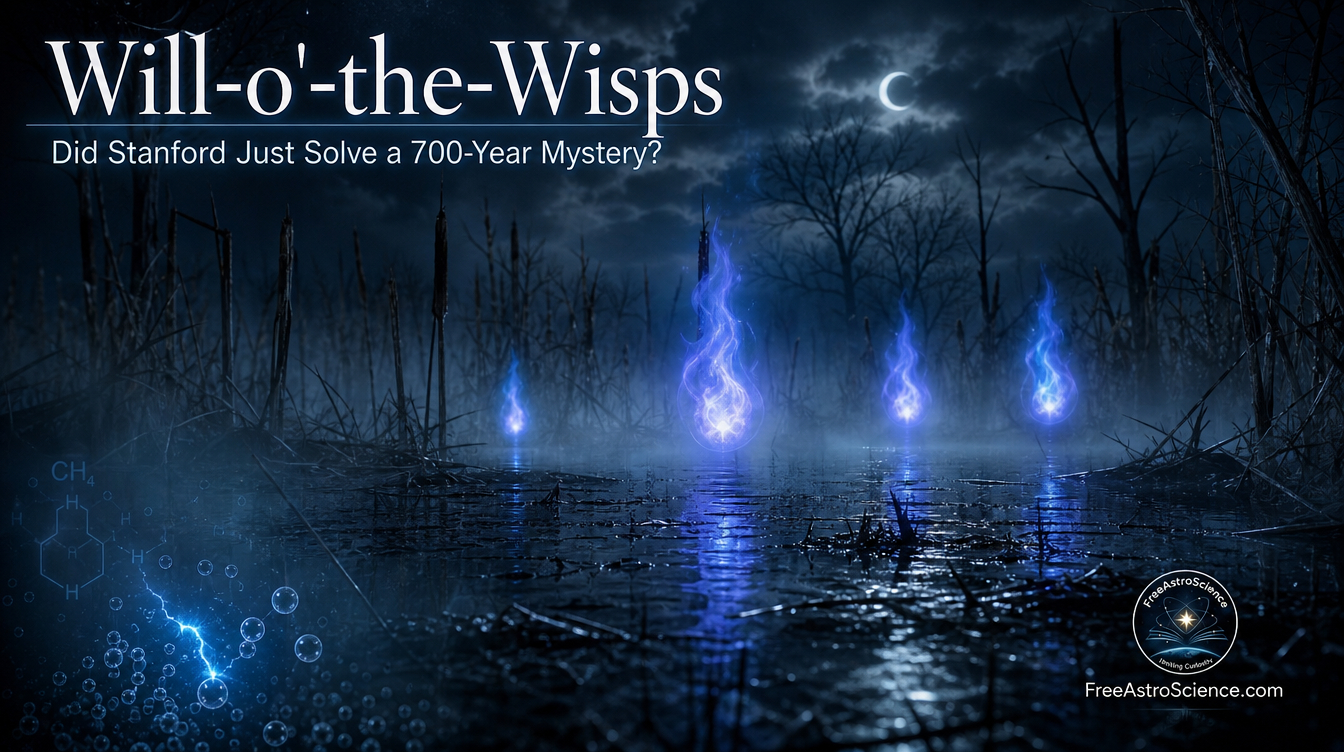
Have you ever wondered what really lit those pale blue flames that danced over swamps and graveyards for centuries, terrifying travelers and inspiring poets from Shakespeare to Goethe? Welcome, dear reader, to another story we’ve prepared for you here at FreeAstroScience.com, where we translate hard science into words you can actually enjoy. Stay with us to the very end — because this mystery, whispered about since 1340, may have just been cracked open by a team at Stanford with high-speed cameras and a tank of bubbles.
The Ghost Lights That Fooled Us for 700 Years — And the Tiny Lightning That Lit Them
Picture this. You’re walking home through a misty marsh, late 14th century, no streetlights, just a torch in your trembling hand. Then something moves. A bluish flame, barely 15 centimeters tall, floats two meters above the wet ground. It doesn’t crackle. It doesn’t burn you. It just… dances.
You’d probably run. So did your ancestors. And for roughly 700 years, nobody could say for sure what those flames were — or what set them alight.
What Are Will-o’-the-Wisps, Really?
The Latin name is ignis fatuus, meaning “foolish fire” — the kind that fools you. It shows up as a pale, bluish flame, usually at night, over swamps, cemeteries, canals, and stagnant water.
Names Across Cultures
Almost every culture that lived near wetlands gave these lights a name. Chinese texts from the 13th century call them shui têng, or “water lanterns.” In Japan they’re hitodama. In Brazil, Tupi folklore speaks of Boitatá — “fire snake” — a guardian that punishes those who harm nature. English speakers know them as will-o’-the-wisp or jack-o’-lantern.
Shakespeare dropped them into Henry IV. Goethe wrote about them in Faust. Emily Dickinson, Charlotte Brontë, Lewis Carroll — they all borrowed the image. Liszt even composed a piano étude called Feux Follets. Tolkien used them in The Lord of the Rings. Harry Potter fans know them too.
What Witnesses Described
Isaac Newton himself, in his Opticks, noted that these flames glow “without heat” — nothing like a candle or burning wood. Joseph Priestley collected reports and found the same pattern: a “dark and calm night,” then a “pale inoffensive light.” They could last up to a quarter of an hour.
So we had the what. The mystery was always the why.
Why Did Scientists Stay Puzzled So Long?
The Cool Flame Clue
Let’s start with what was already known. Swamp gas is roughly two-thirds methane (CH₄), released when bacteria chew through rotting leaves, roots, and animal remains with no oxygen around. Methane can burn. That part’s easy.
Here’s the trick, though. Methane doesn’t just burn one way. Under the right conditions, it produces a “cool flame” — a slow, low-temperature oxidation that glows faintly without throwing off much heat. Humphry Davy spotted the effect back in 1817 using diethyl ether vapor. The chemistry churns out a pinch of hydrogen peroxide, water, carbon monoxide, and — most telling of all — excited formaldehyde, written CH₂O*.
When that excited formaldehyde relaxes, it emits light. The peaks sit at 350 nm and 400 nm. That’s exactly the pale bluish color witnesses kept describing. Case closed, right?
Not quite.
The Ignition Problem Nobody Could Crack
| Property | Hot Flame | Cool Flame (ignis fatuus) |
|---|---|---|
| Temperature | Above 580 °C | Below 475 °C |
| Heat released | Large amount | Barely any |
| Main products | CO₂, H₂O | CH₂O*, H₂O₂, trace CO, H₂, CO₂ |
| Visible color | Bright orange/blue | Pale bluish glow (350–400 nm) |
| Mechanism | Rapid combustion | Slow chemiluminescence |
Data compiled from Pavão et al. (2023) and Xia et al. (2025).
Here’s where everyone got stuck. To ignite methane in open air, you need a lot of energy. The first step of the reaction — methane meeting oxygen to form CH₃ and HO₂ — has an activation energy of 117.38 kcal/mol. That’s equivalent to temperatures above 250 °C. A quiet, misty marsh at midnight just doesn’t get there on its own.
CH4 + O2 ⇌ CH3 + HO2 Ea ≈ 117 kcal/mol
CH3 + O2 ⇌ HCO + H2O
CH3O2 + HO2 ⇌ CH3O2H + O2
CH3O2H + HCO ⇌ CH2O* + CH3O2 → blue glow
People proposed plenty of fixes. The British