What if the deafening silence from our most powerful detectors isn’t a failure of technology, but nature whispering a truth we’ve refused to hear? Welcome, curious minds, to a conversation we’ve been waiting to have with you at FreeAstroScience.com, where we turn tangled physics into something you can actually hold in your hands. Stay with us to the last line — because by the end, you might see the so-called crisis in physics not as a dead end, but as a door we’ve been knocking on from the wrong side.
The Silence of the Detectors: What It Really Tells Us
We remember the late 1970s as a golden hour for physics. Quarks, gluons, the electroweak unification — discoveries came fast, like summer thunderstorms. Then something changed. The storms stopped. Lee Smolin flagged this slowdown years ago, and he was right to do so. But spotting a problem isn’t the same as solving it.
The question still hangs in the air: after decades of patient, expensive, brilliant work, why has no new fundamental structure shown up on our instruments?
What Did Smolin Actually Notice?
Smolin’s observation was simple and uncomfortable. Fundamental physics slowed down drastically after the 1970s. Not paused — slowed. The machines kept getting better. The people kept getting smarter. The results kept getting quieter.
We’ve built bigger accelerators. We’ve pushed detectors to ridiculous sensitivity. We’ve run experiments for longer than some careers last. And the pattern we see is remarkably consistent: no new fundamental degrees of freedom show up.
Where Are All the Missing Particles?
Let’s be blunt about the scoreboard. Here’s what physicists expected, and what actually turned up.
| Prediction | Status | What we see |
|---|---|---|
| Supersymmetric partners at accessible scales | Not seen | LHC silent on SUSY |
| Extra dimensions bending gravity at small scales | Not seen | No measurable deviations |
| Proton decay from unification theories | Not seen | Within current limits, protons seem stable |
| Magnetic monopoles | Not seen | No direct experimental evidence |
| New LHC particles beyond the Higgs | Not seen | Only the 2012 Higgs boson emerged |
| General Relativity passing tests | Confirmed | Still describes every observation correctly |
| Dark matter as a detectable particle | Not seen | Direct detection experiments keep coming up empty |
| Dark energy with internal dynamics | Not seen | Behaves like a plain constant |
| Primordial gravitational waves | Not yet seen | Still below detection thresholds |
All data above come from the same picture Smolin painted . Look at that column. One success and a long string of absences. That’s not bad luck. That’s a pattern.
Could Nature Be More Restricted Than Our Math?
Here’s the reflex answer physicists usually give: we just need more energy, more precision, more time . Build a bigger collider. Wait longer. Refine the instruments.
But there’s a second possibility that deserves its day in court. What if the space of physically realizable configurations is much smaller than the mathematical formalism allows?
Read that again slowly. It doesn’t say quantum mechanics is wrong. It doesn’t say Einstein was wrong. It says something sharper: maybe these theories already contain the real degrees of freedom nature uses, and the silence of our detectors reflects structural limits, not technological ones .
Not everything that is theoretically constructible is realizable in nature .
That single sentence could reshape how we think about the whole enterprise.
How Does a Phase Field Rewrite the Story?
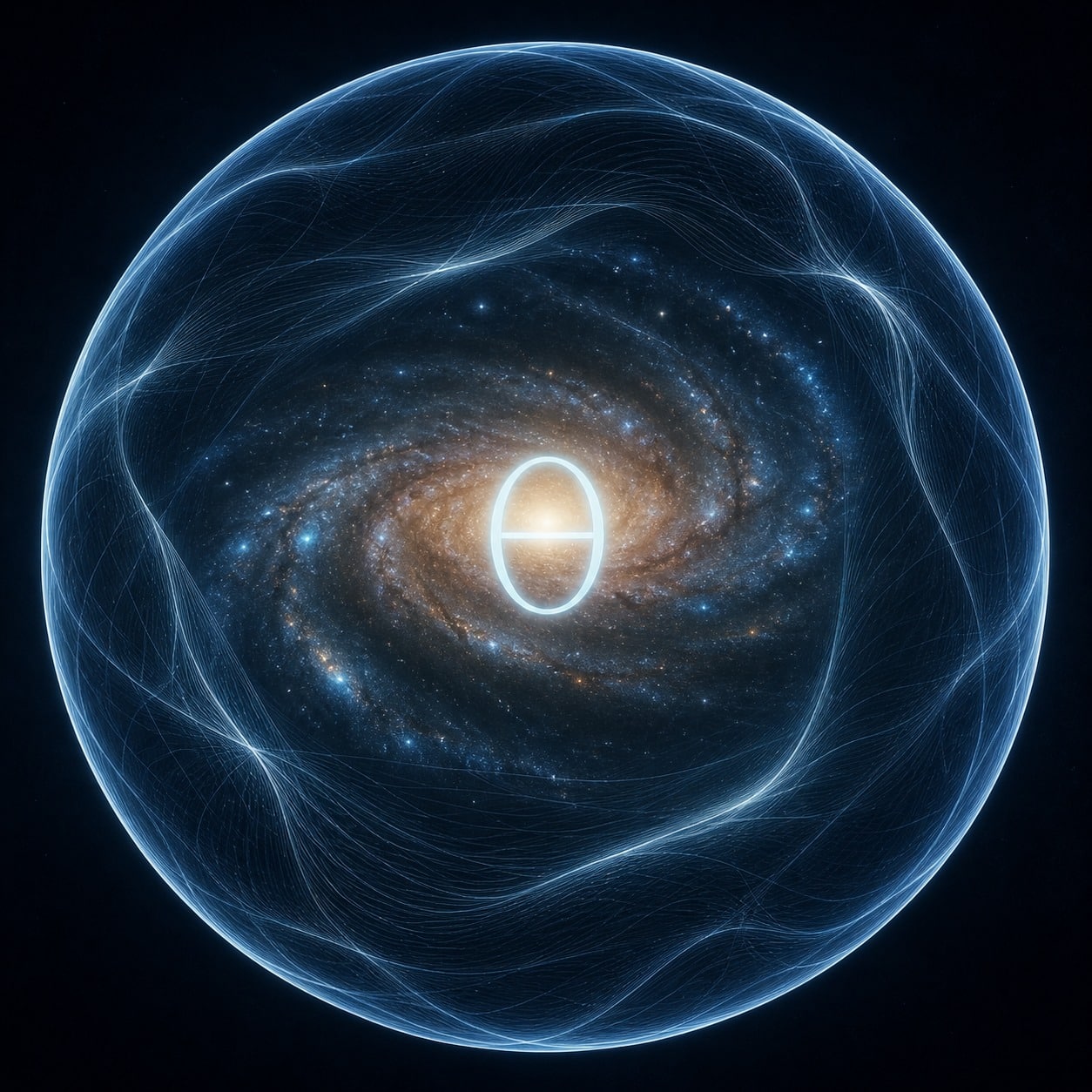
One way to give this idea teeth is to imagine that phenomena emerge from a substrate described by a phase field — call it Θ (theta) . We don’t need to swallow every technical detail. A few principles are enough to see the shape of the argument.
Four principles do most of the heavy lifting :
- Consistency everywhere. The field has to be defined in a coherent way across all of space.
- Global loop conditions. Along closed paths, configurations must match up. This forces discrete structure and topological invariants into the picture.
- Energy cost of deformation. Wild, highly twisted configurations become energetically expensive — nature doesn’t like paying that bill.
- Coherence has a range. Beyond certain scales, correlations fade. That naturally separates coherent behavior from localized behavior.
Notice what these rules do. They don’t add new toys to the formalism. They take options away . They restrict.
Reading Old Puzzles with New Eyes
When we look at long-standing problems through this lens, they shift shape :
- Pauli exclusion principle — no longer a lonely postulate, but a consequence of the state space’s structure.
- Proton stability — the processes that would break it may be strongly suppressed by constraints deeper than today’s models capture.
- No magnetic monopoles — fits the stubborn observational robustness of ∇·B = 0.
- Dark matter’s stealth — if it exists, it may simply not be a weakly coupled, localized particle.
- Dark energy as a constant — more like a global property of the ground state than a new dynamic field.
Why Is Entanglement No Longer Spooky?
Einstein called it “spooky action at a distance.” We love that phrase. But in this picture, the spookiness dissolves.
Two entangled particles aren’t holding a secret phone line across the universe. They share the same phase structure of the field Θ:
Non-local correlations pop out naturally. Relativistic causality stays intact. The link comes from a shared history and a common field, not from signals racing faster than light. Entanglement stops being a magic trick and starts being a memory.
Is Every Math Solution a Real Place?
Einstein’s equations are famously generous. They admit wormholes, exotic geometries, bizarre topologies. Mathematicians keep finding new valid solutions.
But solving an equation on paper isn’t the same as building it in the universe. Physically relevant solutions have to respect energy conditions and the structure of the system underneath . Many exotic configurations end up heavily constrained — or outright locked out.
We think this distinction is the heart of the matter. Mathematical possibility and physical feasibility are not twins. They’re cousins who sometimes disagree.
Can Silence Itself Be the Discovery?
Here’s the reframing that changes everything. The silence of the detectors isn’t an absence of information. It is the information.
Every null result is a measurement. Every “nothing new” is a data point about what nature will and won’t do. Read together, they suggest that pouring more fundamental entities into our theories finds no observational support.
That doesn’t mean new physics is impossible. It means the direction may need to flip. Instead of asking what new particle can we add?, we might ask what constraints make the particles we already know inevitable?
Fundamental physics may not be incomplete in the old-fashioned sense. It may simply be strongly constrained.
An Honest Caveat
We owe you honesty here. The QCS approach sketched above is one way to formalize this idea. It could turn out to be incomplete. It could turn out to be wrong. In the coming years, new particles, new symmetries, or extra dimensions might still walk into a detector and wave hello. That would be spectacular.
The difference, this time, is that the data will decide . Not the elegance of the math. Not the prestige of the theorist. The data.
A Closing Thought From Us to You
We wrote this piece specifically for you at FreeAstroScience.com, where we translate hard science into plain, human language. Our mission is straightforward: we want you to never switch off your mind. Keep it awake. Keep it curious. Because, as Goya reminded us, the sleep of reason breeds monsters.
The silence of the detectors isn’t the end of physics. It might be the sound of physics finally telling us what kind of universe we actually live in — one where the rules are tighter, more elegant, and more restrictive than our equations suggested . The absence of new particles could be whispering a deeper message: that nature, like a great poet, works through constraint, not excess.
Come back and visit us soon at FreeAstroScience.com. We’ll keep asking the questions nobody else dares to ask — and we’d love you sitting right next to us when the next answer arrives.