What if the most mysterious object in the universe isn’t a black hole, a pulsar, or some far-flung galaxy — but the three pounds of wet tissue sitting between your ears right now? Welcome, curious reader. We’re thrilled you’re here at FreeAstroScience.com, where we turn the hardest ideas in science into plain, honest language. On May 19, 2026, at 00:30 UTC+2, we’re hosting a 30-minute live stream that could quietly rearrange how you see yourself. Stick with us to the last paragraph — because what’s coming is genuinely electrifying, and we want you in the room when it happens.
A 30-Minute Live Seminar on the Quantum Mind — Don’t Miss It
We built this article especially for you, right here at FreeAstroScience.com, because we believe big science should never stay locked inside academic halls. Our mission is simple: keep your mind awake. Always. The sleep of reason breeds monsters, and a curious brain is the best shield we’ve got. So let’s walk through what’s coming on May 19 — and why we’re so excited about it.
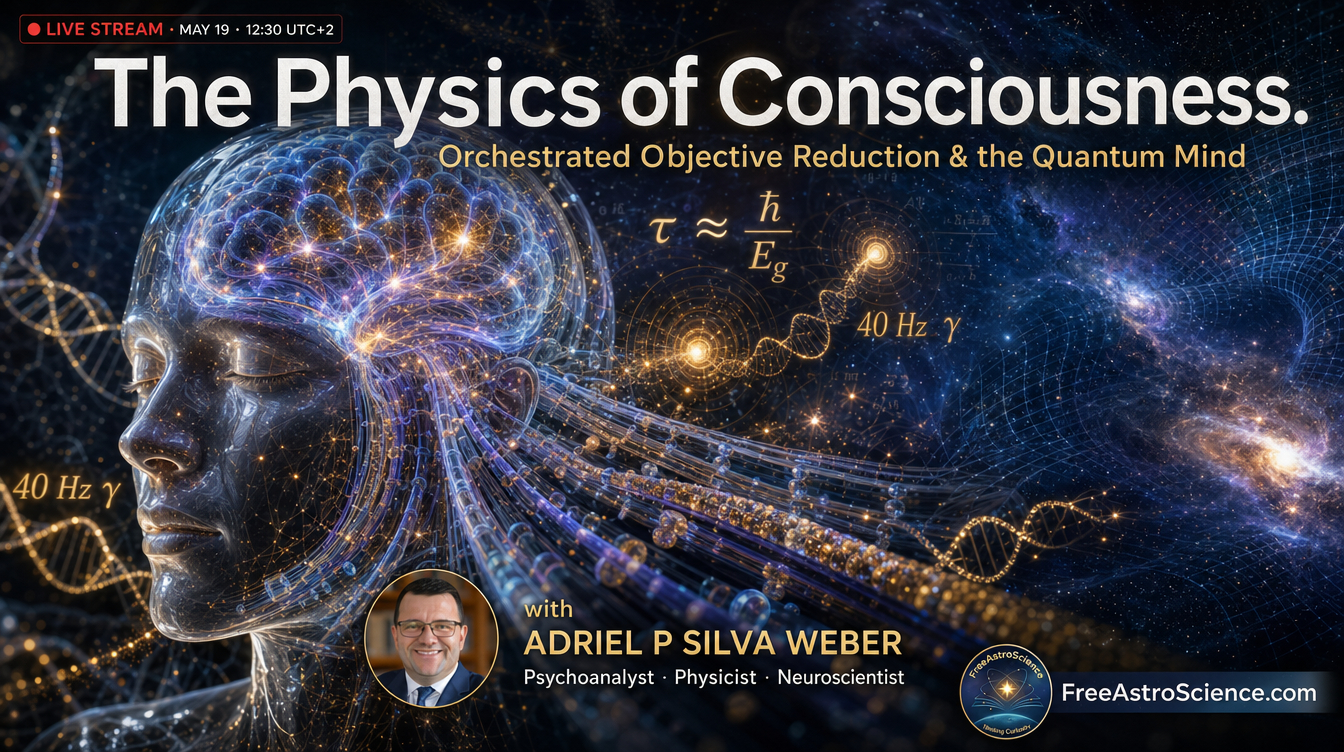
When Are We Going Live?
🔴 Live Stream — The Physics of Consciousness
Block that slot in your calendar. Grab a coffee, tea, or mate — depending on where you’re reading from. We’ll see you live.
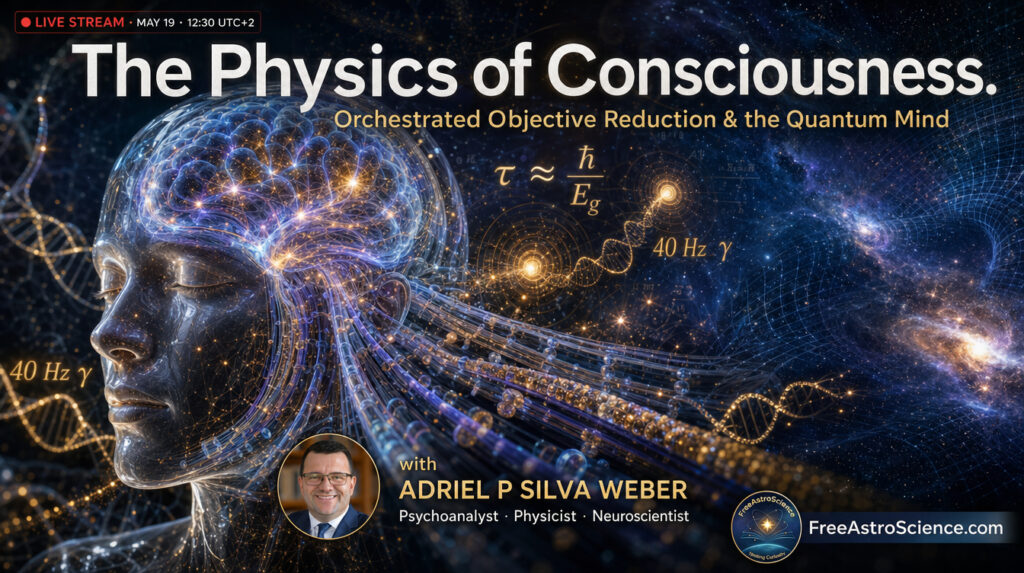
Who Is Adriel P Silva Weber?
Let’s meet our guest. Adriel isn’t your average speaker — not by a long shot. He’s a psychoanalyst, writer, researcher, and speaker with a degree in Physics from Unisinos. On top of that, he carries two MBAs (Project Management and Human Resources Management), a master’s in neuropsychology, and he’s pushing forward right now with a doctorate in neuroscience.
His day job? Manager and Scientific Research Advisor at CPAH — Centro de Pesquisa e Análises Heráclito — where he runs projects like Gifted Debate, Neurogenomic, and RG-TEA. He’s a member of Mensa International and CPAH, and he serves as Brazil Coordinator for the Infinity International Society (IIS).
Here’s what makes him truly special, though. Adriel is twice-exceptional — both gifted and autistic. He writes books on neurodiversity and child development, including Equal Different, A Menina que Brincava com o Vento, Luna e as Borboletas Azuis, and a co-authored work on neuroscience and AI with Prof. Fabiano de Abreu Agrela Rodrigues. When Adriel talks about the mind, he’s speaking from lived experience and hard research. That combination is rare, and it’s exactly why we invited him.
Why Is Consciousness Called “The Hard Problem”?
Here’s the puzzle. Consciousness — the first-person experience of being aware — stays one of science’s deepest unsolved mysteries . Philosophers named it the hard problem for a painfully good reason: why does physical processing in the brain feel like anything at all?
- Classical neuroscience describes what the brain does, but not why it feels like something .
- Purely computational models struggle with qualia and unified awareness .
- Quantum mechanics brings indeterminacy and non-locality — properties that might help close the gap .
The central question Adriel will tackle live: can the laws of physics — especially quantum mechanics — explain how subjective experience rises out of plain matter?
Which Big Theories Fight for the Crown?
Before we get to the quantum story, you should know who’s on the field. Four heavyweight frameworks compete for the title of “best theory of consciousness” .
| Theory | Core Idea |
|---|---|
| Global Workspace | Consciousness arises when information is broadcast widely across a “global workspace” — a classical, computational model . |
| Integrated Information (IIT) | Consciousness matches integrated information (Φ). Any system with high Φ has some degree of experience . |
| Higher-Order Theories | A mental state becomes conscious when a higher-order state represents it — self-referential neural activity . |
| Quantum Mind / Orch-OR | Consciousness emerges from quantum processes inside neurons — specifically, objective reduction of superpositions in microtubules . |
What on Earth Is Orch-OR?
Orchestrated Objective Reduction — Orch-OR for friends — was proposed in the 1990s by an unlikely pair: mathematical physicist Sir Roger Penrose and anesthesiologist Stuart Hameroff . Penrose brought ideas from quantum gravity. Hameroff brought hands-on knowledge of how anesthetic gases switch off awareness.
The theory rests on two joined claims :
- Quantum superpositions happen inside neuronal microtubules.
- These superpositions collapse through Objective Reduction — a real physical event driven by quantum gravity — producing a moment of conscious experience.
Why Is Penrose’s View So Radical?
Penrose argued that standard quantum mechanics is incomplete . Wave function collapse, on his view, isn’t random as the Copenhagen school suggests — it’s a genuine physical event tied to the geometry of spacetime itself. Every “OR” moment becomes a discrete pulse of awareness. Read that again. It’s breathtaking.
Are Microtubules Really Tiny Quantum Computers?
Microtubules are cylindrical protein tubes made of tubulin dimers. They form the skeleton of every neuron. Hameroff proposed they do far more than hold cells in shape — they might be quantum information processors .
- Each tubulin dimer can sit in two shapes — basically a qubit .
- Thousands of tubulins in a neuron may hold quantum superpositions at the same time .
- Ordered water inside microtubule cores may shield these states from thermal noise .
- General anesthetics bind to tubulin and switch off consciousness — a massive clue .
τ ≈ ℏ / EG
Where τ is the collapse time, ℏ is the reduced Planck constant, and EG is the gravitational self-energy of the superposed mass distribution. Plain speak: the bigger the mass separation, the faster the collapse — and the faster the moment of awareness.
Microtubules measure about 25 nanometers wide and stretch hundreds of micrometers, running the full length of a neuron’s axon . And quantum coherence in living tissue isn’t science fiction — we’ve already seen it in photosynthesis and in the navigation of migratory birds . Biology got there first.
What Evidence Supports This Wild Idea?
Warm Quantum Coherence in Biology
Fleming and colleagues showed in 2007 that photosynthetic systems keep quantum coherence at body-friendly temperatures . If plants can do it, why not neurons?
Anesthetics Acting on Tubulin
Every general anesthetic, regardless of its chemical shape, binds to tubulin and switches off awareness . That points to a shared quantum target hiding in plain sight.
The 40 Hz Gamma Rhythm
Neural oscillations around 40 Hz track conscious states. In the 2014 Orch-OR update, Hameroff and Penrose noted these rhythms match the predicted OR collapse rate . Numbers that line up — always a good sign.
Does Orch-OR Hold Up Under Fire?
Honest answer: not without scars. The theory has taken sharp criticism, and we’d be lying if we skipped it.
1. The Decoherence Problem
Max Tegmark (2000) calculated that superpositions in warm, wet tissue would decohere in about 10⁻¹³ seconds — far too fast to drive neural activity on millisecond scales .
2. No Direct Measurement Yet
Nobody has measured a quantum superposition inside a living neuron’s microtubules. Evidence stays indirect .
3. The Explanatory Gap Remains
Even if collapse happens, why would it feel like something? We might just be trading one mystery for another .
4. Non-Computability Dispute
Penrose’s use of Gödel’s theorems to argue that thought exceeds computation is rejected by many philosophers and computer scientists .
Where Is the Research Heading Next?
Despite the pushback, Orch-OR has opened real research paths. Here’s what scientists are chasing right now :
- Quantum dot probes small enough to detect tubulin coherence without killing the cell.
- Cryo-EM imaging resolving tubulin conformations at near-atomic precision.
- Gravity experiments testing Penrose’s OR predictions in isolated macroscopic systems.
- Neural correlates tying 40 Hz gamma activity to specific quantum events.
- Near-death studies exploring whether microtubule information persists after cardiac arrest.
“If quantum mechanics hasn’t profoundly shocked you, you haven’t understood it yet.”
— Niels Bohr
How Can You Join Us Live?
Here’s the plan. On May 19 at 12:30 a.m. UTC+2, Adriel will spend 30 rapid-fire minutes walking us through all of this — the hard problem, Orch-OR, microtubules, gamma waves, anesthetics, and the open questions that keep researchers awake at night. You’ll get to ask questions. You’ll get to push back. You’ll get to think out loud with a global audience of curious minds just like yours.
Bring a friend. Bring your skepticism. Bring your wonder. Just show up.
Final Thoughts: Why Your Mind Matters Tonight
We’ve walked together through one of science’s boldest questions: is your awareness the echo of quantum events happening inside your own neurons? The evidence is partial. The criticism is sharp. The stakes couldn’t be higher. Whether Orch-OR proves right or wrong, the search itself is already reshaping how we think about mind, matter, and what it means to be alive.
We wrote this piece especially for you, right here at FreeAstroScience.com, where we translate hard science into plain speech. Our mission stays the same every day: never let you switch off your mind. Because the sleep of reason breeds monsters, and a wide-awake brain is the best defense we’ve got. Come back often. Bring your questions. And on May 19, meet us live — your seat is already waiting, and we can’t wait to think alongside you.