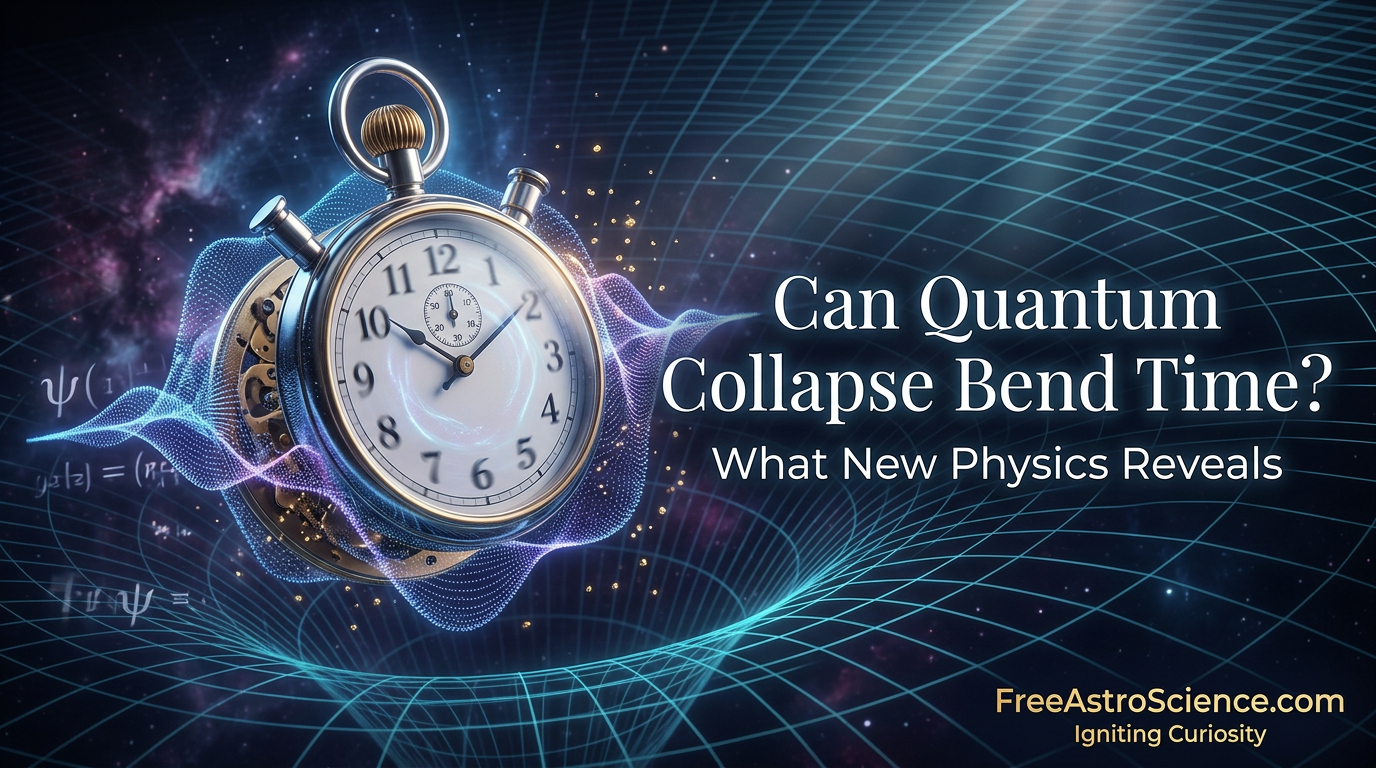
What if time itself carried a tiny quantum wobble we’d never notice?
Welcome, dear reader. We’re glad you stopped by FreeAstroScience.com today. A team of physicists has just published something that sounds like science fiction but is rigorous math: our clocks might measure a time that’s slightly uncertain at its deepest level, and the reason could be gravity whispering inside quantum mechanics. The good news? Your wristwatch is fine. The fascinating part? The numbers reveal a hidden bond between three of physics’ biggest ideas—wavefunction collapse, the Newtonian potential, and the flow of time. Stay with us to the end. We promise that by the last paragraph, you’ll look at a ticking clock and see a small universe inside it.
Why does a quantum world look classical to us?
Here’s the puzzle we’ve all heard about. In the quantum world, a particle can sit in many states at once. Physicists call this superposition, and they describe it with a mathematical object called the wavefunction . Yet in daily life, a chair is in one spot. A coffee cup either falls or stays on the table. Nothing dances between possibilities.
So where does the fuzziness go? Standard quantum mechanics answers with a recipe: when a measurement happens, the wavefunction “collapses” into a single outcome . The problem is that this rule feels patched-on. It needs a measurement device, or sometimes even a conscious observer, to trigger reality. For nearly a century, physicists have argued about whether that’s a real physical process or just a useful fiction.
What are spontaneous collapse models, really?
In the 1980s, a different idea took shape. What if wavefunctions collapse on their own, all the time, everywhere, with no observer needed? These are the spontaneous collapse models, sometimes called dynamical or objective models. They don’t need someone watching. Collapse just happens, continuously, as a built-in feature of nature.
Two proposals lead the pack:
- The Diósi–Penrose (DP) model — links collapse directly to gravity. The mass density of quantum matter gets continuously “measured” by the Newtonian field itself .
- The Continuous Spontaneous Localization (CSL) model — grew from the Ghirardi-Rimini-Weber framework. Each particle experiences random spontaneous localizations, scattered in space and time .
One big advantage sets these apart from classical interpretations. They predict specific, testable effects you can actually chase in a laboratory .
How does gravity sneak into the picture?
Here’s where the new paper gets interesting. Nicola Bortolotti and colleagues from CREF Rome, INFN-LNF, the Wigner Research Center, and Eötvös Loránd University in Budapest looked harder at both models . Their claim is striking: not only DP, but CSL too can be tied to spacetime uncertainty .
Why does this matter? The DP model already assumes a fluctuating Newtonian field. CSL, on the other hand, was born from a different motivation and had never been connected to gravity in a quantitative way . The team showed that CSL’s stochastic noise field can be read as a stochastic component of the Newtonian potential. For the first time, a quantitative bridge—sorry, a quantitative link—between CSL and gravitational fluctuations is on the table .
As Bortolotti puts it: “What we did was take seriously the idea that collapse models can be connected to gravity. Then we asked a very concrete question: what does this imply for time itself?” .
Can a fluctuating gravitational field blur time?
Yes. And that’s the heart of the result. Einstein’s general relativity tells us time flows differently where the gravitational potential changes. If the Newtonian potential jitters randomly, then the rate at which clocks tick must also jitter .
The paper writes the relation compactly. A clock at position x picks up a time fluctuation:
δt(x, t) = (1/c²) ∫₀ᵗ φ(x, τ) dτ
Equation (6): time shift from a stochastic Newtonian potential φ
On average, δt is zero. But its variance grows linearly with time. In plain language: the longer a clock runs, the more the tiny quantum-gravity jitter accumulates .
What does the math say about clock size?
The team ran the calculation for two shapes of clock volume and found a curious dependence on size. A clock smaller than the characteristic “smearing length” σ (the scale on which collapse acts) feels the maximum fluctuation. A much bigger clock averages the noise out and ticks more steadily .
Trade-off alert: tiny clocks give sharp spatial resolution but noisy time. Big clocks give smooth time but blur spatial information . Nature drives a hard bargain.
How small is the predicted time uncertainty?
Let’s put numbers on the table. Using the reference parameters for each model—collapse rate λ = 10⁻¹⁶ s⁻¹ and σ = 10⁻⁷ m for CSL, σ = 10⁻⁹ m for DP—the authors calculated the maximum time wobble an ideal clock would feel after one year of running .
| Model / Device | Key parameter | Time wobble (over 1 year) |
|---|---|---|
| CSL model | λ = 10⁻¹⁶ s⁻¹, σ = 10⁻⁷ m | ≈ 10⁻²⁸ s |
| DP model | σ = 10⁻⁹ m | ≈ 10⁻³¹ s |
| CSL (full experimental range) | 10⁻²⁰ s⁻¹ < λ < 10⁻¹¹ s⁻¹ | 10⁻³¹ – 10⁻²⁶ s |
| Optical lattice clocks (Sr/Yb) | stability ≈ 10⁻¹⁷ / √(t/1s) | ≈ 10⁻¹¹ s over 1 year |
Read the table carefully. The quantum-gravity jitter sits somewhere between 10⁻²⁶ and 10⁻³¹ seconds per year. Today’s best optical clocks drift by about 10⁻¹¹ seconds over the same interval . That’s a gap of roughly fifteen orders of magnitude.
Should atomic clocks worry?
Not a bit. Catalina Curceanu, FQxI member and researcher at INFN-LNF, said it clearly: “The uncertainty is many orders of magnitude below any currently measurable value, so it has no practical consequences for everyday timekeeping” .
Kristian Piscicchia of CREF and INFN-LNF agreed: “Our results explicitly show that modern time-measurement technologies are not affected at all” . Strontium and ytterbium lattice clocks, which already resolve the gravitational redshift across a millimeter-scale atomic sample, can keep doing their job without breaking a sweat .
What about pulsar clocks? Millisecond pulsars reach frequency stabilities close to atomic clocks over decades . The paper notes they’d be essentially blind to collapse-induced noise, since their huge volumes (a neutron star is not exactly compact compared to σ ≈ 10⁻⁹ m) average everything out. That makes them perfect comparison tools—a pulsar-atomic-clock pair could, in principle, detect the tiny residual jitter in the atomic side .
What does this mean for a future theory of everything?
Physics still has an open wound: quantum mechanics and general relativity treat time in opposite ways. In the quantum world, time is an external classical parameter, untouched by what the system does . In Einstein’s theory, time bends and stretches in response to mass and energy .
Collapse models have always sat in an odd spot. They’re non-relativistic, yet they hint at a deeper story . This new paper sharpens that hint. By showing that CSL too can be recast as a gravitational noise theory, the authors suggest that the stochastic field inside collapse models might be a real, physical, fluctuating Newtonian potential .
Curceanu highlighted the broader meaning: “Our work shows that even radical ideas about quantum mechanics can be tested with precise physical measurements—and reassuringly, time-keeping remains one of the most stable pillars of modern physics” .
Why we think this matters
At FreeAstroScience, we love results that do two things at once:
- They reassure us that what already works (atomic clocks, GPS, fundamental constants) keeps working.
- They open a door to new experiments. Future tests could probe collapse parameters from an angle nobody has tried before—looking at time, not at position or emitted radiation.
That’s the kind of scientific humility we respect. The paper doesn’t claim to solve quantum gravity. It says: if collapse is real and gravity drives it, then here’s the exact size of the time wobble. Go measure it.
Final thoughts
We started with a question: can quantum collapse bend time? The answer, after careful math, reads like a haiku. Yes, a little. No, you won’t notice. And yet—maybe, one day, with the right experiment, we will.
This article was written for you by FreeAstroScience.com, where we translate complex scientific ideas into plain language you can actually enjoy. Our goal is simple: we want you to never switch off your mind. Keep it active. Keep it curious. Because as Goya warned us, the sleep of reason breeds monsters.
Come back soon. There’s more of the universe to talk about, and we’d love to share it with you.