What if the singer whose voice made you cry last night never had lungs, never had a heart, never had a single broken night in a Memphis motel room? Welcome, dear reader. We’re glad you’re here. We’re Gerd Dani and the team at FreeAstroScience.com, and today we want to sit down with you and talk about something that’s shaking the music business, Hollywood, and honestly, our idea of what it means to be human. Stay with us until the end, because the story we’re about to tell isn’t really about robots or algorithms. It’s about us.
📑 Table of Contents
- How Did We Get Here From Vinyl to Streaming?
- Who Is Eddie Dalton, the Bluesman Who Never Paid Rent?
- What Do 6,900 Sales and 11 Hit Songs Tell Us?
- Why Is Val Kilmer Still Acting in 2026?
- What Do a Fake Singer and a Dead Actor Have in Common?
- Are Humans Becoming Optional in Art?
- Final Thoughts
How Did We Get Here From Vinyl to Streaming?
There’s an unwritten rule in show business. Every time the industry finds a new format, it squeezes it dry, tosses it, and grabs the next one .
Vinyl held on for thirty years before the cassette stole the crowd. The cassette gave way to the CD. The CD lived just long enough to make us feel guilty about every illegal burn, then MP3 showed up and wiped away the guilt along with the format.
Then streaming arrived. Streaming didn’t sell us music. It sold us access to music. That’s a small word with a massive meaning. Owning a dog isn’t the same as renting one by the hour .
At every step, someone announced the death of music. And at every step, music survived. Uglier to some ears. More democratic to others. But alive.
Now? We’re about to see how optimistic that prediction really was.
Who Is Eddie Dalton, the Bluesman Who Never Paid Rent?
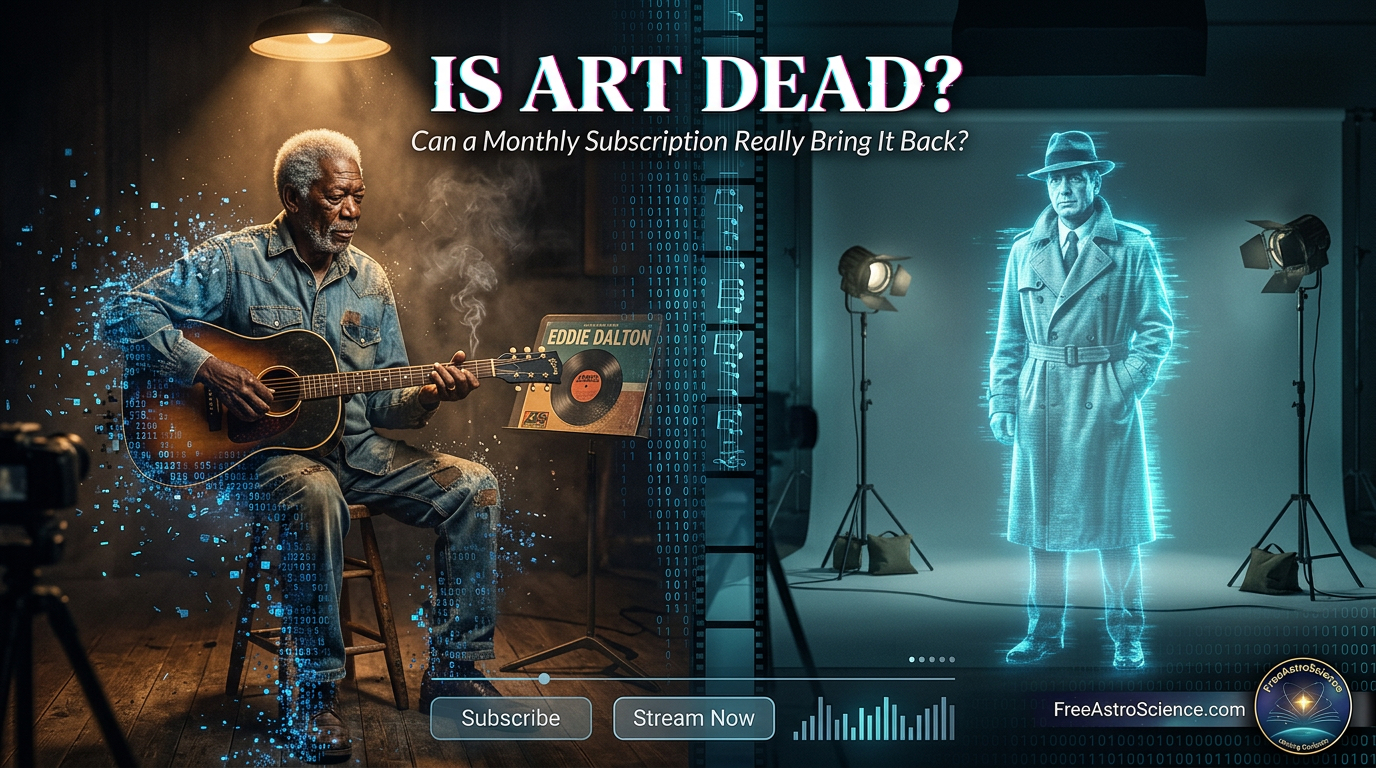
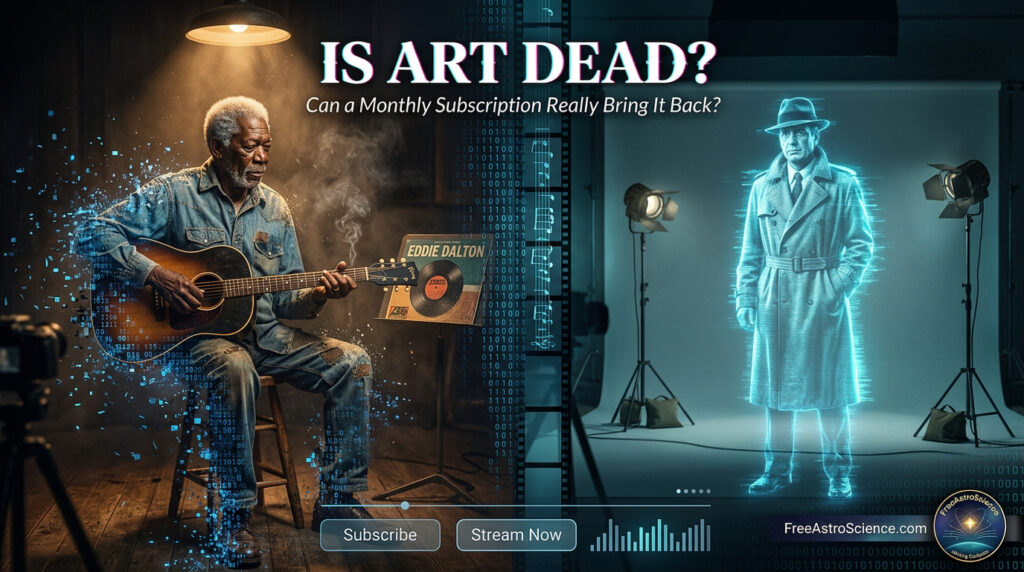
Let us introduce you to Eddie Dalton. White hair. A voice that sounds like it leaked out of a Mississippi jukebox in 1962. Album covers that look like vintage Atlantic Records prints .
His debut album, The Years Between, climbed to number 3 on iTunes. Eleven of his songs sat in the Top 100 at the same time. His single Another Day Old crossed 1.5 million YouTube views .
Here’s the twist: Eddie Dalton doesn’t exist .
No three o’clock soundcheck in a half-empty bar. No record deal with insulting royalties. No beer bottle dodged at a gig. No night spent on the back seat of a broken-down Oldsmobile Delta 88 with dead air conditioning. No fight with a producer about the bass mix. No 4 a.m. showdown with a half-empty bottle of bourbon in a Memphis hotel room .
None of the things that make the blues, the blues. And yet, there he is. On the charts.
Eddie is an AI-generated character. He was built by an American content creator, Dallas Little, who runs a small label called Crunchy Records .
What Do 6,900 Sales and 11 Hit Songs Tell Us?
Little defended himself from accusations of deception by saying the project is “clearly labeled as AI-generated” . Technically true. Technically, the nutrition label on the back of a chip bag is also readable. But let’s look at the math.
| 📊 Metric | Value |
|---|---|
| iTunes peak position | #3 |
| Songs in Top 100 simultaneously | 11 |
| YouTube views (Another Day Old) | 1,500,000+ |
| Real sales (Luminate data) | 6,900 |
| Human beings involved in recording | Zero |
Six thousand nine hundred people. Less than the home crowd at a Torino match during a bad season . Yet the iTunes algorithm amplified those numbers until millions of people saw them.
This confirms what anyone working in digital marketing has known for years. On streaming platforms, it doesn’t matter how many people actually listen to you. It matters how you play the recommendation system .
Why Is Val Kilmer Still Acting in 2026?
While Eddie Dalton was climbing the charts without the inconvenience of a guitar, Hollywood was perfecting a different dream. The dream of every producer: an actor who doesn’t complain about the catering, because he’s dead .
Val Kilmer passed away in April 2025 . But his voice had already become software back in 2016. In Top Gun: Maverick we heard him speak through an algorithm, and nobody suspected a thing. Proof that in Hollywood, the soul is an optional accessory .
Now comes As Deep as the Grave. Kilmer is the lead. He acts. He fills the screen. He never set foot on set .
His heirs swear he “would have approved.” Maybe that’s true. Maybe not. What stays on the table is this: for a film studio, the role of the deceased is perfect. No three-hour makeup sessions. Zero tantrums about Evian temperature. And a punctuality from beyond the grave that slashes insurance costs .
Iceman came back like a Windows update.
What Do a Fake Singer and a Dead Actor Have in Common?
Dalton and Kilmer are roommates in the same paradox .
The first is a commercial ghost born in a laboratory. The second is an emotional ghost dug up for the box office. Different origins, same result. Together they show us something uncomfortable: the human being has become optional .
Talent? Optimizable. Emotions? Reduced to plugins. Bodies? They stop being necessary even for dying .
💭 If only clicks matter to the algorithm, for us, sitting in a dark room with headphones on, the answer stays slightly more complicated. It’s the difference between a kiss and its technical description .
Are Humans Becoming Optional in Art?
Here’s where we, at FreeAstroScience, want to pause and think with you.
The problem isn’t artificial intelligence. The problem is us. We built the systems that reward amplification over authenticity. We trained the algorithms. We clicked. We streamed. We let a recommendation engine decide what deserved our attention.
Think about this. A bluesman needs to have lived the blues. That’s not a romantic idea. That’s the definition. The cracked voice of a man who’s lost something real carries information that no training dataset can reproduce. Or can it?
When 6,900 purchases become 1.5 million views through algorithmic amplification, the feedback loop stops measuring music. It starts measuring compatibility with the system. That’s a different product entirely.
And when Val Kilmer “performs” in a film he never shot, we’re not preserving his art. We’re renting his face. His family may have approved. The law may allow it. But something shifts when presence itself becomes a licensable asset.
We’re not saying AI is evil. We’re saying the sleep of reason breeds monsters, and monsters right now are wearing familiar faces.
Final Thoughts
This article was written specifically for you by FreeAstroScience.com, where we translate complex scientific and cultural questions into language you can actually use. Our mission is simple: we want you to never switch off your mind. Keep it active. Always. Because, as Goya warned, the sleep of reason breeds monsters, and the 21st century is mass-producing them on subscription plans.
Eddie Dalton and Val Kilmer aren’t the problem. They’re symptoms. The real question isn’t whether AI can make music or act in movies. It can. The question is: what are we willing to lose in exchange for convenience?
Music survived vinyl, cassette, CD, MP3, and streaming. But those were changes in format. What we’re watching now is a change in the source. The question isn’t how we’ll listen. It’s whether there’ll still be someone on the other end who has lived something worth singing about.
Come back to FreeAstroScience.com soon. We’ll keep asking the questions that matter, with you, beside you. Because thinking is still free. And we plan to keep it that way.
📚 References
- Signor, F. (2026, April 26). L’arte è morta. Ma con l’abbonamento mensile puoi resuscitarla. MagIA – Magazine Intelligenza Artificiale, Università di Torino. Available at: magia.news
- Luminate Data Report (2026). Sales tracking for AI-generated artists on iTunes charts.
- AI Aware & AI Debating Projects – Public Engagement Grant, Università di Torino in partnership with Società Italiana per l’Etica dell’Intelligenza Artificiale (SIpEIA).