The Iran War’s Economic Ripple: What It Means for Your Family, Your Job, and Your Wallet
Have you noticed your grocery bill climbing faster than your paycheck over the last two months? You’re not imagining it. Welcome, friends. We’re Gerd Dani and the team at FreeAstroScience.com, and we wrote this piece for you — the parent juggling energy bills, the small business owner watching margins shrink, the student wondering why pasta suddenly costs more. Stay with us until the final line. We’ll walk you through the numbers, the science behind the shock, and what the coming months may bring. Because at FreeAstroScience, we believe the sleep of reason breeds monsters — and understanding what’s happening is the first step toward keeping yours wide awake.
📚 What You’ll Find Inside
- Why did a war 4,000 km away hit our kitchens?
- How much have oil and gas prices jumped?
- Is Europe already slipping into recession?
- What does this mean for families at the supermarket?
- Which businesses are getting squeezed the hardest?
- How is the rest of the world coping?
- What happens next? Three possible roads
- Final thoughts from FreeAstroScience
Why Did a War 4,000 km Away Hit Our Kitchens?
Let’s rewind to late February. On 28 February 2026, joint US–Israeli airstrikes — codenamed “Operation Epic Fury” — hit Iranian leadership and military sites, including a strike that killed Supreme Leader Ali Khamenei . Iran struck back with missiles and drones aimed at US bases, Israeli cities, and Gulf infrastructure.
Then came the move that shook the planet: on 4 March 2026, Iran closed the Strait of Hormuz — the 33-km-wide bottleneck through which roughly 20% of the world’s seaborne oil and LNG normally travel . The International Energy Agency called it the “largest supply disruption in the history of the global oil market”.
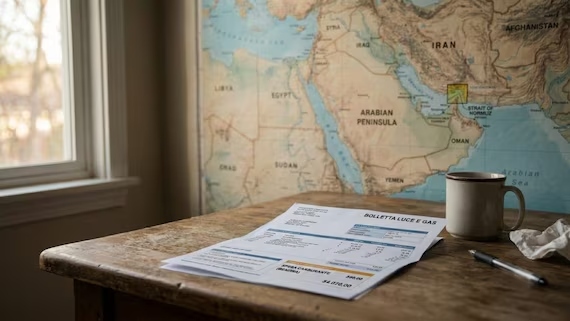
Think of the Strait as the world’s energy windpipe. Pinch it shut, and every engine, factory boiler, and delivery truck on Earth feels the squeeze.
The domino effect in plain language
- Tankers got stuck. QatarEnergy declared force majeure on all exports .
- By 10 March, Gulf oil output had dropped by 6.7 million barrels per day — and by 12 March, at least 10 million .
- On 18 March, Iran struck Qatar’s Ras Laffan LNG complex. Result: a 17% cut in Qatar’s gas capacity, with repairs expected to take 3–5 years .
- LNG spot prices in Asia jumped over 140% .
How Much Have Oil and Gas Prices Jumped?
Let’s look at the raw numbers. On 27 February, Brent crude traded at about $72 per barrel. By 16 March, it was at $106 — a 40%+ leap in roughly two weeks . LNG prices rose about 60% in the same window .
| Commodity | Pre-War (late Feb 2026) | War Peak (March–April 2026) | Change |
|---|---|---|---|
| Brent Crude Oil | $72 / barrel | $106–$120+ / barrel | +40% to +67% |
| Dutch TTF Gas | ~€34 / MWh | €60+ / MWh | ~+76% |
| Asian LNG Spot | Baseline | +140% | More than double |
| US Gasoline (retail) | ~$3.10 / gallon | $4.00 / gallon (31 March) | +30% |
Goldman Sachs now sees Brent averaging $83/barrel in 2026, up from a pre-war forecast of $64 — and TTF gas at €44/MWh versus €34 before . That’s a 20–30% annual rise baked in for the whole year, even if the war ends soon.
Is Europe Already Slipping Into Recession?
Short answer: we’re on the edge. Longer answer: the April data look grim.
The flash Eurozone Composite PMI fell to 48.6 in April from 50.7 in March — the weakest reading in about a year and a half . Anything below 50 means contraction. The services PMI crashed to 47.4, its lowest since the 2021 pandemic lockdowns .
Chris Williamson, chief business economist at S&P Global, put it bluntly: “The eurozone is facing deepening economic woes from the war in the Middle East. The conflict has pushed the economy into decline in April, while driving inflation sharply higher” .
The IMF’s April slashdown
- Euro area growth forecast: 1.1% in 2026 (cut by 0.2 points)
- Germany: 2026 and 2027 forecasts cut by 0.3 percentage points each
- Italy: stuck at just 0.5% annual growth — the weakest in the eurozone
- UK inflation expected to breach 5% in 2026
- UK households projected to be £480 a year poorer
The European Central Bank faces what analysts call a stagflation dilemma. On 19 March, the ECB postponed its planned rate cuts . Prediction markets now price a 72% chance of an ECB rate hike in 2026 — up from low double digits before Hormuz shut .
Is this a repeat of 2022?
Not quite, says Goldman Sachs economist Niklas Garnadt. Three differences stand out :
- Smaller price shock. In 2022, Brent averaged $99 (+40%) and TTF hit €133 (+180%). Today’s numbers are roughly half that.
- Oil-driven, not gas-driven. The pain spreads across autos, machinery, and electrical goods rather than concentrating in chemicals and metals.
- Asia isn’t insulated this time. Chinese petrochemical prices are rising too — so Europe loses less of its competitive edge than it did three years ago.
Goldman estimates the shock will lower euro area industrial production by almost 2% by end-2027 — about half the 4% drag from 2022/23 .
What Does This Mean for Families at the Supermarket?
Here’s where the headlines meet your kitchen table.
In Gulf states, retailers are already airlifting staples, and consumer prices have spiked 40–120% on basic groceries . Europe hasn’t seen anything that dramatic — yet — but the warning signs are clear.
Why food? Because oil and gas power fertilizer, tractors, freight ships, and refrigeration. The British Food Policy Institute has warned of long-term food price rises because of disruption in fuel and fertilizer markets . The World Food Programme warned that 45 million more people, mostly in Asia and Africa, could fall into acute food insecurity .
Rising food prices hit the poorest hardest — they spend a bigger share of their income on food . That’s not an abstraction. That’s a parent choosing between heating and a proper dinner.
💡 Quick check for your household:
- Petrol and diesel: expect €0.15–€0.40/litre extra in most of Europe (mirroring the 30%+ gasoline rises seen in the US and Canada)
- Winter heating 2026–27: budget 20–30% more if TTF gas stays near €60/MWh
- Grocery basket: watch bread, pasta, dairy, and meat as fertilizer costs filter through
- UK families specifically: around £480/year lost purchasing power
Which Businesses Are Getting Squeezed the Hardest?
April’s PMI data tell a split story. Manufacturing output rose — paradoxically — because companies are panic-stockpiling ahead of expected shortages . That’s defensive, not healthy.
Chemical and steel makers in the UK and EU have slapped on surcharges of up to 30% to cover surging electricity and feedstock costs . Some sectors face real risk of permanent deindustrialization .
| Sector | Main Pain Point | Visible Impact |
|---|---|---|
| Chemicals / Steel | Electricity + feedstock | Up to 30% surcharges |
| Aviation (Gulf & global) | Airspace closures | Near-total halt for Emirates, Qatar Airways |
| Shipping | Rerouting via Cape of Good Hope | Higher freight, longer delivery times |
| Autos / Machinery | Oil-linked input costs | Margin compression across exporters |
| Services (eurozone) | Consumer caution | PMI at 47.4, weakest since 2021 |
Global stocks fell 5.5% since the war began, with Asian markets hit worst: Japan’s Nikkei 225 down 11%, India’s Nifty50 down 7%, and Europe’s STOXX 600 down 6% .
How Is the Rest of the World Coping?
The short version: unevenly, and often badly.
- Cambodia: petrol up nearly 68%
- Vietnam: +50%
- Nigeria: +35%
- Canada: +28%
- Pakistan, Thailand, Philippines: four-day government work weeks to conserve fuel
- Myanmar: alternate-day driving rules
- Sri Lanka: QR-code rationing at the pump
The UN Development Programme estimated the war could shrink Arab economies by $120–194 billion in GDP after just one month of fighting . Goldman Sachs forecasts Kuwait and Qatar’s 2026 GDP falling 14%, with Saudi Arabia down 3% and the UAE down 5% .
China sits in a better spot thanks to years of energy diversification — big investments in renewables, nuclear, coal, and a huge strategic reserve . But as an export nation, China still suffers when global demand softens .
The World Trade Organization estimates that if oil and gas prices stay high through 2026, global GDP growth could fall by 0.3%, with Europe losing at least 1% .
What Happens Next? Three Possible Roads
Capital Economics mapped out the scenarios :
🟢 Short war
Iranian attacks stop soon, Hormuz reopens. Brent falls to ~$65/barrel by year-end . Recovery takes about 6 months.
🟡 Contained war (3 months)
Brent averages $150/barrel over the next six months. Europe and Asia swing between stagflation and mild recession .
🔴 Prolonged war
Brent hits ~$130/barrel in Q2, Germany and Italy slip into technical recession by end-2026 , and IMF warns of a possible global recession.
Vitol CEO Russell Hardy warned on 21 April that one billion barrels of oil production will be lost because of the war . That’s not a number we recover from quickly.
Brussels does have one unused lever: roughly €80 billion of the European Recovery Fund that probably won’t be disbursed before the year-end deadline . Goldman Sachs economist Filippo Taddei argues it could be redirected toward grid modernization, following the 2022 REPowerEU precedent .
Final Thoughts From FreeAstroScience
So what have we learned together? A war that began 4,000 km from Paris, Rome, or Madrid has already trimmed European GDP forecasts, pushed PMI readings into contraction for the first time since late 2024, and added hundreds of euros to the annual bills of ordinary families . It has shaken the Gulf’s image as a safe haven, threatened food security for 45 million more people, and put the ECB in an impossible bind between fighting inflation and preventing recession .
The physics of this shock is simple: energy is the blood of every modern economy. Squeeze the arteries — the Strait of Hormuz, the Ras Laffan LNG plant — and the whole body struggles. The human cost, though, is anything but simple. It lands on pensioners choosing between heating and food, on factory workers watching plants close, on farmers crushed between fuel costs and fertilizer bills.
This piece was written for you by the team at FreeAstroScience.com, where we take complicated science and economics and translate them into language everyone can grasp. We believe that keeping your mind active — always, every day — is the single best defense against the chaos of our times. Because, as Goya reminded us: the sleep of reason breeds monsters.
Don’t let this article be the last one you read on the subject. Come back to FreeAstroScience.com often. Bring your questions, your doubts, your curiosity. We’ll keep digging, keep translating, keep watching the skies and the markets with you. Stay curious. Stay awake. And take care of each other out there.
— Gerd Dani & the FreeAstroScience team