Don’t Judge a Book by the Voice on Its Cover
The Sentence That Stopped Me Cold
A stranger laughed at my voice today.
The screen glowed pale blue against the salt air drifting in from the Adriatic, and for a moment I just sat there, reading and re-reading five small words: “bro. how can we take it seriously.” That sweat-smile emoji at the end carried more weight than the words themselves. The casual cruelty of someone who’d never met me, never read a line of my work.
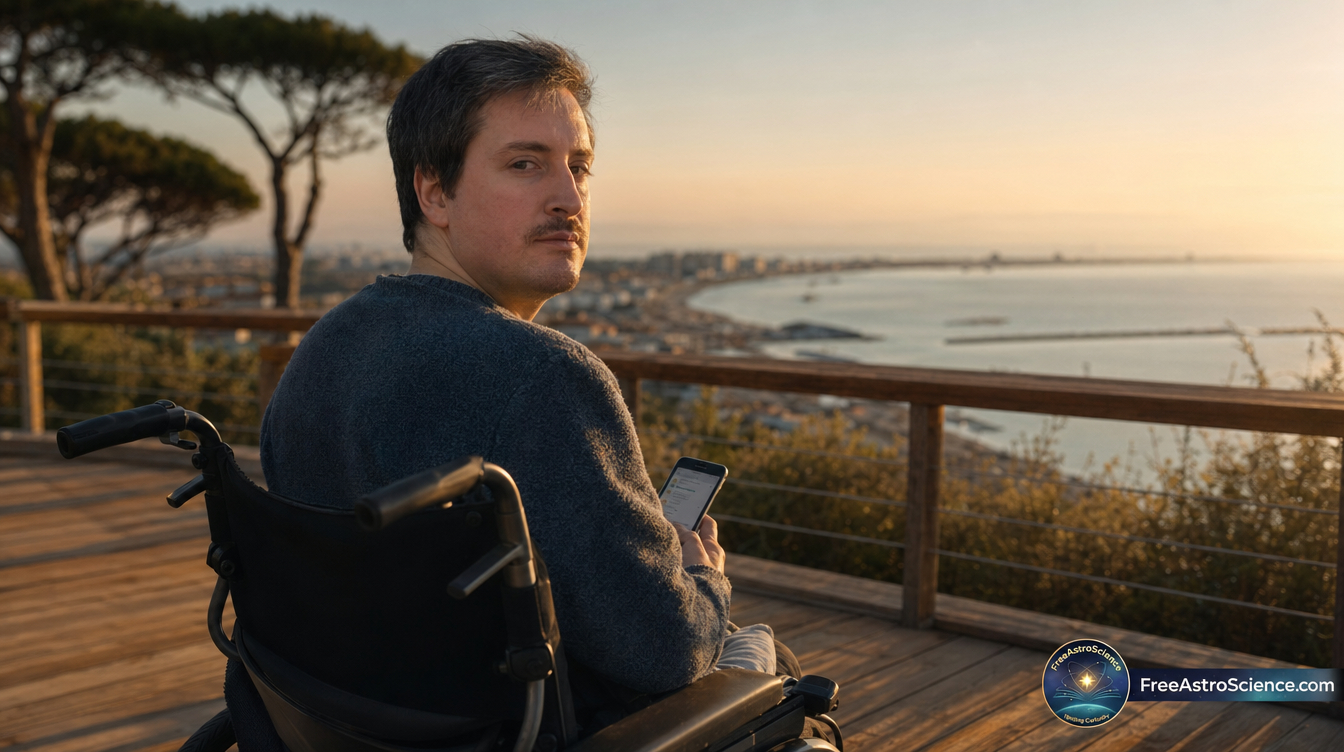
I’m writing this from Rimini, where the September sun still has bite and the beach umbrellas haven’t all come down yet. I appeared in a short on MattyAtoms, a YouTube channel run by a friend who lets me talk about the things I love — aliens, astrophysics, the weird quiet questions of the cosmos. My voice doesn’t work the way most voices do.
Dystonia, a movement disorder I’ve lived with since childhood, twists my words on their way out.
So when @Anchovienips dropped that comment, I felt something familiar. Not anger. More like fatigue.
The Thread That Surprised Me
Here’s the part I didn’t expect.
Before MattyAtoms had even hit reply, other strangers stepped in. @bookworm0208 wrote, “Are you making fun of him? Thats kind of mean” — two short lines that smelled of plain, unfussy decency. Then @serendipity4881 came in hotter, with a wink emoji and a question about whether @Anchovienips was “intellectually inept, or just over all inept.”
I laughed. I’m allowed to laugh at the people defending me — it’s one of the small joys of being on the receiving end of unsolicited kindness.
What happened next is the reason I’m writing this piece at all.
@Anchovienips came back, but not to double down. They wrote: “not at all. it did come as a shock when i heard him speak but i agree and understand his pov of the conversation.” Four minutes later, something rarer still arrived.
“i never considered how broad this topic of conversation was, i didnt even consider the possibility that it was possible for someone with a speech impediment to ever think and talk about supernatural stuff. like aliens and whatnot. makes me feel more appreciative of people.”
Read that again. Slowly.
What a Speech Impediment Actually Is (In Plain English)
A quick detour — and I’ll simplify the science deliberately so we can stay on the same page.
Dystonia is a neurological condition. The brain sends muscles the wrong instructions, so movements get pulled into involuntary positions — including the small, fast muscles of the tongue, lips and larynx that shape speech. It has nothing whatsoever to do with thinking.
The thoughts arrive whole, fully formed, often racing ahead of what my mouth can produce. My degree in astronomy from Bologna, my master’s in physics from Milan, the articles I write almost daily for FreeAstroScience — none of that happened despite the dystonia. It happened alongside it.
A brain that struggles to drive a tongue will still solve a differential equation.
The confusion between how someone speaks and what someone knows is one of the oldest, most boring mistakes our species makes.
The Moment a Mind Changes
I’ve thought about that comment thread for two days now.
What moved me wasn’t the apology. Apologies are cheap — I’ve collected enough to fill a small museum. What moved me was the line “i didnt even consider the possibility.”
That’s honest in a way most people aren’t willing to be. @Anchovienips named the thing most of us hide: a quiet, unexamined assumption that intelligence sounds a certain way, walks a certain way, fits a certain shape.
It doesn’t.
That kid who couldn’t read out loud in school? She writes poetry at home. The man at the supermarket who takes ages to count change once worked as an engineer. The young scientist whose voice fights him every time he opens his mouth runs a science platform with tens of thousands of readers from a desk in Emilia-Romagna.
Why MattyAtoms Got It Right
When the channel owner replied to the thread, he didn’t get defensive on my behalf. (Bless him for that — the temptation is always real.) He just explained: “Gerd has a neurological condition that makes it hard for him to speak, and makes it so that he is bound in a wheelchair. However, please don’t confuse this with his intelligence.”
That’s the whole sermon, right there.
Disability advocacy isn’t about asking people to feel sorry for us. It’s about asking them to update a faulty assumption — to do the small, decent work of separating the body from the mind, the voice from the thought, the wheelchair from the human being sitting in it.
Most people, when invited to do that work, will do it. @Anchovienips did it in under an hour, on a phone, in front of strangers. That’s not a small thing.
What I’d Like You to Take From This
Never give up on people too quickly.
The first comment was ugly. The last comment was honest. Between them sat a few other humans willing to push back on cruelty without performing outrage.
That’s how change actually moves — not through grand gestures, but through small corrections, made publicly, by ordinary people who feel the moment and don’t look away.
If you’ve ever caught yourself making the assumption @Anchovienips made — that a struggling voice signals a struggling mind — I’m not angry with you. I’d ask you to do what they did. Sit with the surprise, notice the gap in your imagination, and let it close.
A Note Before I Close
The wind shifted while I was writing this, and the smell of pine resin from the umbrella pines along the lungomare started seeping through the open window. I’m tired in the good way — the way you feel after saying something you needed to say.
Science gave me a vocabulary for the universe. It also gave me a vocabulary for myself: a body that doesn’t quite obey, a voice that fights its way out, a brain that keeps asking questions anyway.
Dystonia is part of how I move through the world. It isn’t who I am.
So the next time you watch a video and someone speaks differently — slower, harder, with effort that’s audible — would you do me one favour? Listen to what they’re saying, not just how they’re saying it. There’s a fair chance they’ve thought about it longer than most of us, just to get the sentence out.
And to @Anchovienips, wherever you are: thank you. You did the harder, braver thing. You changed your mind in public — most people never manage it once.
— Gerd Dani, President of FreeAstroScience, writing from Rimini