Have you ever watched a wave roll onto a beach and wondered if alien shores feel the same pull? We have. And thanks to a team at MIT, Cornell, Miami, and Woods Hole, we finally have real numbers to picture those distant coastlines.
Welcome to FreeAstroScience.com, where we write these stories just for you. We’re Gerd Dani, and this article was crafted specifically so you can understand a paper that most people will never read. Our mission here is simple: we want to keep your mind awake, because the sleep of reason breeds monsters.
Stick with us to the end. By the time you finish, you’ll picture Titan’s slow three-meter swells, Mars’ ancient crater lakes, and even ripples on a planet made of molten rock. Let’s go.
📑 What’s inside this article
- Why should alien waves matter to us?
- How did the team build PlanetWaves?
- What two rules govern every ocean in the universe?
- Did ancient Mars roar with real surf?
- Why are Titan’s methane waves giants in slow motion?
- What happens on sulfuric acid, water, and lava worlds?
- What does all this teach us about hunting alien oceans?
- Final thoughts
What MIT’s New Wave Model Tells Us About Oceans Beyond Earth
Why should alien waves matter to us?
Picture Miller’s planet from Interstellar. A kilometer-tall wall of water crashes down on the astronauts. Kip Thorne, the film’s science advisor, said those monsters came from a nearby black hole, not the wind.
But here’s the thing. Real alien waves, driven by ordinary wind, might still astonish you.
Waves shape coastlines. They move sediment. They mix chemistry inside lakes. They change how sunlight bounces off an ocean, which matters when we point telescopes at distant worlds. If we want to know what the surface of another planet actually looks like, we need to understand its waves.
Until now, we mostly borrowed Earth-based rules and hoped they worked elsewhere. They don’t. Not on Titan. Not on ancient Mars. Definitely not on a planet with lakes of liquid rock.
That’s why a team led by Una G. Schneck at MIT built something new.
How did the team build PlanetWaves?
Schneck and her colleagues published their work in the Journal of Geophysical Research: Planets in 2026. They adapted the University of Miami Wave Model, written originally in FORTRAN, into a flexible tool called PlanetWaves, coded in MATLAB.
The model tracks energy going into the water from the wind. Then it subtracts the energy lost through six different sinks:
- Wind input (Sin)
- Wave breaking with white-capping (Swb)
- Plunging breakers in shallow water (Spb)
- Turbulent dissipation (Std)
- Bottom friction (Sbf)
- Viscous dissipation (Sν)
The core equation looks scary, but it’s really just bookkeeping for wave energy:
∂E/∂t + ∇·(cg E) = ρg · Σ Si
Energy change over time equals wind input minus all dissipation terms (simplified from Equation 1 in Schneck et al., 2026).
They tested it against 20 years of real buoy data from Lake Superior. The model nailed it, with an error of just 0.23 meters, better than the classic JONSWAP and Pierson-Moskowitz formulas most of us learned in textbooks.
With Earth-calibration done, they turned the dial. What if gravity is weaker? What if the liquid is methane instead of water? What if the atmosphere is thicker than a pressure cooker? The model kept working.
What two rules govern every ocean in the universe?
From all their runs, two simple patterns jumped out. These are the wave-world commandments, and they hold whether you’re on Earth, Saturn’s moon, or a super-Earth 40 light-years away.
Rule one. Waves start more easily when the liquid has weak surface tension, the atmosphere is thick, or gravity is low.
Rule two. Waves grow taller when the liquid is less dense, the atmosphere is thick, or gravity is low.
Read those twice. They’re the key that opens every door in this paper.
Did ancient Mars roar with real surf?
Mars today is dry, cold, and wind-whipped. But billions of years ago? Liquid water filled crater lakes, carved valley networks, and built delta fans. The Perseverance rover sits inside Jezero crater right now, studying one of those ancient shorelines.
The team modeled Jezero as a 45-km-wide lake, 10 meters deep, with easterly winds blowing for 10 hours straight. Here’s what they found.
With a 50 kPa atmosphere (about half Earth’s pressure), waves start growing at just 1.7 m/s of wind. Bump the atmosphere up to 200 kPa, and that threshold drops to 1.2 m/s. Compare that to Earth’s 2.2 m/s. Mars’ weaker gravity (3.71 m/s²) makes wave generation easier.
At 10 m/s winds, the western shore of Jezero would have seen waves roughly 1.5 meters tall under the thinner atmosphere, and up to 2.4 meters under the thicker one.
This matters. As Mars’ atmosphere thinned over billions of years, its waves shrank too. Wave heights dropped by 60-65% when pressure fell from 200 to 50 kPa. Any ripples you see preserved in Martian rocks today tell a story about the air above them.
Why are Titan’s methane waves giants in slow motion?
Now for our favorite character. Titan.
Saturn’s largest moon is the only other body in our solar system with stable liquid on its surface. Those lakes aren’t water. They’re a soup of methane, ethane, and dissolved nitrogen, at -180°C. Gravity is feeble (1.352 m/s²). The atmosphere is 1.5 times thicker than Earth’s.
Plug those numbers into PlanetWaves, and waves start forming with a breeze of just 0.6 m/s. A gentle walking pace.
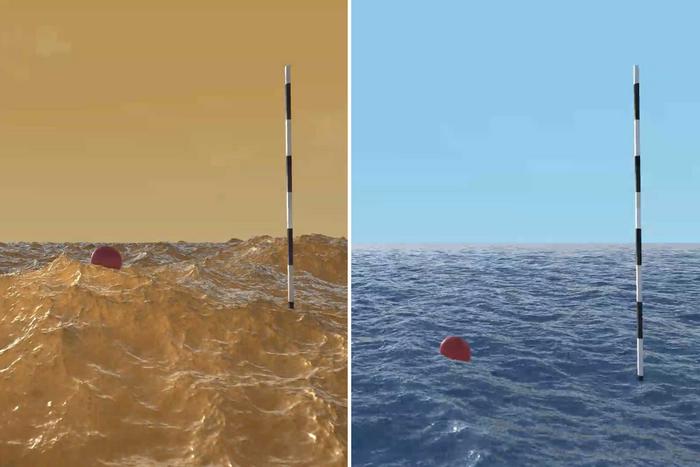
More amazing? At a wind of 4 m/s, Earth would give you ripples around 0.2 meters. Titan hands you waves 3.3 meters tall. Sixteen times bigger. And they roll forward in slow motion because gravity is so gentle there.
| World | Liquid | Gravity (m/s²) | Min Wind (m/s) | Wave Height at 5 m/s (m) |
|---|---|---|---|---|
| Earth | Water | 9.81 | 2.2 | 0.3 |
| Paleo-Mars | Water | 3.71 | 1.2–1.7 | 0.7–1.4 |
| Modern Titan | Methane + Ethane + N₂ | 1.352 | 0.6 | 5.0 |
| Past Titan | Liquid N₂ | 1.352 | 0.5 | 3.9 |
| Kepler 1649-b | Sulfuric Acid | 8.87 | 5.3 | 0.0 |
| LHS 1140-b | Water | 18.4 | 2.7 | 0.2 |
| 55 Cancri-e | Molten Rock | 22.7 | 37.1 | 0.0 |
Here’s where things get tricky. The Cassini spacecraft flew by Titan’s lakes for years and found them smooth. Radar measurements showed surface roughness under 10 millimeters. If waves should form so easily on Titan, where are they?
The team suggests two answers. First, Cassini’s resolution may have missed them. Second, Titan’s winds near Ontario Lacus usually stay weak, below the threshold. We’ll need NASA’s Dragonfly mission, launching later this decade, to settle the argument.
What happens on sulfuric acid, water, and lava worlds?
The team didn’t stop at our solar system. They ran three exoplanet scenarios, each stranger than the last.
Kepler 1649-b sits 300 light-years away and resembles Venus. The model imagined sulfuric acid lakes with a thick CO₂ atmosphere. Waves need a stiff wind of 5.3 m/s to start, thanks to that acid’s high surface tension. Once going, though, they reach Earth-like heights because gravity is similar (8.87 m/s²).
LHS 1140-b is a super-Earth that JWST recently examined. Current data hints it might be a real water world. With gravity nearly double Earth’s (18.4 m/s²), waves start at 2.7 m/s and stay shorter than ours. A calm day on LHS 1140-b would look calmer than a calm day here.
55 Cancri-e is the wildest of all. A lava world, 41 light-years away, with a surface hot enough to melt granite. We modeled an ocean of andesite magma at 1,500 K. You’d need winds of 37.1 m/s, near hurricane force, just to stir a ripple. JWST actually found a thin atmosphere of CO or CO₂ on this planet last year, so lava waves are a genuine possibility, not just a thought experiment.
Want a perspective? If winds reached 200 m/s on 55 Cancri-e under a thick 1,000-bar atmosphere, waves could rise 245 meters. That’s taller than the Eiffel Tower. Picture that.
What does all this teach us about hunting alien oceans?
Waves aren’t just pretty. They change how light bounces off a planet’s surface. When we point the next generation of space telescopes at exoplanets, the presence or absence of specular reflection, the glint of sun on water, could betray an ocean we cannot see directly.
Knowing the rules of alien waves helps us interpret those glints. A shimmering, smooth surface might mean no wind, or a viscous liquid, or high gravity pinning everything down. A churning surface suggests a thick atmosphere and weak gravity.
This paper gives astronomers a decoder ring. And for those of us who love planetary science, it reminds us that Earth’s familiar physics stretches across the galaxy, once we tweak the constants.
What should we take home from all this?
We’ve covered a lot. Let’s tie the threads.
A team led by Una Schneck built a wave model that works on any planet. Two universal rules emerged: thin liquids and thick air make taller waves, and weak gravity with high pressure lowers the threshold for waves to form. Applied to real worlds, those rules predict gentle 3-meter swells on Titan, variable waves on ancient Mars tied to atmospheric thickness, and exotic scenarios on sulfuric acid, water, and lava exoplanets.
Here’s what we love about this work. It turns science fiction into testable science. When Dragonfly lands on Titan, when future telescopes catch the glint of an alien sea, we’ll have numbers to compare against. We’ll know what we’re looking at.
And maybe that’s the deeper lesson. Nature follows the same physics everywhere. Only the ingredients change. When we understand the rules, the universe feels a little less alien and a lot more like home.
Come back to FreeAstroScience.com whenever you want to keep your mind awake. We’ll be here, writing stories that refuse to let you stop wondering. Because a mind at rest is the most dangerous place in the cosmos.
📚 Sources & further reading
- Schneck, U. G., Detelich, C. E., Curcic, M., Ashton, A. D., Hayes, A. G., & Perron, J. T. (2026). Modeling Wind-Driven Waves on Other Planets: Applications to Mars, Titan, and Exoplanets. Journal of Geophysical Research: Planets, 131, e2025JE009490. https://doi.org/10.1029/2025JE009490
- Tomaswick, A. (2026, April 23). The Mechanics of Alien Waves. Universe Today.
- PlanetWaves code repository: github.com/Cornell-MIT/PlanetWaves
- Hayes, A. G. (2016). The Lakes and Seas of Titan. Annual Review of Earth and Planetary Sciences, 44, 57-83.
- Rubin, D. M., et al. (2022). Ancient winds, waves, and atmosphere in Gale crater, Mars. JGR: Planets, 127(4).
- Hu, R., et al. (2024). A secondary atmosphere on the rocky exoplanet 55 Cancri e. Nature, 630, 609-612.