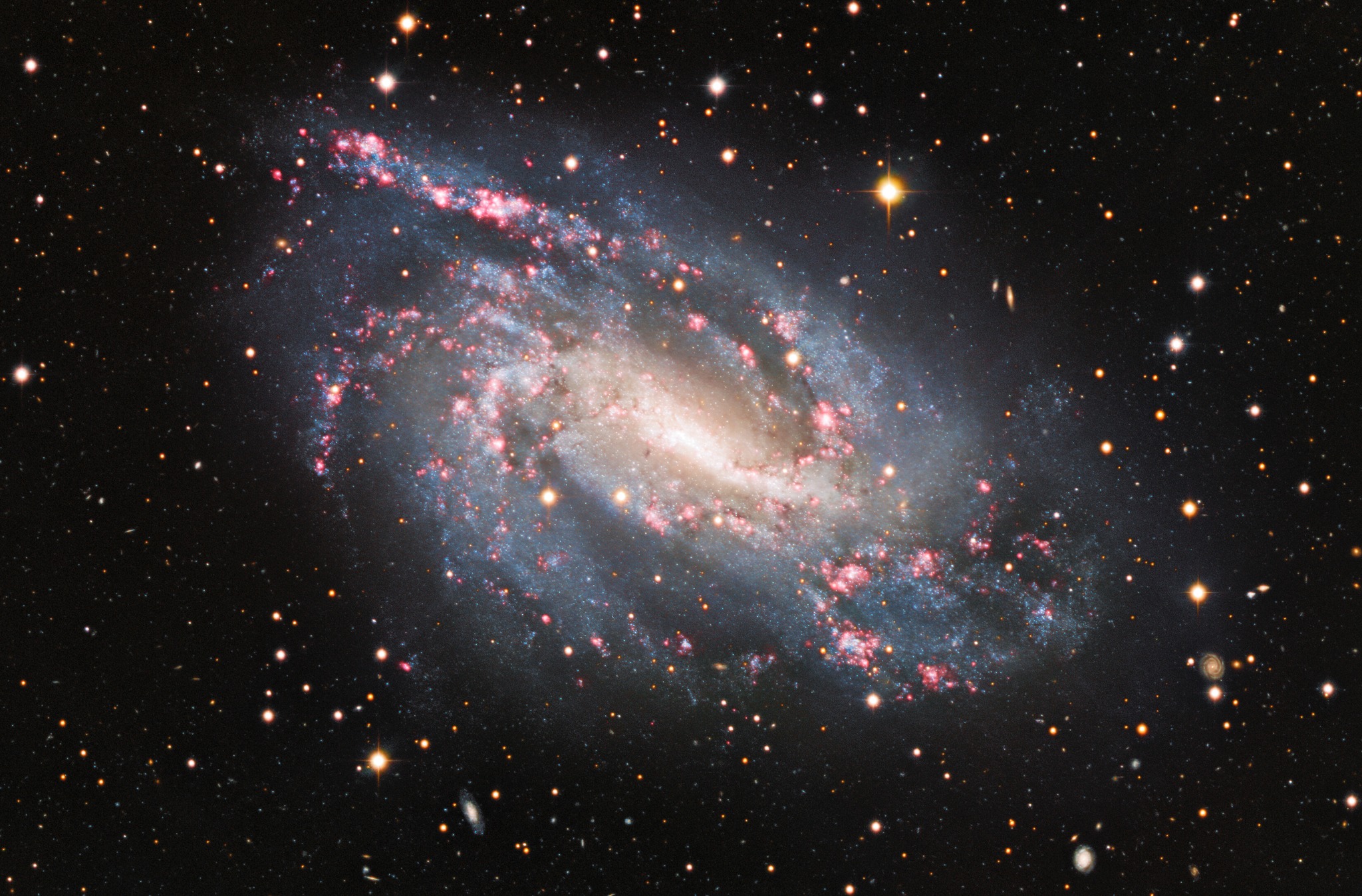
Have you ever looked at a spiral galaxy and assumed they all follow the same tidy, symmetrical rules? The Amatha Galaxy shatters that idea. With a lopsided arm, an off-center bar, and a mysterious hydrogen cloud dangling off its edge — this galaxy is anything but ordinary.
Welcome to FreeAstroScience, where we turn complex scientific principles into language anyone can enjoy. Whether you’re a seasoned stargazer or someone who just felt the pull of curiosity, you belong here. This article was written specifically for you.
Today, we’re traveling 30 million light-years to a barred spiral galaxy in the constellation Triangulum. Stay with us to the very end — there’s an unexplained hydrogen cloud, a stellar merger event, and some genuinely surprising astrophysics waiting for you.
The Amatha Galaxy — NGC 925’s Hidden World in Triangulum
What Exactly Is the Amatha Galaxy?
Sitting about 30.3 million light-years from Earth in the constellation Triangulum, the Amatha Galaxy is a barred spiral galaxy with a personality all its own. You might also see it listed under its catalog names: NGC 925, PGC 9332, or UGC 1913.
How big is it? The galaxy stretches roughly 100,000 light-years from edge to edge — comparable to our own Milky Way. Its estimated mass comes in at around 50 billion solar masses, placing it among moderately sized galaxies in the nearby universe.
Astronomers classify its morphology as SB(s)d. That code packs a lot of meaning. The “SB” tells us there’s a bar structure. The “(s)” means no surrounding ring. And the “d” signals loosely wound spiral arms. Think of NGC 925 as a galaxy that prefers a relaxed, open design over tightly coiled symmetry.
Who Discovered NGC 925?
The story starts on September 13, 1784. William Herschel — the German-born British astronomer who also discovered Uranus — was scanning the heavens from Slough, England.
He used a self-built 18.7-inch reflecting telescope. That night, he spotted something faint and fuzzy. He catalogued it as III 177, where Class III meant “very faint nebula.” His notes read:
“Very faint, considerably large, irregularly round, resolvable, 2 or 3′ in diameter.”
Nobody knew what galaxies were back then. Herschel simply saw a dim smudge among the stars. Over a century later, Danish astronomer John Louis Emil Dreyer gave it the designation NGC 925 in his New General Catalogue of Nebulae and Clusters of Stars, published in 1888.
Why Does Its Spiral Structure Look So Unusual?
Most spiral galaxies show a certain balance. Two or more arms curving outward from the center, roughly mirroring each other. The Amatha Galaxy didn’t get that memo.
A Dominant Southern Arm
Look at any image of NGC 925. You’ll spot the imbalance right away. The southern spiral arm is longer, brighter, and more sharply defined than its northern counterpart. The northern arm looks patchy and “flocculent” — a term astronomers use when the structure appears clumpy and loosely organized.
This asymmetry gives the galaxy a distinctive twisting shape. It almost looks like one arm decided to grow while the other lagged behind.
The Offset Bar — A Magellanic Fingerprint
Here’s the second surprise. The galactic bar doesn’t sit at the geometric center of the galaxy. It’s offset — shifted to one side.
Why does that matter? This combination — a dominant spiral arm paired with an off-center bar — is the signature of a Magellanic spiral galaxy. These galaxies share structural traits with the Large Magellanic Cloud, one of the Milky Way’s own satellite galaxies.
NGC 925 is tilted about 55° relative to our line of sight, along a position angle of 102°. That inclination gives us an angled perspective — not face-on, not edge-on — that reveals both the bar and the arm structure clearly.
Where Is Star Formation Happening in NGC 925?
If you want to find new stars being born, follow the bar. Star formation runs along the entire length of NGC 925’s offset bar. The spiral arms glow with activity too. Together, they host numerous H II regions — pockets of ionized hydrogen that light up as young, hot stars heat the surrounding gas .
In 2025, astronomers found something new: a low-surface-brightness clump in the southwestern portion of the galaxy. They also spotted a gas bridge linking this faint stellar overdensity to the main body of NGC 925. Whether this clump is a tiny neighboring galaxy or just a dense knot within NGC 925 itself? That question remains open.
What Is the Mysterious Hydrogen Cloud?
This is where the story gets really interesting.
Connected to the Amatha Galaxy by a thin streamer of gas, a cloud of neutral hydrogen (H I) floats nearby. Its estimated mass: about 10 million solar masses — not trivial, but small compared to the galaxy’s 50 billion.
Pisano and collaborators first reported this cloud in 1998. Since then, astronomers have debated its origin. Three hypotheses sit on the table:
- A dwarf satellite galaxy — a tiny companion in orbit around NGC 925
- Tidal debris — leftover wreckage from a long-ago gravitational encounter
- Primordial gas — raw material from the early universe that never formed stars
None has been confirmed. This cloud sits at the boundary between known and unknown — a reminder that even nearby galaxies can hold unsolved puzzles.
Which Galaxy Group Does NGC 925 Call Home?
The Amatha Galaxy belongs to the NGC 1023 Group, a collection of galaxies gravitationally bound together. The group centers on NGC 1023, the Perseus Lenticular Galaxy, and lies within our Local Supercluster.
NGC 925 ranks as the second brightest galaxy in this group. Its neighbors include NGC 959 in Triangulum, NGC 1058 and NGC 1003 in Perseus, and the striking Silver Sliver Galaxy (NGC 891) in Andromeda.
But here’s the thing: despite living in a group, the Amatha Galaxy keeps its distance. The nearest member sits at least 650,000 light-years away. NGC 925 doesn’t interact with any of its neighbors. It’s a cosmic loner within a crowd.
Did a Luminous Red Nova Erupt Here?
No supernova has ever been recorded in NGC 925. But on July 26, 2023, the ATLAS survey (Asteroid Terrestrial-impact Last Alert System) caught something unusual: a luminous red nova designated AT 2023nzt.
It appeared as a faint transient — magnitude 19 — in the galaxy’s outskirts. At peak brightness, it reached an absolute magnitude of −11.5.
What causes a luminous red nova? The leading theory points to a stellar merger. Two stars spiral toward each other under gravity’s pull and merge into a single object. The process releases a burst of red-tinted light — hence the name.
While not as dramatic as a supernova explosion, a luminous red nova gives us a front-row seat to one of the most intimate events in stellar evolution.
How Do We Measure the Distance to NGC 925?
Measuring cosmic distances is never simple. For NGC 925, astronomers tried two methods — and they produced different numbers.
Method 1: Redshift and Hubble’s Law
The galaxy has a redshift of z ≈ 0.00185 and a heliocentric radial velocity of 553 km/s. Hubble’s Law relates velocity to distance:
H0 ≈ 70 km/s/Mpc (Hubble constant)
d ≈ 553 ÷ 70 ≈ 7.9 Mpc ≈ 25.8 million light-years
Method 2: Cepheid Variable Stars
The Hubble Space Telescope observed Cepheid variables in NGC 925 as part of its Key Project on the Extragalactic Distance Scale. These pulsating stars — often called “standard candles” — gave a more precise answer:
d = 9.29 ± 0.69 Mpc = 30.3 ± 2.3 million light-years
Why the gap between methods? The redshift approach assumes galaxies move purely with the expansion of the universe. In reality, they also drift under the gravitational tug of nearby structures. For a galaxy this close, those peculiar motions introduce real uncertainty. That’s why Cepheid-calibrated distances are considered more reliable at these ranges.
How Can You Spot the Amatha Galaxy Tonight?
Want to see NGC 925 for yourself? Here’s your game plan.
Equipment: You’ll need a medium-to-large telescope. The galaxy’s low surface brightness means a 10-inch telescope shows an elongated patch of light. Larger instruments reveal the bar and arm structure.
Where to look: Find Gamma Trianguli (Apdu), a magnitude 4.01 star that anchors the base of Triangulum’s triangle shape. NGC 925 sits nearby — roughly one-third of the way from Mirfak in Perseus to Hamal in Aries.
Best observing window: June through April. On November 2, the galaxy reaches opposition and crosses the meridian at local midnight.
Declination note: At +33° 35′, this is a northern-hemisphere target. Observers south of latitude 56° S won’t see it.
NGC 925 — Key Properties at a Glance
| Popular Name | Amatha Galaxy |
|---|---|
| Catalogue Designations | NGC 925 · PGC 9332 · UGC 1913 · MCG +05‑06‑045 · CGCG 504‑085 |
| Constellation | Triangulum |
| Object Type | Barred spiral galaxy |
| Morphological Type | SB(s)d |
| Right Ascension (J2000) | 02h 27m 16.913s |
| Declination (J2000) | +33° 34′ 43.97″ |
| Distance | 30.3 ± 2.3 million light-years (9.29 ± 0.69 Mpc) |
| Estimated Diameter | ~100,000 light-years |
| Estimated Mass | ~50 billion solar masses (M☉) |
| Apparent Magnitude (V) | 10.7 |
| Apparent Size | 10′.5 × 5′.9 |
| Surface Brightness | 14.4 mag/arcmin² |
| Redshift (z) | 0.001846 ± 0.000010 |
| Heliocentric Radial Velocity | 553 ± 3 km/s |
| Inclination | 55° |
| Position Angle | 102° |
| Galaxy Group | NGC 1023 Group |
| Discoverer | William Herschel |
| Discovery Date | 13 September 1784 |
About the Featured Image
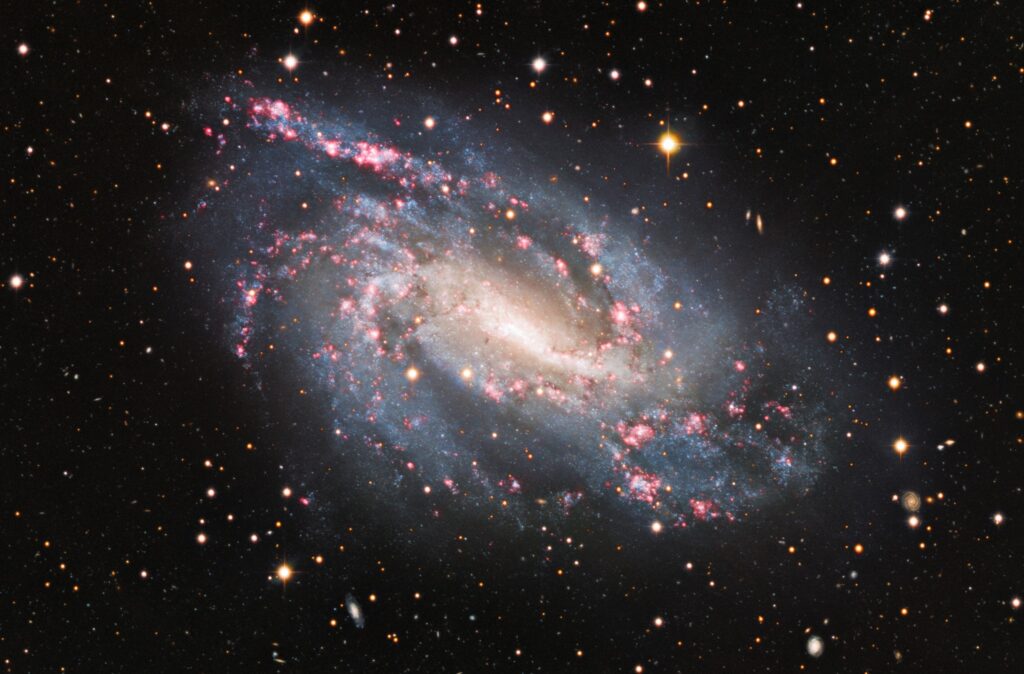
The image accompanying this article is a composite optical photograph of the Amatha Galaxy. It was captured with the 4-metre Nicholas U. Mayall telescope at Kitt Peak National Observatory in Arizona.
To build this colorful portrait, astronomers layered data from several filters:
- U-band (355 nm) — rendered in blue, capturing ultraviolet wavelengths
- B-band (438 nm) — also rendered in blue, covering blue-visible light
- R-band (651 nm) — rendered in orange, capturing red-visible wavelengths
- Hα narrow-band filter — rendered in red, isolating the emission of ionized hydrogen
That Hα layer is especially telling. It makes the H II regions pop — glowing red knots scattered along the bar and spiral arms where new stars are being born. Each red dot in the image marks a stellar nursery, a spot where gas is collapsing and igniting into fresh starlight.
A Galaxy That Doesn’t Play by the Rules
The Amatha Galaxy reminds us that the universe doesn’t always follow neat patterns. An offset bar. A lopsided arm. A hydrogen cloud of unknown origin. A stellar merger caught in the act. NGC 925 packs a lot of story into 100,000 light-years of space.
Some of the biggest questions about this galaxy remain unanswered. Is that hydrogen cloud a captured dwarf galaxy? Primordial gas? Tidal wreckage? We don’t know yet — and that honest uncertainty is part of what makes astronomy so alive.
At FreeAstroScience.com, we believe you should never switch off your mind. Keep it active. Keep it curious. As Francisco Goya warned centuries ago, “the sleep of reason breeds monsters.” The antidote? Knowledge. A willingness to look up and ask hard questions.
Come back to FreeAstroScience.com anytime. We’ll be here — turning the complex into the clear, one galaxy at a time.
Written by Gerd Dani for FreeAstroScience — Science and Cultural Group. Where complex scientific principles meet simple, human language.