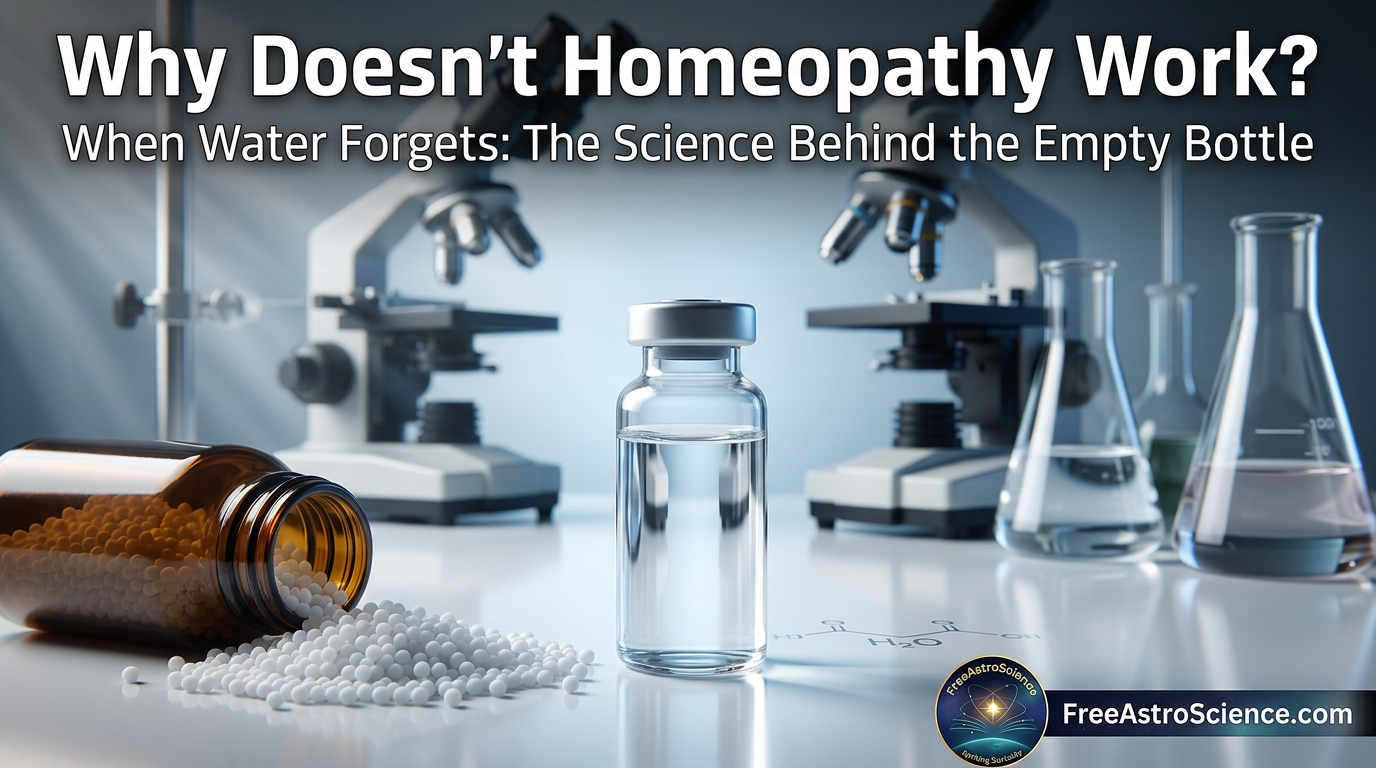
When Water Forgets: Why Homeopathy Doesn’t Work
Have you ever wondered why a medicine with no active ingredient is still sold in pharmacies around the world — and why millions of people swear by it?
Welcome to FreeAstroScience, where we explain complex scientific principles in simple terms. We’re glad you’re here. My name is Gerd Dani, and I write from my wheelchair with the same curiosity that drives all of us to ask hard questions about the world. Today, we’re tackling one of the most persistent myths in modern health: homeopathy.
Consumers spend billions of dollars per year on homeopathic products. That’s real money. Real hope. And, as science tells us again and again — real disappointment. Not because people are foolish. But because the story they’ve been told doesn’t match reality.
So let’s walk through the evidence together, calmly and honestly. No judgment. Just facts, explained in a way that respects your intelligence. Stick with us to the end — you’ll come away with a clearer picture of what’s going on inside that little bottle of sugar pills. And if you’ve ever felt confused by conflicting health claims, know this: you’re not alone.
📑 Table of Contents
- What Exactly Is Homeopathy?
- The Three Pillars — And Why They Crumble
- The Math of Extreme Dilution
- Does Water Have a Memory?
- What Do 1,800+ Studies Actually Say?
- The Placebo Effect: Why People “Feel Better”
- Is Homeopathy Dangerous?
- How Are Governments Responding?
- Final Thoughts
What Exactly Is Homeopathy?
Let’s clear up a common mistake first. Homeopathy is not an umbrella term for natural medicine, herbal remedies, or anything “alternative.” It’s a very specific system invented more than 200 years ago by a German physician named Samuel Hahnemann (1755–1843) .
Hahnemann was a caring doctor. He watched his colleagues bleed patients, purge them, and dose them with toxic mercury compounds. He thought: there has to be a gentler way. That instinct was noble. The system he built from it, though, was based on assumptions that modern science has since shown to be wrong .
Here’s what happened. While translating a medical text by Scottish physician William Cullen, Hahnemann decided to swallow some cinchona bark — the same bark used to treat malaria. He developed fever-like symptoms. From this single self-experiment, he drew a sweeping conclusion: a substance that causes symptoms in a healthy person can cure similar symptoms in a sick person .
That idea became the foundation of homeopathy. The name itself comes from the Greek words hómoios (like) and páthos (suffering) .
We now know that cinchona bark treats malaria because it contains quinine, which kills the Plasmodium falciparum parasite directly. The mechanism has nothing to do with “like curing like” .
The Three Pillars — And Why They Crumble
Homeopathy rests on three ideas. Let’s look at each one honestly.
1. “Like Cures Like” (The Principle of Similarity)
This is the belief that a substance causing certain symptoms in a healthy person will cure those same symptoms in a sick person. For example, red onion makes your eyes water, so homeopaths use it (as Allium cepa) to treat allergies .
Where’s the problem? This thinking comes from a pre-scientific tradition sometimes called “sympathetic magic” — the idea that similar-looking things are connected. Walnuts look like brains, so they must treat brain diseases. Beans look like kidneys, so they must heal kidney problems .
Modern medicine works differently. Drugs bind to specific receptors. They block enzymes. They target pathogens. There’s a measurable, testable cause-and-effect chain . The principle of similarity, by contrast, has no scientific evidence or support .
2. The Law of Infinitesimals (Less Is More)
Hahnemann noticed that smaller doses seemed to cause fewer side effects. He then took a leap: he concluded that the smaller the dose, the stronger the medicine .
This is the opposite of how chemistry and pharmacology work. In every other branch of science, reducing the amount of an active ingredient reduces its effect. The homeopathic claim that dilution increases potency contradicts the dose-to-effect relationship and the law of mass action .
3. Potentization (Ritual Shaking)
Between each round of dilution, homeopaths vigorously shake (or “succuss”) the solution. They believe this process transfers a “spiritual healing power” from the substance into the water .
No known physical mechanism supports this claim. We’ll look at the “water memory” idea more closely in a moment.
The Math of Extreme Dilution
This is where things get striking. Let’s talk numbers — because numbers don’t lie.
A common homeopathic dilution is called 30C. The “C” stands for centesimal, meaning a 1:100 dilution repeated 30 times. That’s a ratio of 1 to 10⁶⁰ .
How big is 10⁶⁰? Let us put it in perspective.
| Comparison | Scale |
|---|---|
| Molecules in a glass of water | ~10²⁵ |
| Stars in the observable universe | ~10²⁴ |
| Atoms in the entire Earth | ~10⁵⁰ |
| 30C homeopathic dilution | 1 : 10⁶⁰ |
| A 30C dilution is like dissolving one tablet in a volume of water greater than all of Earth’s oceans combined . | |
At a 12C dilution (1:10²⁴), you’ve already passed the threshold set by Avogadro’s constant (~6.022 × 10²³). Beyond this point, statistically, not a single molecule of the original substance remains in the solution .
Here’s the formula that describes the dilution process:
Concentration after n centesimal dilutions:
Cn = C0 × (1/100)n = C0 × 10−2n
For n = 30 → C30 = C0 × 10−60
Where C0 is the initial concentration and n is the number of dilution steps.
In plain English: after 30 rounds of 1:100 dilution, you’d need a container of water larger than the observable universe to expect even one molecule of the original substance to be floating around in there. What you’re swallowing is water. Or sugar. Nothing more .
Does Water Have a Memory?
Faced with the molecule problem, some homeopaths shifted the argument. They now claim that water “remembers” the substance it once touched — that vigorous shaking leaves an electromagnetic imprint in the water, and this ghostly imprint is what heals .
It’s an imaginative idea. But physics doesn’t support it.
Hydrogen bonds between water molecules — the connections that give water its structure at any given instant — last for roughly one picosecond. That’s one-trillionth of a second (10⁻¹² s) . Water molecules are in constant, chaotic motion. Any “structure” is reshuffled billions of times per second. There is no stable architecture capable of storing chemical information over time .
And here’s a question homeopaths have never answered convincingly: if water remembers the healing substance, why doesn’t it also remember every other substance it has ever contacted? Every pipe, every mineral, every pollutant? The water in a homeopathic remedy has had a long journey before it reached the pharmacy shelf .
As the scientists at McGill University’s Office for Science and Society put it: “Not only is there no evidence that the structure of water can somehow be altered in this fashion, there is no explanation offered for how this ghostly image can cure disease” .
What Do 1,800+ Studies Actually Say?
Science doesn’t rely on a single experiment. We look at the totality of evidence — systematic reviews, meta-analyses, and large-scale assessments that bring together hundreds of studies at once.
Here’s what they found.
The Australian NHMRC Review (2015)
The largest and most comprehensive review of homeopathy was conducted by Australia’s National Health and Medical Research Council (NHMRC). It examined 57 systematic reviews covering 176 individual studies and over 1,800 research papers .
The conclusion was unambiguous:
“There are no health conditions for which there is reliable evidence that homeopathy is effective.”
The European Academies’ Verdict (2017)
The European Academies’ Science Advisory Council (EASAC) arrived at a similar position: homeopathy’s claims are “implausible and inconsistent with established scientific concepts” .
Since 1991: Ten Major Reviews
Between 1991 and the present, 10 large-scale reviews have been published — including some by researchers sympathetic to homeopathy. Not one of them found sound evidence that homeopathic remedies work better than a placebo .
| Body / Review | Year | Finding |
|---|---|---|
| Australian NHMRC | 2015 | No reliable evidence for any condition |
| EASAC (Europe) | 2017 | Claims implausible, inconsistent with science |
| UK Science & Technology Committee | 2010 | No evidence beyond placebo |
| NHS England | 2017 | Recommended GPs stop prescribing |
| Russian Academy of Sciences | 2017 | Homeopathy is pseudoscience |
| Mathie et al. (homeopath-led) | 2014–2018 | No convincing evidence of efficacy |
When even the reviews conducted by homeopaths themselves can’t find proof that it works, we’re looking at a clear pattern .
The Placebo Effect: Why People “Feel Better”
Here’s the thing that makes this topic so human, so emotionally charged. People genuinely do feel better after taking homeopathic remedies. We don’t doubt their experience. We just need to understand why.
Your Brain Is a Powerful Pharmacist
The placebo effect is real and well-documented. When you believe you’re receiving treatment — when a caring practitioner listens to you for 45 minutes, asks about your life, your sleep, your emotions — your brain responds. It releases endorphins and dopamine, reducing your perception of pain and discomfort .
This isn’t a small effect. The placebo response hovers around 30–40% . That’s significant. It explains why millions of people across India, Germany, France, and elsewhere report positive experiences .
Natural Recovery Does the Heavy Lifting
Many conditions people treat with homeopathy — colds, mild flu, seasonal aches, headaches — resolve on their own . Your immune system does the work. But we tend to credit the last thing we took before feeling better.
Regression to the Mean
There’s a statistical pattern at play too. We usually seek treatment when symptoms are at their worst — at their peak. Since symptoms naturally fluctuate, it’s probable that after the peak, things will improve regardless of what we do . We credit the remedy. The math credits time.
The Subtle but Important Distinction
Homeopathy can change how a person perceives a disease. It cannot change the biological cause of a disease . That’s not a minor difference. For a headache? Maybe the placebo comfort is enough. For cancer, diabetes, or a bacterial infection? Relying on sugar pills can cost time you don’t have.
Is Homeopathy Dangerous?
At first glance, swallowing sugar pills or drops of water seems harmless. And in a narrow physical sense, that’s often true — homeopathic preparations are typically biochemically inert .
But the danger isn’t always in the pill. It’s in what you don’t take instead.
- If patients or parents refuse or delay proven medical treatment in favor of homeopathy, it can prolong suffering and even cause death .
- Homeopathy wastes healthcare resources that could be directed toward treatments that actually work .
- A 2017 study warned that homeopathy might cause people to stop conventional treatment .
- Some homeopathic products tested by the National Center for Complementary and Integrative Health (NIH) in the U.S. contained undiluted heavy metals, posing a direct health risk .
The Royal Veterinary College also confirmed that homeopathy in animal care only appears to work because of perceptual errors made by the pet owners themselves — not because of any real biological effect.
As Cancer Research UK states plainly: “No reputable scientific cancer organisation supports any of these claims” about homeopathy treating cancer .
How Are Governments Responding?
The scientific consensus has begun to shift public policy. Here’s what’s changed in recent years:
- United Kingdom: NHS England recommended in 2017 that GPs stop prescribing homeopathic remedies. The NHS no longer funds them .
- France: Removed public funding for homeopathy in 2021 .
- Spain: Announced plans to ban homeopathy and other pseudotherapies from health centers .
- Australia: The NHMRC’s 2015 report concluded there is no condition for which homeopathy is effective .
- Russia: The Russian Academy of Sciences declared homeopathy a pseudoscience .
And yet, in Germany — homeopathy’s birthplace — it still receives government support and statutory health insurance reimbursement. Around 7,000 German physicians carry an official “additional homeopathy designation” . Sales in Germany run into the hundreds of millions of euros. In the United States, the figure is around $3 billion, a threefold increase over the past decade .
The gap between what science knows and what the market sells remains wide.
Final Thoughts: The Sleep of Reason
Let’s be honest with each other. The appeal of homeopathy is deeply human. When mainstream medicine feels rushed, impersonal, or overwhelming, a homeopath who sits with you for 45 minutes and asks about your whole life feels like a balm. We understand that. We respect that need.
But the remedy itself — the sugar pellet, the water drop — does nothing that a placebo wouldn’t do . Its three founding principles contradict the laws of chemistry, physics, and biology as we know them . After more than 1,800 studies, the scientific verdict is consistent and clear: homeopathy is not an effective treatment for any health condition .
That doesn’t mean your feelings aren’t valid. It means your healing deserves better tools. Real medicine. Real evidence. Real care.
At FreeAstroScience.com, we believe in explaining the universe — from the structure of atoms to the structure of galaxies — in words that everyone can understand. We want to educate you, not to tell you what to think, but to keep your mind active and questioning at all times. Because as Goya once warned us, the sleep of reason breeds monsters.
Come back to FreeAstroScience whenever you’re curious. We’ll be here — asking questions, chasing evidence, and making sense of this beautiful, complicated world together.
📚 References & Sources
- McGill University — “Homeopathy Is Scientifically Implausible” (2024)
- EMBO Reports — “Homeopathy: Where Is the Science?” (2019)
- Wikipedia — Homeopathy
- Journal of Business Ethics — “Against the Sale of Homeopathy” (2024)
- Cancer Research UK — Homeopathy
- Smithsonian — “1,800 Studies Later, Scientists Conclude Homeopathy Doesn’t Work”
- Royal Veterinary College — Homeopathy and Perceptual Errors
- The BMJ — “Homeopathy Is Not Effective for Any Health Condition” (2015)