The fate of stars similar to our Sun is marked by a radical transformation: after shining for billions of years, they expand into majestic red giants before contracting into dense, cooling remnants known as white dwarfs. A recent study conducted by the Institute of Science and Technology Austria (Ista) has cast new light on this process, successfully linking—for the first time—the magnetic fields detected in the cores of red giants with those emerging on the surface of ancient white dwarfs. This discovery suggests that magnetism is not a transient phenomenon, but a lasting heritage that accompanies a star throughout its entire existence.

The magnetic legacy of stars: from red giant cores to white dwarfs
The research led by Lukas Einramhof and Lisa Bugnet has revived the “fossil field” theory, a scenario previously sidelined but now supported by new asteroseismic data. The central idea is that magnetic fields form during the very earliest stages of a star’s life and remain trapped within its depths, surviving the turbulent structural changes of subsequent phases. These fields act as a sort of genetic fingerprint, preserving crucial information about the star’s past even when it has reached the end of its life cycle.
For decades, the scientific community struggled to explain why older white dwarfs tend to exhibit much more intense surface magnetism than younger ones. The model proposed by Ista suggests that the magnetic field is not created anew, but gradually emerges from the interior as the star evolves and cools. This “surfacing” process transforms internal magnetism into an externally visible characteristic, allowing astrophysicists to study the evolutionary history of stellar remains by observing their magnetized surfaces.
The integration of data from different stages of stellar life allows us to view the white dwarf as the exposed core of the preceding red giant. Since the red giant sheds its outer layers during the transition, what we observe on the surface of the white dwarf is, in fact, the same internal region that was once buried in the heart of the dying star. This physical continuity provides the missing evidence to validate the link between the deep magnetism of the past and the surface magnetism of the present.
The team further emphasized that for this connection to be possible, magnetism must affect a significant portion of the core as early as the initial stages. It is not so much the raw strength of the field that matters, but its volumetric extent within the progenitor stellar structure. This perspective changes how we imagine the interior of stars, suggesting that magnetism is a much more widespread and fundamental structural component than previously hypothesized by conventional models.
The dance of vibrations: listening to the hearts of stars
Asteroseismology, the study of “starquakes,” was the key instrument that allowed researchers to look inside red giants. Just as seismic waves on Earth reveal our planet’s composition, stellar oscillations allow for the probing of distant stellar cores that would otherwise be invisible. Thanks to these measurements, it has been possible to confirm the presence of strong magnetic fields in the hearts of red giants millions of years before they become white dwarfs.
These natural vibrations provide a detailed map of internal physical conditions, acting as a kind of cosmic ultrasound. Without asteroseismology, scientists would be limited to observing only surface light, remaining “blind” to the dynamic processes occurring in the core. The data collected showed a temporal discrepancy between the presence of internal magnetism and its surface manifestation, a puzzle that Ista’s new theoretical model has finally managed to resolve.
The success of this approach lies in the ability to unite independent observations that were previously treated as separate compartments. The theoretical astrophysics team built a conceptual bridge between magnetized white dwarfs and red giants, demonstrating that the two phenomena are sides of the same evolutionary coin. This synthesis not only validates the fossil field theory but reinforces the idea that stellar evolution is a coherent and strictly interconnected process across its various phases.
Furthermore, simulations revealed an unexpected detail regarding the shape of these fields: they might not be concentrated at a single central point, but organized into “shell” structures. This configuration, similar to the surface of a basketball, sees the magnetism becoming more intense in specific layers rather than at the geometric center of the core. This morphological discovery is essential for understanding how the magnetic field manages to resist the internal mixing of stellar matter during phases of expansion and contraction.
Reflections on the Sun: a preview of our future
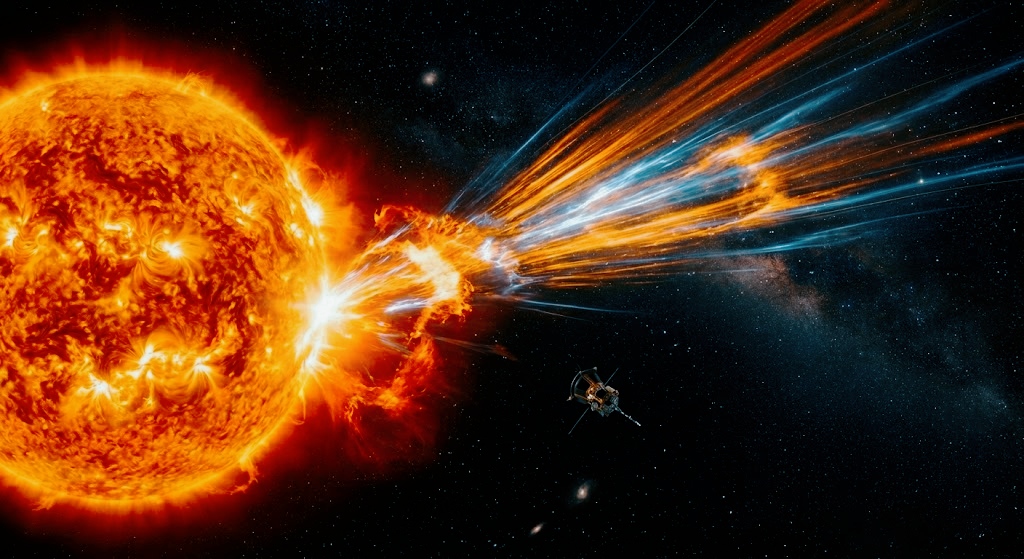
Understanding the magnetism of white dwarfs is not merely an exercise in galactic archaeology; it has direct implications for our knowledge of the Sun. As a star halfway through its journey, the Sun will one day transform into a red giant, likely swallowing the inner planets before fading out as a white dwarf. Currently, many models assume that the solar core is non-magnetic, but these new findings suggest we may have been mistaken about the deep nature of our star.
If the heart of the Sun were indeed magnetized, our understanding of its lifespan and internal functioning would change radically. A strong magnetic field could influence the transport of hydrogen from the outer layers toward the center, potentially acting as a factor capable of extending the star’s life. This possibility opens new scenarios regarding the long-term stability of the solar system and the speed at which the Sun will consume its nuclear fuel in the final stages.
However, magnetism is a double-edged sword: while it can extend stellar life, it can also accelerate certain evolutionary processes or violently influence the ejection of outer layers. The Ista research highlights how much we are still partially in the dark regarding the mechanisms regulating the Sun’s central engine. Identifying the presence of a fossil magnetic field in our star would change the reference parameters for all modern stellar astrophysics.
Einramhof’s conclusions suggest an even bolder vision: it is likely that almost all stars are magnetic, even if current technology does not always allow us to detect it. Magnetism could be the norm rather than the exception—an invisible thread guiding the evolution of every star in the galaxy. This work lays the foundation for future observations that will seek traces of magnetism in the Sun, preparing us to better understand the fiery sunset that awaits our planetary system.
Conclusions and new frontiers of research
The work of the Austrian researchers represents a turning point because it re-establishes magnetism as an active protagonist of stellar evolution. No longer a mere byproduct, it is a driving force capable of resisting for billions of years and influencing the very structure of stellar remains. The ability to link observational data separated by millions of years in cosmic time demonstrates the power of modern theoretical models when fed by precise measurements such as asteroseismology.
The discovery that magnetic fields form shell structures opens new questions about fluid dynamics inside stars. These magnetic shells could act as barriers or channels for energy, influencing how heat is transported from the center to the surface. Understanding this magnetic architecture is essential for refining the numerical simulations that scientists use to predict the behavior of stars throughout the galaxy.
Furthermore, the study highlights the importance of not discarding past theories when new observation technologies emerge. The fossil field theory, though set aside for a decade, proved to be the most suitable tool to explain the new data collected. This methodological approach encourages a continuous review of scientific dogmas in light of increasingly powerful tools, such as the next generation of space telescopes that will study the oscillations of thousands of other stars.
The journey toward a total understanding of stellar magnetism is still long, but the route is now mapped. While we continue to observe white dwarfs as mirrors of the past, we are beginning to see them as windows into the future. Each new piece of information gathered from these silent, magnetized remnants brings us closer to answering the fundamental question: what will truly happen to our star and the world it illuminates when the hydrogen in its heart begins to run low?
The study is published in Astronomy & Astrophysics.