
How Does Orion Survive the Fiery Plunge Back to Earth?
What happens when a spacecraft slams into Earth’s atmosphere at 40,000 km/h — faster than a bullet, hotter than the surface of the Sun?
Welcome, dear reader, to FreeAstroScience.com — where we break down the most extraordinary science into words that speak to everyone. Whether you’re a space enthusiast, a physics student, or just someone who looked up at the Moon tonight and wondered how we’ll get back from there, you belong here. We’re glad you found us.
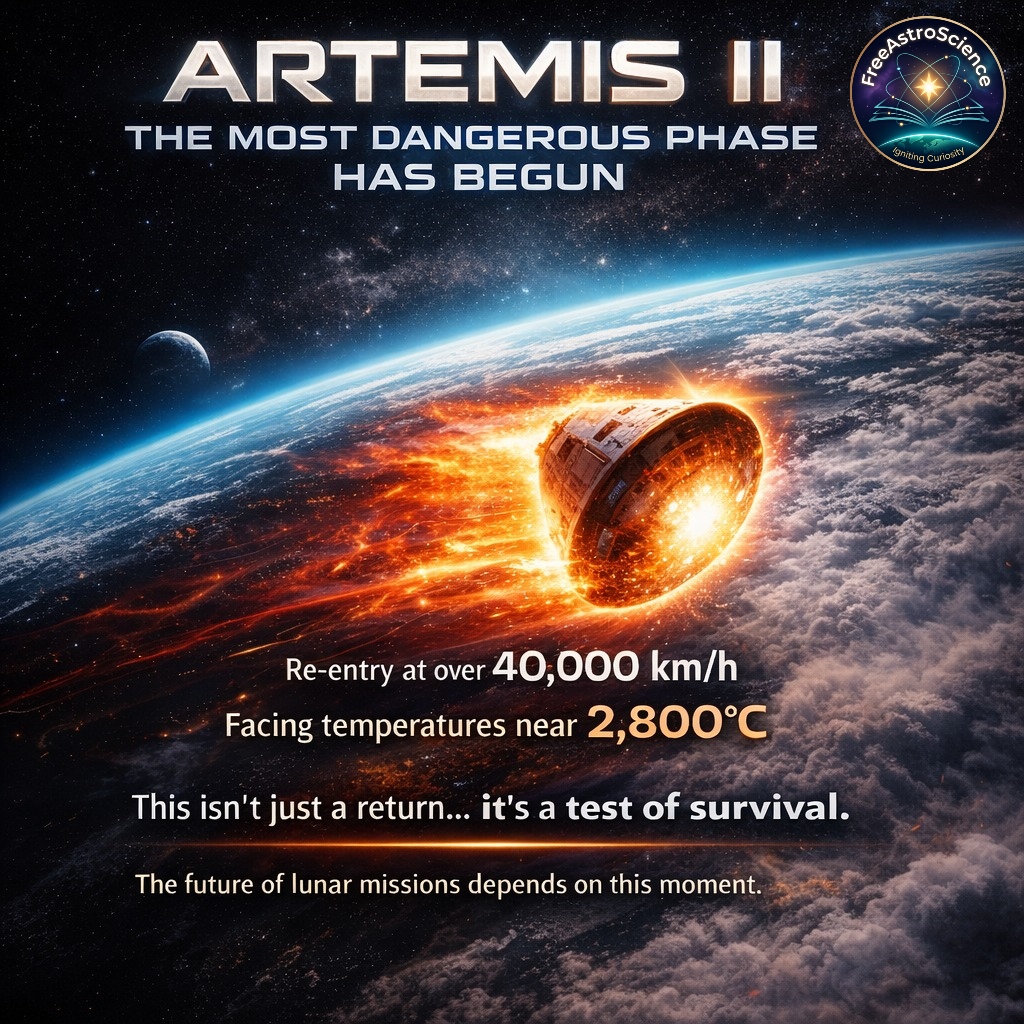
Today, we’re telling the story of one of the most dangerous feats of engineering ever attempted: the atmospheric re-entry of NASA’s Orion capsule during the Artemis II mission. This isn’t a routine landing. It’s a controlled collision with the sky at speeds that turn air into plasma and push a heat shield to its absolute limit. Four astronauts will be inside — Reid Wiseman, Victor Glover, Christina Koch, and Jeremy Hansen — trusting physics, materials science, and decades of human ingenuity to bring them home alive.
Stick with us through every section. By the end, you’ll understand not just what happens during re-entry, but why it works — and why the future of lunar exploration depends on it.
🚀 Table of Contents
- 1.Why Is Re-Entry the Most Dangerous Phase?
- 2.The Physics of Hitting a Wall of Air
- 3.What Is Skip Re-Entry — and Why Does Orion Bounce?
- 4.How Does the AVCOAT Heat Shield Protect the Crew?
- 5.What G-Forces Will the Astronauts Experience?
- 6.The Mathematics Behind Re-Entry Dynamics
- 7.From Mach 32 to Splashdown: The Parachute Sequence
- 8.Why Does the Future of Artemis Depend on This Moment?
Why Is Re-Entry the Most Dangerous Phase?
Let’s be honest with each other. Launching a rocket is terrifying. But coming home? That’s where the real fear lives.
When Orion returns from the Moon, it doesn’t drift gently back to Earth like a leaf falling from a tree. It comes screaming in at over 40,000 km/h — roughly 11.1 km/s, or about Mach 32. To put that in perspective, a rifle bullet travels at around 1 km/s. Orion arrives more than ten times faster.
And here’s the thing that makes re-entry from the Moon uniquely brutal: it’s about 30% faster than returning from low Earth orbit (LEO). The Space Shuttle came home at about 7.8 km/s. The Apollo capsules — the last spacecraft to carry humans from the Moon — re-entered at 11 km/s, just like Orion will. But that was over fifty years ago. We haven’t tested a crewed capsule at these speeds since Apollo 17 in December 1972.
That gap of more than half a century should give us pause. The materials are different now. The guidance systems are different. The stakes, with renewed global interest in the Moon, are enormous.
During those minutes of peak heating, the capsule’s exterior reaches temperatures near 2,800°C — roughly half the surface temperature of the Sun (about 5,500°C). The air itself doesn’t just get hot; it ionizes into plasma, wrapping the capsule in a sheath of superheated gas that temporarily cuts off all radio communication. We call this the communications blackout, and it lasts several minutes. During that window, Mission Control can’t talk to the crew. The crew can’t talk to Mission Control. Everyone waits.
The Physics of Hitting a Wall of Air
Here’s a concept that sounds counterintuitive at first: the atmosphere is your brake pedal.
Orion carries no massive retro-rockets to slow itself down from 40,000 km/h. That would require an absurd amount of fuel — fuel the spacecraft doesn’t have. Instead, it uses Earth’s atmosphere itself as a braking mechanism. Engineers call this aerodynamic deceleration, and it’s one of the most elegant — and violent — tricks in spaceflight.
How Does Kinetic Energy Become Heat?
When a blunt body like Orion enters the atmosphere at hypersonic speed, it compresses the air in front of it so violently that the air molecules can’t get out of the way fast enough. This creates a bow shock wave — a curved region of compressed, superheated gas standing off a short distance from the heat shield.
The critical physics here involves conservation of energy. Orion’s kinetic energy at entry is staggering. For a capsule with a mass of roughly 8,500 kg (the crew module alone), the kinetic energy at 11.1 km/s is:
🔢 Kinetic Energy at Entry Interface
KE = ½ × m × v²
KE = ½ × 8,500 kg × (11,100 m/s)²
KE ≈ 5.24 × 10¹¹ J ≈ 524 Gigajoules
That’s roughly equivalent to the energy released by 125 tons of TNT.
All of that energy must go somewhere. It doesn’t vanish. It converts into heat — transferred to the surrounding air and to the capsule’s heat shield through convective and radiative heating. The bow shock heats the air to temperatures exceeding 7,000°C in certain regions, though the heat shield surface itself stays around 2,800°C thanks to clever material engineering.
Why a Blunt Body?
This is one of the great insights from H. Julian Allen at NACA (NASA’s predecessor) in the 1950s. A sharp, aerodynamic shape might seem like the logical choice — cut through the air, right? Wrong. A sharp nose concentrates all the heating at the tip. A blunt body creates a wider, detached shock wave that pushes most of the superheated air around the capsule rather than into it. The blunt shape keeps roughly 99% of the re-entry heat in the surrounding airflow, away from the vehicle.
Orion’s crew module is shaped like a truncated cone — a gumdrop, some engineers say — with a diameter of 5.02 meters at its widest point. That flat bottom faces forward during re-entry, and that’s exactly where the heat shield lives.
What Is Skip Re-Entry — and Why Does Orion Bounce?
This is where Orion’s re-entry becomes genuinely different from anything NASA has flown with crew before.
Instead of a single, straight dive into the atmosphere — the approach Apollo used — Orion performs a skip re-entry. Think of it like skipping a stone across a pond. The capsule enters the upper atmosphere, decelerates partially, then rises back up briefly above the denser layers before plunging in a second time for the final descent.
Why Bother with Two Dips?
Three reasons, and they’re all significant:
- Heat management. By splitting the re-entry into two phases, the capsule spreads the total heating load over a longer period. Instead of one ferocious blast of 2,800°C, the heat shield endures two shorter, more manageable pulses. This reduces the peak heat flux and gives the thermal protection system a better chance of surviving without degradation that could endanger the crew.
- G-force reduction. A single ballistic re-entry from lunar return speed can produce peak deceleration forces of 7–8 g or higher. The skip maneuver brings that down to a more tolerable 4 g or less. That’s still four times your body weight pressing on your chest, but it’s survivable and manageable for trained astronauts.
- Landing precision. Here’s a practical benefit that doesn’t get enough attention. The skip allows guidance computers to steer toward a precise splashdown location in the Pacific Ocean. By adjusting the angle, timing, and duration of each atmospheric pass, Orion can land within approximately 1.8 km of the target point. Apollo’s accuracy was good for its era, but Orion’s skip technique offers tighter control — and that matters for recovery crews waiting in the water below.
The Re-Entry Corridor
For the skip to work, Orion must enter the atmosphere within an extremely narrow corridor of angles. We call this the entry flight path angle, and for Orion returning from the Moon, it sits around −5.86° (negative because the capsule is coming in below the local horizontal).
⚠️ The Re-Entry Corridor — A Razor’s Edge
| Scenario | Entry Angle | Outcome |
|---|---|---|
| Too shallow | Shallower than −5.2° | Capsule bounces off the atmosphere and flies back into space — skip-out |
| Too steep | Steeper than −6.8° | Extreme g-forces (>12 g) and heat exceeding shield capacity — destructive |
| Nominal | About −5.86° | Controlled skip, manageable heating, safe splashdown ✓ |
The usable corridor is roughly 1.5° wide. At orbital speeds, that translates to a targeting accuracy of just a few kilometers at the entry interface — typically defined at an altitude of 122 km (400,000 ft).
That corridor is thin. A little too shallow, and Orion skips off the atmosphere entirely, like a stone thrown too flat. A little too steep, and the g-forces and heating become catastrophic. The guidance system must thread this needle with extraordinary precision.
How Does the AVCOAT Heat Shield Protect the Crew?
Between the crew and 2,800°C of blazing plasma stands a single layer of material just a few centimeters thick. It’s called AVCOAT, and it’s the largest ablative heat shield ever built for a human spacecraft.
What Does “Ablative” Mean?
An ablative heat shield works by sacrificing itself. As the outer surface heats up, the material chars, melts, and vaporizes — carrying thermal energy away from the spacecraft as it goes. The gas that boils off the surface creates a thin boundary layer that acts as an additional insulator, pushing hot air away from the structure beneath.
It’s brilliant in its simplicity: you don’t try to resist the heat. You let the heat consume the outer layer, and the act of consumption protects everything underneath.
AVCOAT by the Numbers
AVCOAT was originally developed for the Apollo program in the 1960s. NASA resurrected and modernized the formula for Orion. Here are the key specs:
🛡️ AVCOAT Heat Shield Specifications
| Property | Value |
|---|---|
| Diameter | 5.02 meters (16.5 ft) |
| Material | AVCOAT-5026-39 (silica fibers in epoxy-novolac resin) |
| Construction | 330,000+ honeycomb cells filled by hand |
| Peak surface temperature | ~2,800°C (5,072°F) |
| Peak heat flux | ~200 W/cm² |
| Mass | Approximately 186 kg |
During Artemis I — the uncrewed test flight in November–December 2022 — the heat shield performed well overall, but engineers noticed more charring and material loss than predicted by computer models. Some AVCOAT material came off in larger-than-expected chunks. NASA spent considerable time analyzing this data before clearing Artemis II for flight. They concluded the heat shield would still protect the crew within acceptable safety margins, but the slight discrepancy between prediction and reality is a reminder: re-entry physics is hard, and surprises still happen.
What G-Forces Will the Astronauts Experience?
When we talk about deceleration during re-entry, we express it in g-forces — multiples of Earth’s standard gravitational acceleration (9.81 m/s²). Sitting in your chair right now, you feel 1 g. During Orion’s skip re-entry, here’s roughly what happens:
First Atmospheric Pass
The capsule enters the atmosphere and slows from about 11.1 km/s to roughly 8–9 km/s. During this first dip, deceleration peaks at around 3–4 g for about 2–3 minutes. The crew will feel pressed heavily into their seats. Breathing becomes labored. Moving your arms feels like lifting weights.
Brief Ballistic Coast
After the first pass, Orion rises back to altitudes around 60–80 km — still within the very thin upper atmosphere but high enough to reduce drag dramatically. This phase lasts only about 60–90 seconds. Deceleration drops near zero. A brief reprieve.
Second Atmospheric Pass
The capsule dives back in, now at lower speed. Deceleration peaks again at about 3–4 g, though some trajectory profiles can push slightly higher. This second phase bleeds off the remaining orbital velocity, slowing Orion to roughly 480 km/h (about 300 mph) — subsonic speed — at an altitude of around 7,600 meters (25,000 ft).
Compare this to Apollo, where astronauts sometimes experienced 6.5 g or more in a single, punishing deceleration pulse. The skip entry cuts the peak g-load nearly in half. That’s not just comfort — it’s safety.
The Mathematics Behind Re-Entry Dynamics
For those of us who love equations — and even for those who simply appreciate the elegance beneath the engineering — let’s look at the core physics that govern Orion’s return.
The Re-Entry Equations of Motion
A capsule’s trajectory through the atmosphere can be described by a coupled set of differential equations. In a simplified 2D planar model (ignoring Earth’s rotation and assuming a spherical Earth), the equations for velocity (v), flight path angle (γ), and altitude (h) are:
📐 Simplified Planar Re-Entry Equations
Velocity equation:
m(dv/dt) = −D − mg·sin(γ)
Flight path angle equation:
mv(dγ/dt) = L − mg·cos(γ) + (mv²·cos(γ))/(R + h)
Altitude equation:
dh/dt = v·sin(γ)
Where: m = capsule mass, D = aerodynamic drag, L = aerodynamic lift, g = gravitational acceleration, γ = flight path angle, R = Earth’s radius, h = altitude above surface.
The drag force D and lift force L depend on atmospheric density (ρ), velocity, the capsule’s reference area (A), and its aerodynamic coefficients:
D = ½ · ρ · v² · CD · A
L = ½ · ρ · v² · CL · A
Orion’s drag coefficient CD ≈ 1.3–1.6 (varies with Mach number). Its lift-to-drag ratio (L/D) is approximately 0.3–0.4, generated by flying at a slight angle of attack.
Why Lift Matters on a “Falling” Capsule
You might wonder: how does a gumdrop-shaped capsule generate lift? The answer is the angle of attack. Orion flies slightly tilted — its center of mass is offset from the geometric center, which naturally causes it to trim at an angle of about 18–20° relative to the oncoming airflow. That asymmetry produces a small but real lift force.
By rolling the capsule around its velocity vector (a maneuver called “bank angle modulation”), the guidance system can steer that lift vector up, down, left, or right. This is how Orion controls its skip altitude, manages g-loads, and targets the splashdown site — all without any thrusters firing during the dense-atmosphere portion of re-entry.
The Stagnation Point Heating Formula
The heat that reaches the shield follows a relationship first described by Fay and Riddell in 1958. A simplified version for convective heating at the stagnation point (the center of the blunt face) is:
🔥 Stagnation Point Heating (Simplified)
q̇ ∝ (ρ/Rn)0.5 · v³
Where: q̇ = heat flux (W/m²), ρ = atmospheric density, Rn = nose radius of the capsule, v = velocity. Notice the cubic dependence on velocity — double the speed and the heating rate increases eightfold.
That v³ dependence is why lunar return is so much more punishing than LEO return. The 30% increase in speed compared to LEO translates to more than double the heating rate. This single equation explains everything about why Artemis re-entry sits at the edge of what’s thermally survivable for current materials.
From Mach 32 to Splashdown: The Parachute Sequence
After the atmosphere has done its work — scrubbing 99% of Orion’s kinetic energy through aerodynamic drag — the capsule is still falling too fast to survive impact. At about 7,600 meters altitude and 480 km/h, the parachute deployment sequence begins.
It’s not one parachute. It’s eleven. And they deploy in a carefully choreographed cascade:
🪂 Orion Parachute Deployment Sequence
| Phase | Altitude | Chutes | Purpose |
|---|---|---|---|
| 1 | ~7,600 m | 2 forward bay cover chutes | Pull off the forward bay cover to expose main chutes |
| 2 | ~7,300 m | 3 drogue chutes | Slow and stabilize from ~480 to ~200 km/h |
| 3 | ~3,000 m | 3 pilot chutes | Extract the 3 main parachutes from their containers |
| 4 | ~3,000 m → 0 m | 3 main chutes (each 35 m / 116 ft diameter) | Slow the capsule to ~32 km/h (20 mph) for splashdown |
The system is designed to be single-fault tolerant: Orion can land safely even if one main parachute fails to deploy.
When those three enormous main canopies bloom open — each one 35 meters across, about the size of a football field’s end zone — Orion’s descent rate drops to roughly 32 km/h (20 mph). That’s still a hard landing. Splashdown in the Pacific Ocean provides a final cushion of deceleration as the capsule hits the water.
The entire process — from entry interface at 122 km altitude to splashdown at sea level — takes approximately 20 minutes. Twenty minutes to go from cosmic speed to floating.
Why Does the Future of Artemis Depend on This Moment?
Artemis II is not just a test of the Orion capsule’s heat shield or its parachutes. It’s a test of whether we can still bring humans home from the Moon.
We did it six times with Apollo, between 1969 and 1972. But the people who built those systems are largely retired or gone. The manufacturing techniques were different. The institutional knowledge faded. NASA built Orion from a mixture of inherited principles and modern engineering — and that blend has to prove itself now, with lives on the line.
If Artemis II’s re-entry succeeds, it opens the door for Artemis III — the mission that will land the first woman and the first person of color on the lunar surface. Beyond that, Artemis IV and V will begin building the Gateway lunar station. Every one of those missions ends the same way: an Orion capsule hurtling back from the Moon at 11 km/s, trusting its heat shield, its guidance, and the skip re-entry technique.
The image that inspired this article says it perfectly: “This isn’t just a return… it’s a test of survival.” And that’s no exaggeration. It’s physics, plainly stated.
Conclusion
We’ve traveled together from the cold silence of translunar space to the blinding fury of a 2,800°C plasma sheath and down through the quiet bloom of three enormous parachutes settling toward the Pacific. Along the way, we’ve seen how kinetic energy becomes heat, how a stone can skip on the pond of our atmosphere, and how a hand-filled honeycomb shield stands between four human beings and destruction.
What strikes us most is the honesty of the physics. Re-entry doesn’t care about politics or budgets or timelines. It obeys equations — the Fay-Riddell heating relationship, the v³ dependence, the narrow corridor of entry angles. Get the math right, and you come home. Get it wrong, and there’s no second chance. That clarity is both terrifying and beautiful.
At FreeAstroScience.com, we believe that explaining these principles in plain language isn’t just educational — it’s necessary. The sleep of reason breeds monsters, as Goya once warned. When we stop asking “how does that work?” and “what’s the evidence?”, we lose something essential. So we’ll keep writing. Keep questioning. Keep making the universe a little less mysterious and a lot more wondrous.
Come back soon. There’s always more sky to explore.
📚 References & Sources
- NASA — Artemis II Mission Overview
- NASA — Orion Spacecraft Reference Guide
- NASA Technical Reports Server — AVCOAT Heat Shield Analysis
- Lockheed Martin — Orion Multi-Purpose Crew Vehicle
- Fay, J.A. & Riddell, F.R. (1958). “Theory of Stagnation Point Heat Transfer in Dissociated Air.” Journal of the Aerospace Sciences, 25(2), 73–85.
- Allen, H.J. & Eggers, A.J. (1958). “A Study of the Motion and Aerodynamic Heating of Ballistic Missiles Entering the Earth’s Atmosphere at High Supersonic Speeds.” NACA Report 1381.
- NASA Artemis Blog — Artemis I Re-Entry Data and Heat Shield Post-Flight Analysis
- Image credit: Artemis II infographic — provided source image depicting Orion re-entry parameters.



Kindly and well at all