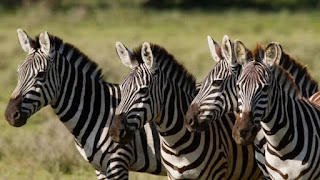
Venturing into the captivating terrain of African savannahs, one cannot overlook the majestic Zebras- renowned for their unique striped coats. These black and white stripes aren’t just aesthetic; they are the result of millions of years of evolutionary adaptations, serving a multitude of survival purposes.
Escape Artists: Camouflage and Mimicry
Stripes on zebras are more than decorative. They are a strategic evolutionary adaptation that assists in survival amidst nature’s unforgiving food chain. This distinctive pattern creates an optical illusion, making it challenging for predators to single out a zebra from the towering grass and fluctuating shadows of the landscape. By blending into their surroundings, zebras effectively escape the scrutiny of lions, hyenas, and other predators, disrupting their vision in terms of contrast and movement.
Nature’s Air Conditioner: The Cooling Theory
While camouflage is a compelling reason for the stripes, another fascinating hypothesis suggests thermal regulation as a motivator behind this extraordinary pattern. The contrast between black stripes absorbing heat and white areas reflecting it could generate airflow over the zebra’s body, resulting in a natural cooling process. This cooling mechanism might be particularly beneficial in intense heat, with the adaptability of the stripes providing potential thermal insulation in colder conditions.
Striped Signals: Zebra Communication
Zebra stripes could also serve as a medium of communication within the species. The quality and appearance of stripes could indicate health and genetic fitness, influencing mate selection. More defined stripes might assert dominance, establishing a social hierarchy within the herd. Zebras could also use stripe patterns to signal danger or coordinate collective defense in threatening situations.
Adaptive Camouflage: Changes in Stripes Over Time
Climatic changes and geographic movements could have influenced the evolution of zebra stripes. As zebras migrate across diverse landscapes, their stripes might have adapted to maintain effective camouflage. Changes in vegetation and environmental conditions could have necessitated these adaptations, with striped coloration providing a survival advantage against predators or herbivorous competitors. Fossil and archaeological evidence could further elucidate this intriguing evolutionary journey.
In conclusion, the enigmatic stripes of zebras are a testament to the marvelous adaptability of nature, serving pivotal roles in survival, communication, and thermal regulation.
Gerd Dani — Founder & Director Gerd Dani is the visionary in a wheelchair behind FreeAstroScience. An astronomy graduate and a master's in physics, he founded this blog in June 2020, driven by a passion for breaking down complex scientific and philosophical concepts into bite-sized, digestible pieces. As President, he is dedicated to making science accessible to everyone, from students to seasoned academics.
(()=>{async function handleCredentialResponse(response){try{const res=await fetch('https://freeastroscience.com/wp-login.php?action=googlesitekit_auth',{method:'POST',headers:{'Content-Type':'application/x-www-form-urlencoded'},body:new URLSearchParams(response)});/* Preserve comment text in case of redirect after login on a page with a Sign in with Google button in the WordPress comments. */ const commentText=document.querySelector('#comment')?.value;const postId=document.querySelectorAll('.googlesitekit-sign-in-with-google__comments-form-button')?.[0]?.className?.match(/googlesitekit-sign-in-with-google__comments-form-button-postid-(\d+)/)?.[1];if(!! commentText?.length){sessionStorage.setItem(`siwg-comment-text-${postId}`,commentText);}location.reload();}catch(error){console.error(error);}}if(typeof google !=='undefined'){google.accounts.id.initialize({client_id:'251104905146-eghigrtua82ec7aan4em9fle9u5f0ilc.apps.googleusercontent.com',callback:handleCredentialResponse,library_name:'Site-Kit'});}const defaultButtonOptions={"theme":"outline","text":"signin_with","shape":"rectangular"};document.querySelectorAll('.googlesitekit-sign-in-with-google__frontend-output-button').forEach((siwgButtonDiv)=>{const buttonOptions={shape:siwgButtonDiv.getAttribute('data-googlesitekit-siwg-shape')|| defaultButtonOptions.shape,text:siwgButtonDiv.getAttribute('data-googlesitekit-siwg-text')|| defaultButtonOptions.text,theme:siwgButtonDiv.getAttribute('data-googlesitekit-siwg-theme')|| defaultButtonOptions.theme,};if(typeof google !=='undefined'){google.accounts.id.renderButton(siwgButtonDiv,buttonOptions);}});/* If there is a matching saved comment text in sessionStorage,restore it to the comment field and remove it from sessionStorage. */ const postId=document.body.className.match(/postid-(\d+)/)?.[1];const commentField=document.querySelector('#comment');const commentText=sessionStorage.getItem(`siwg-comment-text-${postId}`);if(commentText?.length && commentField && !! postId){commentField.value=commentText;sessionStorage.removeItem(`siwg-comment-text-${postId}`);}})();
var astra = {"break_point":"921","isRtl":"","is_scroll_to_id":"1","is_scroll_to_top":"1","is_header_footer_builder_active":"1","responsive_cart_click":"flyout","is_dark_palette":"","revealEffectEnable":"","edit_post_url":"https://freeastroscience.com/wp-admin/post.php?post={{id}}&action=edit","ajax_url":"https://freeastroscience.com/wp-admin/admin-ajax.php","infinite_count":"2","infinite_total":"0","pagination":"number","infinite_scroll_event":"scroll","no_more_post_message":"No more posts to show.","grid_layout":{"desktop":3,"tablet":1,"mobile":1},"site_url":"https://freeastroscience.com","blogArchiveTitleLayout":"layout-2","blogArchiveTitleOn":"1","show_comments":"Show Comments","enableHistoryPushState":"1","masonryEnabled":"","blogMasonryBreakPoint":"0"};
//# sourceURL=astra-theme-js-js-extra