
Have you ever gazed at the night sky and wondered how the vast cosmos operates? What secrets lie in the dance of distant galaxies? At FreeAstroScience.com, we’re on a mission to illuminate the mysteries of the universe, making them accessible and fascinating for all. Today, we invite you to journey through the cosmos as we unravel Hubble’s Law, a cornerstone of astronomical understanding. Prepare for an enlightening exploration that promises to expand your horizons and deepen your appreciation for the cosmic ballet.
The Birth of Hubble’s Law: Tracing Cosmic Expansion
Long before Hubble’s monumental contribution, the universe whispered its expanding nature to those who dared to listen. It was an era of intellectual giants: Alexander Friedmann and Georges Lemaître laid the foundations, paving the way for Edwin Hubble’s groundbreaking revelation. We’ll venture back in time to witness the conception of the idea that forever changed our cosmic perspective.
Friedmann’s Universe: The Prelude to Expansion
In the early 20th century, Alexander Friedmann, armed with Einstein’s general relativity, hypothesized a universe in flux. His equations suggested a cosmos that stretched and grew, offering a mathematical symphony that hinted at an expanding reality.
Lemaître’s Vision: The Proportionality of Cosmic Drift
Georges Lemaître, a thinker of celestial proportions, arrived independently at a similar conclusion. In 1927, he discerned a pattern: galaxies seemed to recede faster with increasing distance, suggesting a proportional relationship that whispered the secrets of the universe’s scale.
Edwin Hubble: Empirical Proof of a Growing Cosmos
With the mighty Hale Telescope as his lens to the heavens, Edwin Hubble observed galaxies in retreat, their light stretched to redder wavelengths—a telltale sign of cosmic separation. His observations were a testament to the theories of Friedmann and Lemaître, solidifying the notion of an expanding universe with empirical evidence.
Dissecting Hubble’s Law: The Formula of the Cosmos
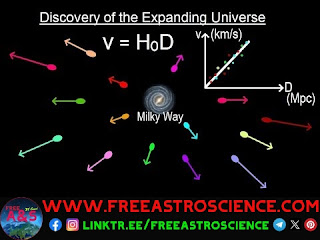
At the heart of modern cosmology lies Hubble’s Law, a simple yet profound equation: v = H0*D. It’s a cosmic yardstick, connecting the speed of a galaxy’s retreat (v) to its distance (D) with the Hubble constant (H0) as the conversion factor.
The Hubble constant (H0) is the rate at which the universe expands, a value that evolves over cosmic time. It’s a figure that tells us how fast a galaxy one megaparsec away recedes from our vantage point—a number central to the story of our universe’s growth.

The Doppler Effect: The Color of Motion
The Doppler effect is crucial to grasping Hubble’s Law. It explains how the light from galaxies shifts in color as they move, giving us a cosmic speedometer. Blue for approaching, red for retreating—this chromatic shift is the key to unlocking the velocity of the cosmos.

Expanding Universe and Big Bang Evidence
Hubble’s Law doesn’t just measure; it tells a story of origins. This law supports the Big Bang model, painting a picture of a universe that was once compact and hot, expanding and cooling to become the vast expanse we marvel at today.
The Hubble Flow: Not a River, but a Tide
In this grand cosmic expansion, it’s not galaxies that traverse space but space itself that stretches, carrying galaxies along in what we call the Hubble flow—an ocean of spacetime where celestial bodies are adrift.
Redshift and Cosmic Yardsticks
The dance between redshift and distance is a critical duet. By measuring the redshift, we can infer a galaxy’s recession speed. The greater the redshift, the faster it moves away, allowing us to map the vastness of the universe.
The Hubble Tension: A Cosmic Conundrum
With advances in observation, a curious conflict has emerged: the Hubble tension. Our view of the early universe suggests a slower expansion than what we observe today—a puzzle that tantalizes scientists and hints at undiscovered physics.
Reflections on Hubble’s Legacy
Hubble’s Law, a linchpin of cosmic comprehension, offers a window to the universe’s expansion, bolsters the Big Bang framework, and extends our cosmic measuring tape to the farthest reaches of space. Yet, in science, every law is a stepping stone to deeper truths.
The Quest Continues at FreeAstroScience.com
Our celestial journey has only begun. As we delve deeper into the cosmos, who knows what wonders await discovery? Stay with us at FreeAstroScience.com, where we continue our pursuit of the universe’s enigmas with passion and curiosity.
Join us on this cosmic voyage. Learn. Discover. Be captivated by the unfolding universe, and let’s together unlock the enigmas of the cosmos, one discovery at a time.