When we think about the achievements of Romans we often picture breathtaking structures, like the Colosseum, which could accommodate crowds comparable to todays largest stadiums. However it is crucial to recognize that one of the Romans most accomplishments was their network of roads that connected every corner of their vast empire.
This remarkable system was an engineering marvel for its time. Continues to leave an impact even today. The construction of these roads showcased the Romans ingenious capabilities. Studying their methods offers insights into their advanced techniques.
The Ingenious Road Building Process
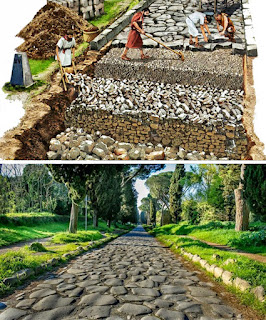
To establish a foundation for their roadways the Romans began by digging trenches. These trenches were then filled with layers of materials ranging from stones to smaller rocks, gravel and sand. This combination ensured stability and durability allowing the roads to withstand the test of time and constant usage.
Once these trenches were filled up to ground level the Romans would dig deeper by 60 centimeters (or about two feet) and cover this new layer with compacted gravel. In Latin this process was known as “pavire” or “pavement,” creating an stable surface, for travel and transportation.
This method serves as an example of the peoples resourcefulness and their exceptional skills, in engineering.
The Via Appia Antica; An Exemplary Instance
An extraordinary illustration of road construction can be observed in the Via Appia Antica, an ancient highway connecting Rome to Brindisi in the southeastern region of Italy. This historical route, visible and usable today offers a glimpse into the Romans advanced engineering capabilities. Serves as a tangible reminder of their remarkable expertise in construction.
Conclusion; Enduring Heritage
The road system undoubtedly stands as a groundbreaking accomplishment that facilitated the expansion and administration of their empire. These roads enabled communication, trade and military operations allowing Rome to maintain control over territories. The construction techniques employed by the Romans continue to inspire engineers even today as they draw inspiration from these innovative methods.
In summary the Roman roadways not showcase engineering prowess but also leave behind a lasting legacy that continually inspires and informs present day infrastructure projects. By exploring the intricacies of their construction we can gain an appreciation, for this civilizations remarkable achievements.
Gerd Dani — Founder & Director Gerd Dani is the visionary in a wheelchair behind FreeAstroScience. An astronomy graduate and a master's in physics, he founded this blog in June 2020, driven by a passion for breaking down complex scientific and philosophical concepts into bite-sized, digestible pieces. As President, he is dedicated to making science accessible to everyone, from students to seasoned academics.
(()=>{async function handleCredentialResponse(response){try{const res=await fetch('https://freeastroscience.com/wp-login.php?action=googlesitekit_auth',{method:'POST',headers:{'Content-Type':'application/x-www-form-urlencoded'},body:new URLSearchParams(response)});/* Preserve comment text in case of redirect after login on a page with a Sign in with Google button in the WordPress comments. */ const commentText=document.querySelector('#comment')?.value;const postId=document.querySelectorAll('.googlesitekit-sign-in-with-google__comments-form-button')?.[0]?.className?.match(/googlesitekit-sign-in-with-google__comments-form-button-postid-(\d+)/)?.[1];if(!! commentText?.length){sessionStorage.setItem(`siwg-comment-text-${postId}`,commentText);}location.reload();}catch(error){console.error(error);}}if(typeof google !=='undefined'){google.accounts.id.initialize({client_id:'251104905146-eghigrtua82ec7aan4em9fle9u5f0ilc.apps.googleusercontent.com',callback:handleCredentialResponse,library_name:'Site-Kit'});}const defaultButtonOptions={"theme":"outline","text":"signin_with","shape":"rectangular"};document.querySelectorAll('.googlesitekit-sign-in-with-google__frontend-output-button').forEach((siwgButtonDiv)=>{const buttonOptions={shape:siwgButtonDiv.getAttribute('data-googlesitekit-siwg-shape')|| defaultButtonOptions.shape,text:siwgButtonDiv.getAttribute('data-googlesitekit-siwg-text')|| defaultButtonOptions.text,theme:siwgButtonDiv.getAttribute('data-googlesitekit-siwg-theme')|| defaultButtonOptions.theme,};if(typeof google !=='undefined'){google.accounts.id.renderButton(siwgButtonDiv,buttonOptions);}});/* If there is a matching saved comment text in sessionStorage,restore it to the comment field and remove it from sessionStorage. */ const postId=document.body.className.match(/postid-(\d+)/)?.[1];const commentField=document.querySelector('#comment');const commentText=sessionStorage.getItem(`siwg-comment-text-${postId}`);if(commentText?.length && commentField && !! postId){commentField.value=commentText;sessionStorage.removeItem(`siwg-comment-text-${postId}`);}})();
var astra = {"break_point":"921","isRtl":"","is_scroll_to_id":"1","is_scroll_to_top":"1","is_header_footer_builder_active":"1","responsive_cart_click":"flyout","is_dark_palette":"","revealEffectEnable":"","edit_post_url":"https://freeastroscience.com/wp-admin/post.php?post={{id}}&action=edit","ajax_url":"https://freeastroscience.com/wp-admin/admin-ajax.php","infinite_count":"2","infinite_total":"0","pagination":"number","infinite_scroll_event":"scroll","no_more_post_message":"No more posts to show.","grid_layout":{"desktop":3,"tablet":1,"mobile":1},"site_url":"https://freeastroscience.com","blogArchiveTitleLayout":"layout-2","blogArchiveTitleOn":"1","show_comments":"Show Comments","enableHistoryPushState":"1","masonryEnabled":"","blogMasonryBreakPoint":"0"};
//# sourceURL=astra-theme-js-js-extra