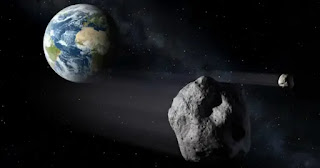

In the world of celestial discoveries, a remarkable event occurred on July 15, 2023. The ATLAS telescope in South Africa discovered an asteroid of approximately 200 feet (60 meters) in diameter, just two days after its closest approach to our planet. This asteroid, dubbed 2023 NT1, is about the size of an airplane. Its size is comparable to the infamous asteroid that left a significant mark on Arizona around 50,000 years ago – the well-known Barringer or Meteor Crater.
Interestingly, this newly discovered asteroid passed within a quarter of the moon’s distance (about 100,000 km) from Earth at 12:12 p.m. Italian time on July 13, 2023. However, this raises the question, why didn’t any of our telescopes detect it sooner? The answer lies in the asteroid’s trajectory, coming towards Earth from the direction of the Sun – a recognized blind spot in our defense against space rocks.
But the European Space Agency (ESA) has a plan to address this vulnerability. The ESA has proposed a mission, known as NEOMIR, designed to detect asteroids approaching from the Sun’s direction. NEOMIR will orbit between Earth and the Sun at the first Lagrange point (L1), serving as an early warning system for detecting asteroids down to 20 meters in size that earthbound instruments might miss. However, the launch of NEOMIR is not scheduled until 2030.
To understand more about these celestial bodies, let’s delve into some basic information.
Asteroids are rocky celestial bodies that are typically irregular in shape and not very bright. Most dwell within the asteroid belt, a region situated between Mars and Jupiter. Asteroids come in various shapes, with some even possessing their own natural satellites.
Contrary to asteroids, comets consist of both rock and ice. As a comet nears the Sun, the ice vaporizes and is expelled, along with dust, forming a ‘fuzzy’ appearance and sometimes two tails.
A meteoroid, on the other hand, is a relatively small fragment of an asteroid or comet, often resulting from collisions. When a meteoroid enters Earth’s atmosphere, it becomes a meteor, reaching high speeds and glowing brightly due to friction with the air, often seen as a ‘shooting star’. If it survives the descent and lands on Earth, it’s then referred to as a meteorite.