
Have you ever wondered what stories a galaxy’s appearance can tell us about its past and future? Join me on a fascinating journey as we explore UGCA 193, a remarkable galaxy that’s challenging our understanding of stellar evolution and galaxy formation. I’ll show you how this cosmic waterfall of stars is helping us unlock some of the universe’s most intriguing mysteries.
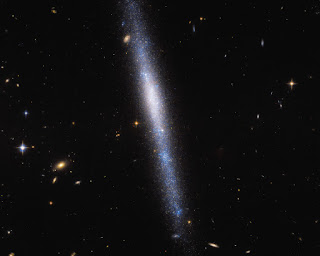
Credit: ESA/Hubble & NASA, R. Tully, Gagandeep Anand.
The Cosmic Waterfall
UGCA 193 presents a striking sight in the constellation Sextans, appearing as a mesmerizing cascade of stars when viewed from Earth. Unlike typical spiral galaxies, it lacks the characteristic dusty bands and features an unusually small yellow core. What makes this galaxy truly spectacular is its abundance of brilliant blue stars, creating an ethereal waterfall-like appearance.
Temperature and Mass: A Stellar Connection
The predominant blue hue of UGCA 193’s stars tells us a remarkable story about their nature. These stellar giants burn at temperatures approximately six times hotter than our Sun. In the cosmic temperature scale, blue stars represent the hottest stellar objects, while cooler stars appear red or orange to our eyes. This temperature-color relationship provides crucial insights into the galaxy’s stellar population:
Mass Characteristics
- Blue stars are significantly more massive than our Sun
- Higher mass correlates with higher surface temperatures
- These stars burn hotter and brighter due to their greater mass
Star Formation Dynamics
UGCA 193 exemplifies active star formation processes in dwarf galaxies. Recent studies have shown that star formation in galaxies can occur through different mechanisms:
Formation Pathways
- In-situ star formation occurs directly from gas at galactic centers
- Star formation can proceed in multiple episodes throughout a galaxy’s evolution
- Young, enriched populations indicate recent star formation activity
Galactic Evolution Insights
The presence of numerous hot, blue stars in UGCA 193 indicates recent and ongoing star formation. This aligns with our understanding of galactic evolution, where:
Star Formation Rates
- Dwarf galaxies can show varying levels of star formation activity
- Specific star formation rates help us understand galactic evolution
- Environmental factors influence star formation patterns
A Window into Cosmic Processes
As president of FreeAstroScience, I find UGCA 193 particularly fascinating because it serves as a natural laboratory for studying stellar evolution. The galaxy’s unique characteristics provide valuable insights into how stars form and evolve in different galactic environments.
The story of UGCA 193 reminds us that every galaxy in our vast universe has its own unique tale to tell. Through careful observation and analysis, we continue to unravel the complex processes that shape our cosmic neighborhood, one star at a time. Whether you’re an aspiring astronomer or simply curious about the cosmos, UGCA 193 stands as a testament to the dynamic and ever-changing nature of our universe.