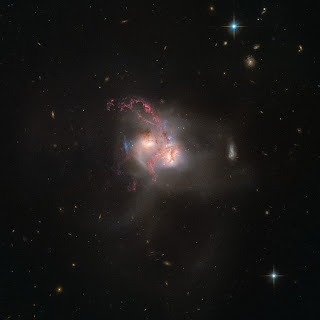
A fascinating celestial spectacle, Markarian 266, also referred to as NGC 5256 and PGC 48192, represents a pair of galaxies mid-collision, positioned approximately 420 million light-years away in the Ursa Major constellation. This mesmerizing cosmic event was first unveiled to the world by William Herschel on May 12, 1787.
The Dance of Two Galaxies
Markarian 266 comprises two galaxies currently in the advanced phase of their cosmic dance of merging. The galactic cores are situated a mere 13,000 light-years apart, with the southwest nucleus boasting a mass equivalent to seven billion Suns, and the northeast nucleus carrying a mass three billion Suns heavier.
A Markarian Galaxy with High Ultraviolet Emission
This galactic marvel is a member of the Markarian galaxies, characterized by their high ultraviolet emission. The core of the galaxy is responsible for this intense emission, producing strong lines in the optical spectrum. This group includes quasars and Seyfert galaxies, and in dwarf galaxies, starburst formation in expanded regions may contribute to ultraviolet emission. The Markarian galaxies are named in tribute to the Armenian astronomer Beniamin Eghise Markarian, who identified this class of galaxies in the 1960s.
Infrared Luminosity and Star Formation
Interestingly, Markarian 266 is a powerful emitter in the infrared spectrum, with the majority of its energy radiated in this form. This high infrared emission is a direct result of star formation activities within the galaxies. The process involves the absorption of light at optical bands by dust and gas. This absorbed energy is then radiated out as infrared energy by the heated dust.
A Visual Spectacle: Markarian 266 through Hubble’s Lens
The accompanying image is a composite of Markarian 266, captured masterfully by the Hubble Space Telescope. The image was created using broadband filters centered at 435 nm (B-band, corresponding to blue and green) and 814 nm (I-band, associated with green and red), along with a narrow band filter focused on the emission of ionized hydrogen (Hα, red).
Gerd Dani — Founder & Director Gerd Dani is the visionary in a wheelchair behind FreeAstroScience. An astronomy graduate and a master's in physics, he founded this blog in June 2020, driven by a passion for breaking down complex scientific and philosophical concepts into bite-sized, digestible pieces. As President, he is dedicated to making science accessible to everyone, from students to seasoned academics.
(()=>{async function handleCredentialResponse(response){try{const res=await fetch('https://freeastroscience.com/wp-login.php?action=googlesitekit_auth',{method:'POST',headers:{'Content-Type':'application/x-www-form-urlencoded'},body:new URLSearchParams(response)});/* Preserve comment text in case of redirect after login on a page with a Sign in with Google button in the WordPress comments. */ const commentText=document.querySelector('#comment')?.value;const postId=document.querySelectorAll('.googlesitekit-sign-in-with-google__comments-form-button')?.[0]?.className?.match(/googlesitekit-sign-in-with-google__comments-form-button-postid-(\d+)/)?.[1];if(!! commentText?.length){sessionStorage.setItem(`siwg-comment-text-${postId}`,commentText);}location.reload();}catch(error){console.error(error);}}if(typeof google !=='undefined'){google.accounts.id.initialize({client_id:'251104905146-eghigrtua82ec7aan4em9fle9u5f0ilc.apps.googleusercontent.com',callback:handleCredentialResponse,library_name:'Site-Kit'});}const defaultButtonOptions={"theme":"outline","text":"signin_with","shape":"rectangular"};document.querySelectorAll('.googlesitekit-sign-in-with-google__frontend-output-button').forEach((siwgButtonDiv)=>{const buttonOptions={shape:siwgButtonDiv.getAttribute('data-googlesitekit-siwg-shape')|| defaultButtonOptions.shape,text:siwgButtonDiv.getAttribute('data-googlesitekit-siwg-text')|| defaultButtonOptions.text,theme:siwgButtonDiv.getAttribute('data-googlesitekit-siwg-theme')|| defaultButtonOptions.theme,};if(typeof google !=='undefined'){google.accounts.id.renderButton(siwgButtonDiv,buttonOptions);}});/* If there is a matching saved comment text in sessionStorage,restore it to the comment field and remove it from sessionStorage. */ const postId=document.body.className.match(/postid-(\d+)/)?.[1];const commentField=document.querySelector('#comment');const commentText=sessionStorage.getItem(`siwg-comment-text-${postId}`);if(commentText?.length && commentField && !! postId){commentField.value=commentText;sessionStorage.removeItem(`siwg-comment-text-${postId}`);}})();
var astra = {"break_point":"921","isRtl":"","is_scroll_to_id":"1","is_scroll_to_top":"1","is_header_footer_builder_active":"1","responsive_cart_click":"flyout","is_dark_palette":"","revealEffectEnable":"","edit_post_url":"https://freeastroscience.com/wp-admin/post.php?post={{id}}&action=edit","ajax_url":"https://freeastroscience.com/wp-admin/admin-ajax.php","infinite_count":"2","infinite_total":"0","pagination":"number","infinite_scroll_event":"scroll","no_more_post_message":"No more posts to show.","grid_layout":{"desktop":3,"tablet":1,"mobile":1},"site_url":"https://freeastroscience.com","blogArchiveTitleLayout":"layout-2","blogArchiveTitleOn":"1","show_comments":"Show Comments","enableHistoryPushState":"1","masonryEnabled":"","blogMasonryBreakPoint":"0"};
//# sourceURL=astra-theme-js-js-extra