
Welcome to FreeAstroScience.com, where we make complex scientific concepts accessible and engaging! Today, we’re diving into the mesmerizing relationship between music and science. Whether you’re a music lover, a science enthusiast, or simply curious about how the universe works, this article will reveal the hidden mathematical patterns that make music truly magical. Let’s explore how the language of mathematics orchestrates the symphony of sound!
The Science Behind the Sound
Understanding Musical Vibrations
Ever wonder why your favorite song hits you right in the feels? It all starts with vibrations – tiny disturbances in the air that create sound waves[11]. These waves travel through space like ripples in a pond, reaching our ears and transforming into the beautiful melodies we know and love. The distance between these wave peaks, called wavelengths, determines the pitch we hear[11].
The Mathematical Magic of Music
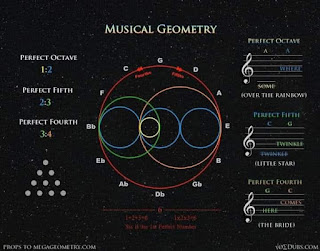
You might not realize it, but when you’re jamming to your playlist, you’re actually experiencing complex mathematical relationships in action. The ancient Greek mathematician Pythagoras first discovered this connection when he noticed that musical harmony could be expressed through simple numerical ratios:
- Octave: 2:1 ratio
- Perfect fifth: 3:2 ratio
- Perfect fourth: 4:3 ratio
The Brain on Music
A Neural Symphony
When we listen to music, our brains light up like a Christmas tree! Multiple regions work together in perfect harmony:
- The auditory cortex processes sound
- Motor regions get us moving to the beat
- Pleasure centers release feel-good chemicals
The Universal Language
Music truly is a universal language that transcends cultural boundaries[9]. While different cultures may have their own unique musical traditions, certain elements remain consistent across the globe, such as the use of scales and rhythmic patterns.
Pythagoras’s Musical Universe
The Music of the Spheres
Here’s something mind-blowing: Pythagoras believed that the entire universe was orchestrated by musical harmony. He proposed that celestial bodies, through their orbital movements, created a cosmic symphony – the “music of the spheres”. While we can’t actually hear these cosmic tunes, modern science has found fascinating patterns in planetary movements that somewhat align with his theory.
The Modern Science of Sound
Digital Harmony
Today’s technology allows us to understand music on an even deeper level. Through advanced brain imaging, scientists can observe how music affects our neural pathways and influences our emotions. This research has led to breakthrough applications in therapy and medicine.
Conclusion
As we’ve explored today at FreeAstroScience.com, music isn’t just an art form – it’s a perfect blend of mathematics, physics, and neuroscience. From the simple ratios discovered by Pythagoras to the complex neural networks activated in our brains, music demonstrates how science and art are two sides of the same cosmic coin. Next time you listen to your favorite tune, remember: you’re not just hearing music; you’re experiencing the mathematical poetry of the universe!
Keep exploring the wonders of science with us at FreeAstroScience.com, where we continue to unravel the mysteries of our universe, one fascinating concept at a time!