The Spectacular View of NGC 2276: Insights from the Hubble Telescope
By
Gerd Dani
| Published : June 25, 2023 | Last updated : March 28, 2026
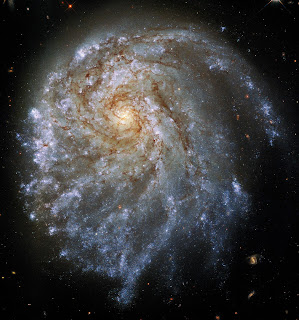
A few years back, the Hubble Telescope unveiled a breathtaking image of NGC 2276, a spiral galaxy sitting 120 million light-years away from our planet. This seemingly ordinary spiral galaxy, upon closer inspection, reveals unusual characteristics that intrigue astronomers.
The core of most galaxies, usually depicted in a vibrant yellow hue, typically sits at the exact center. In NGC 2276’s case, however, this center is intriguingly off-center, positioned towards the upper left. Additionally, the galaxy’s outer spiral arms exhibit a subtle distortion, suggesting that NGC 2276 has recently experienced a gravitational interaction with an unseen smaller galaxy.
Further observation of NGC 2276 reveals another unique aspect: the regions on the left appear significantly bluer and brighter than their counterparts on the right. This striking contrast is believed to be a result of the interaction between NGC 2276 and the hot intergalactic gas. This interaction sparked numerous star formation phenomena in the outer left arms, leading to the creation of several intensely bright, massive stars.
All credit for this remarkable observation of NGC 2276 goes to NASA, ESA, STScI, and Paul Sell. This striking image serves as a reminder of the awe-inspiring beauty and complexity of the cosmos that surrounds us.
Gerd Dani — Founder & Director Gerd Dani is the visionary in a wheelchair behind FreeAstroScience. An astronomy graduate and a master's in physics, he founded this blog in June 2020, driven by a passion for breaking down complex scientific and philosophical concepts into bite-sized, digestible pieces. As President, he is dedicated to making science accessible to everyone, from students to seasoned academics.
var astra = {"break_point":"921","isRtl":"","is_scroll_to_id":"1","is_scroll_to_top":"1","is_header_footer_builder_active":"1","responsive_cart_click":"flyout","is_dark_palette":"","revealEffectEnable":"","edit_post_url":"https://freeastroscience.com/wp-admin/post.php?post={{id}}&action=edit","ajax_url":"https://freeastroscience.com/wp-admin/admin-ajax.php","infinite_count":"2","infinite_total":"0","pagination":"number","infinite_scroll_event":"scroll","no_more_post_message":"No more posts to show.","grid_layout":{"desktop":3,"tablet":1,"mobile":1},"site_url":"https://freeastroscience.com","blogArchiveTitleLayout":"layout-2","blogArchiveTitleOn":"1","show_comments":"Show Comments","enableHistoryPushState":"1","masonryEnabled":"","blogMasonryBreakPoint":"0"};
//# sourceURL=astra-theme-js-js-extra