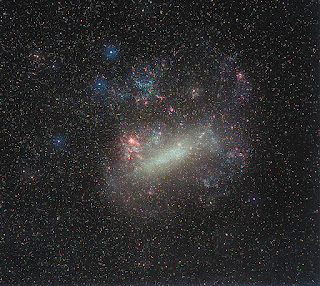

The cosmos is a vast expanse filled with galaxies, each hosting a multitude of smaller satellite galaxies. Our home, the Milky Way, is no exception. It’s circled by numerous smaller galaxies, among which the Large Magellanic Cloud stands out as the largest.
Each satellite galaxy possesses a unique narrative. They may have originated in the orbit of their host galaxy or may have been ensnared by its gravitational pull. Their evolution is equally diverse: some achieve a stable orbit lasting billions of years, others manage to break free from the gravitational grip, and yet some others are swallowed whole. The Large Magellanic Cloud, for instance, spiraled into the Milky Way’s orbit roughly 1.5 billion years ago. Until recently, it was either expected to maintain its stable orbit for eons or break free due to its impressive velocity.
However, 2019 research brought forth surprising revelations. It emerged that the Large Magellanic Cloud contains far more dark matter than previously assumed, making it considerably more massive. Consequently, it’s shedding energy at a higher rate than estimated, setting it on a collision course with the Milky Way in approximately 2 billion years.
As for our Solar System, these cosmic events will barely make a ripple. Given the vast distances between stars, the likelihood of two stars interacting during a galactic collision is slim.
The collision’s primary impact will be on the interstellar medium of the two galaxies. It’s probable that it will spark star formation events. Moreover, if any material spirals into the Milky Way’s core, it could rejuvenate the dormant supermassive black hole, causing it to emit high-energy radiation jets.
Image Credit: NASA, ESA, Hubble.