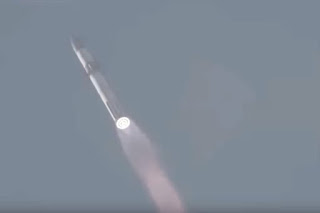
Despite not accomplishing its entire mission, SpaceX’s second Starship test flight was a testament to significant progress. The Starship spacecraft and Super Heavy booster met a dramatic end over the ocean but not before achieving several noteworthy milestones.
The rocket surpassed its performance from the first test flight in April, delving deeper into its flight profile. During the initial attempt, the Starship began an unplanned descent with its tail overhead, merely four minutes post-liftoff. In this test, the Starship and Super Heavy booster had not even separated.
However, this second attempt saw SpaceX accomplish this feat. Approximately two and a half minutes into the flight, the Starship ignited its engines and successfully detached through a novel procedure termed “hot staging.”
This segment signaled a crucial turning point for SpaceX, as hot staging was deemed the flight’s riskiest part by SpaceX CEO Elon Musk in October. A successful completion of this stage would be considered a mission success, and indeed, it was.
The flight didn’t proceed without hitches, though. The Super Heavy booster lost control shortly after separation, culminating in an explosion over the Gulf of Mexico. Despite this, the loss of the booster is not considered a significant setback.
Post separation, the Starship continued its journey without issues. Approximately eight minutes into the flight, the mission control echoed with cheers as the Starship neared the end of engine consumption, charting its path towards Earth’s orbit.
However, about nine minutes post-launch, SpaceX reported a loss of video signal with the Starship, and around two and a half minutes later, a loss of telemetry. This signaled that the Starship’s flight had deviated from the planned course.
John Insprucker, the host of SpaceX’s live stream, later confirmed the proactive destruction of the Starship to prevent it from veering off course. Despite this, SpaceX emphasized that the test flight was a success, providing valuable data for future missions.
NASA chief, Bill Nelson, congratulated SpaceX post-flight. NASA, having invested over $4 billion in Starship, plans to utilize the spacecraft for its flagship Artemis program to land astronauts on the moon.
The Federal Aviation Administration, having licensed the Starship’s test flight, issued a statement acknowledging the incident. The agency will likely initiate an investigation into the mishap as per standard protocol.
SpaceX takes a unique approach to rocket design, focusing on rapid prototyping and extensive testing, accepting potential failures during early development stages as opportunities for improvement.
The Starship managed to reach an altitude of roughly 150 kilometers post separation from the Super Heavy rocket, marking a significant stride in SpaceX’s journey towards space exploration.
Gerd Dani — Founder & Director Gerd Dani is the visionary in a wheelchair behind FreeAstroScience. An astronomy graduate and a master's in physics, he founded this blog in June 2020, driven by a passion for breaking down complex scientific and philosophical concepts into bite-sized, digestible pieces. As President, he is dedicated to making science accessible to everyone, from students to seasoned academics.
(()=>{async function handleCredentialResponse(response){try{const res=await fetch('https://freeastroscience.com/wp-login.php?action=googlesitekit_auth',{method:'POST',headers:{'Content-Type':'application/x-www-form-urlencoded'},body:new URLSearchParams(response)});/* Preserve comment text in case of redirect after login on a page with a Sign in with Google button in the WordPress comments. */ const commentText=document.querySelector('#comment')?.value;const postId=document.querySelectorAll('.googlesitekit-sign-in-with-google__comments-form-button')?.[0]?.className?.match(/googlesitekit-sign-in-with-google__comments-form-button-postid-(\d+)/)?.[1];if(!! commentText?.length){sessionStorage.setItem(`siwg-comment-text-${postId}`,commentText);}location.reload();}catch(error){console.error(error);}}if(typeof google !=='undefined'){google.accounts.id.initialize({client_id:'251104905146-eghigrtua82ec7aan4em9fle9u5f0ilc.apps.googleusercontent.com',callback:handleCredentialResponse,library_name:'Site-Kit'});}const defaultButtonOptions={"theme":"outline","text":"signin_with","shape":"rectangular"};document.querySelectorAll('.googlesitekit-sign-in-with-google__frontend-output-button').forEach((siwgButtonDiv)=>{const buttonOptions={shape:siwgButtonDiv.getAttribute('data-googlesitekit-siwg-shape')|| defaultButtonOptions.shape,text:siwgButtonDiv.getAttribute('data-googlesitekit-siwg-text')|| defaultButtonOptions.text,theme:siwgButtonDiv.getAttribute('data-googlesitekit-siwg-theme')|| defaultButtonOptions.theme,};if(typeof google !=='undefined'){google.accounts.id.renderButton(siwgButtonDiv,buttonOptions);}});/* If there is a matching saved comment text in sessionStorage,restore it to the comment field and remove it from sessionStorage. */ const postId=document.body.className.match(/postid-(\d+)/)?.[1];const commentField=document.querySelector('#comment');const commentText=sessionStorage.getItem(`siwg-comment-text-${postId}`);if(commentText?.length && commentField && !! postId){commentField.value=commentText;sessionStorage.removeItem(`siwg-comment-text-${postId}`);}})();
var astra = {"break_point":"921","isRtl":"","is_scroll_to_id":"1","is_scroll_to_top":"1","is_header_footer_builder_active":"1","responsive_cart_click":"flyout","is_dark_palette":"","revealEffectEnable":"","edit_post_url":"https://freeastroscience.com/wp-admin/post.php?post={{id}}&action=edit","ajax_url":"https://freeastroscience.com/wp-admin/admin-ajax.php","infinite_count":"2","infinite_total":"0","pagination":"number","infinite_scroll_event":"scroll","no_more_post_message":"No more posts to show.","grid_layout":{"desktop":3,"tablet":1,"mobile":1},"site_url":"https://freeastroscience.com","blogArchiveTitleLayout":"layout-2","blogArchiveTitleOn":"1","show_comments":"Show Comments","enableHistoryPushState":"1","masonryEnabled":"","blogMasonryBreakPoint":"0"};
//# sourceURL=astra-theme-js-js-extra