
Have you ever looked up at the night sky, dotted with countless stars, and felt impossibly small? It’s a feeling that connects us across generations. But what if I told you that just 100 years ago, our concept of the “entire universe” was thousands of times smaller than what we know it to be today?
Here at FreeAstroScience.com, we make complex science simple and exciting. We believe you should never turn off your mind, because, as the saying goes, the sleep of reason breeds monsters. We’ve written this article specifically for you, to take you on a journey through time and space. Stick with us to the end, and you’ll discover not only how our cosmic map exploded in size but also what the next century holds for our understanding of the universe.
How Did Our Cosmic Map Explode in Just One Century?
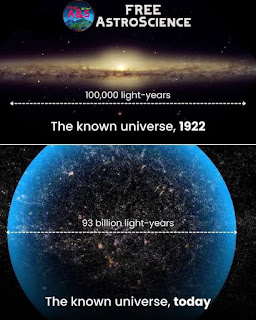
It’s hard to imagine, but in 1922, the most brilliant astronomers believed the universe was just our own Milky Way galaxy—a cozy 100,000 light-years across . Everything we could see, they thought, was contained within our galactic home. Mysterious smudges in the sky, which we now know are other galaxies, were dismissed as mere gas clouds or “spiral nebulae” .
From a Single Galaxy to Trillions
Then came the game-changer: a man named Edwin Hubble. In the 1920s, using the colossal 100-inch Hooker Telescope in California, Hubble turned his attention to the Andromeda “nebula” .

Figure 1: The 100-inch Hooker Telescope at Mount Wilson Observatory, which Edwin Hubble used for his groundbreaking discoveries.
He spotted special stars called Cepheid variables, which pulse at a rate connected to their true brightness. By measuring them, he calculated that Andromeda was nearly a million light-years away—far, far outside the Milky Way .
Key Finding: In that moment, our universe shattered its old boundaries. It wasn’t one galaxy; it was a vast ocean of them, potentially numbering in the billions . Our entire conception of reality was forever changed.
The Universe on the Move
Hubble didn’t stop there. By 1929, he made an even more profound discovery. He noticed that the light from distant galaxies was stretched, or “redshifted,” as if they were all rushing away from us . And the farther away a galaxy was, the faster it was moving.
This is what we now call Hubble’s Law, and it was the first concrete proof that the universe is expanding . Think of it like baking raisin bread. As the dough (space) expands, every raisin (galaxy) moves away from every other raisin. From any single raisin’s perspective, it looks like everything is rushing away from it. This discovery became the cornerstone of the Big Bang theory, our modern story of cosmic origins .
What Is the Universe’s Size and Speed Today?
Fast forward to today. Armed with powerful tools like the Hubble Space Telescope (named in his honor), we’ve continued to map the cosmos, and the numbers are mind-boggling.
Measuring the Unmeasurable: 93 Billion Light-Years
Today, we estimate the observable universe is about 93 billion light-years in diameter 19]].
But what does “observable” mean? It’s not the entire universe. It’s just the part from which light has had enough time to reach us since the Big Bang, about 13.8 billion years ago. Because space itself is expanding, the starting point of that ancient light is now much farther away than 13.8 billion light-years.
The true size of the universe? We don’t know. It could be at least 37 trillion light-years across, or it might even be infinite 29]]. What we see is just our cosmic horizon—our little bubble in a potentially endless ocean.
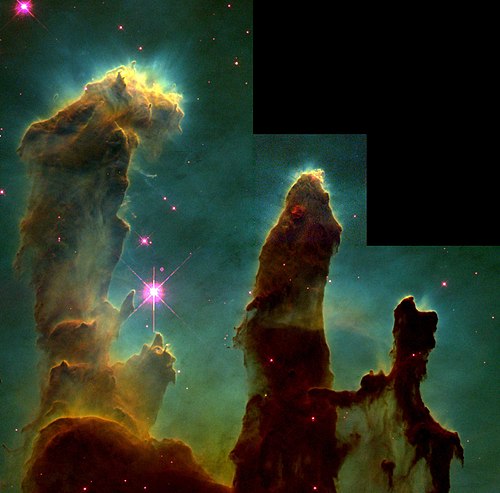
Figure 2: The Pillars of Creation in the Eagle Nebula, a vast star-forming region, showcases the incredible scale and beauty of our cosmos.
The “Hubble Tension”: A Cosmic Speeding Ticket?
So, we know the universe is expanding, but how fast? This is one of the biggest debates in cosmology today, a puzzle known as the “Hubble Tension.”
Scientists have two main ways of measuring the expansion rate, and they don’t quite agree:
- Looking at the Early Universe: By studying the faint afterglow of the Big Bang (the Cosmic Microwave Background), scientists get a speed of about 67.4 kilometers per second per megaparsec .
- Looking at the Local Universe: By measuring distances to nearby galaxies using stars and supernovae, they get a faster speed of about 73 km/s/Mpc .
This isn’t just a small rounding error. The difference is significant enough that it might be pointing toward new physics—something fundamental about the universe, like a mysterious force or particle, that we haven’t discovered yet .
So, How Much Bigger Will Our Universe Be in 100 Years?
This brings us back to our original question. Given everything we know, what will our cosmic map look like a century from now?
The answer has two parts. First, the boundary of our observable universe will expand. In 100 years, light from regions that are currently 100 light-years beyond our view will finally reach us. So, the diameter of our observable bubble will grow by 200 light-years. That might sound like a lot, but it’s a tiny fraction of its current 93-billion-light-year size.
The more exciting answer, however, isn’t about physical size—it’s about the explosion in our knowledge.
A Glimpse into the Future with New Eyes
In the next 100 years, we won’t just be adding a few light-years to our map; we’ll be rewriting it entirely with a fleet of new, powerful telescopes.
| Mission Name | Launch Year (Est.) | Key Goal |
|---|---|---|
| Nancy Grace Roman Telescope | 2027 | To map billions of galaxies and directly image large exoplanets, studying dark energy . |
| LISA (Laser Interferometer) | 2037 | To detect gravitational waves from space, hearing the echoes of merging supermassive black holes. |
| Habitable Worlds Observatory | ~2040 | To directly image Earth-like planets around other stars and search their atmospheres for signs of life . |
These future observatories, successors to giants like the Hubble and James Webb Space Telescopes, will give us the ability to see things we can only dream of today. We’ll be able to search for biosignatures—hints of life like oxygen and methane—on dozens of worlds, potentially answering the ultimate question: Are we alone?

Figure 3: The Hubble Space Telescope, a pioneer in cosmic discovery, paved the way for future observatories that will peer even deeper into space and time.
What Lies Beyond the Edge of What We Can See?
Even with these incredible new tools, we’ll still be faced with the ultimate mystery: what’s outside our observable bubble? Science has some fascinating, if unproven, ideas.
An Endless Ocean of Stars?
The simplest and perhaps most awe-inspiring idea is that the universe is infinite . If this is true, then our 93-billion-light-year sphere is just a single grain of sand on an endless beach. Somewhere out there, beyond our view, there would be countless other galaxies, stars, and maybe even other planets with beings looking up at their own night sky, wondering the same things we do.
Or Are We One of Many Universes?
Another mind-bending theory is the multiverse. This idea, born from theories of cosmic inflation and quantum physics, suggests that our universe is just one “bubble” in a vast cosmic foam of other universes . Each bubble could have its own unique laws of physics.
This theory is appealing because it could help explain why our universe seems so perfectly “fine-tuned” for life . If there are infinite universes, it’s not so surprising that at least one—ours—happened to have the right conditions for stars, planets, and people to exist. It’s a wild idea, but one that scientists are actively exploring.
Our Cosmic Journey Is Just Beginning
So, how much bigger will our universe be in 100 years? The physical boundary of what we can see will have grown by a sliver. But our understanding of it will be immeasurably larger.
We’ve journeyed from believing we were the center of a single galaxy to realizing we live in a vast, expanding cosmos of trillions of galaxies. We’ve learned its current size and speed, even uncovering puzzles like the Hubble Tension that hint at deeper secrets. And in the next century, we’ll build new eyes to search for life on other worlds and peer deeper into the unknown.
The universe we know today is just a fraction of the whole story. The greatest discoveries are still ahead of us.
We invite you to keep exploring with us. Come back to FreeAstroScience.com anytime you want to feed your curiosity and keep your mind sharp. After all, the quest for knowledge is the greatest adventure there is.