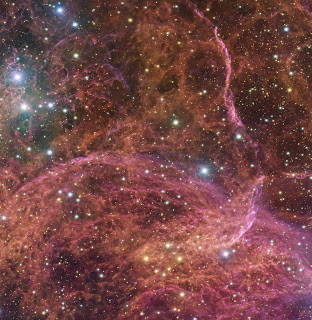
Immerse yourself in the captivating universe of the Vela Supernova Remnant, also known by its identifiers Gum 16 and SNR G263.9-03.3. This remarkable Supernova Remnant (SNR) is nestled approximately 800 light-years away within the constellation of Vela.
The progenitor star of the Vela SNR experienced a cataclysmic explosion, known as a type II supernova, approximately 11,000-12,000 years ago. This explosion birthed the Vela pulsar, a highly magnetized rotating neutron star. The existence of the Vela pulsar provides the first concrete observational proof that supernova explosions indeed form neutron stars.
Moreover, the Vela SNR shares the cosmic stage with Puppis A, another SNR located four times further away. These two celestial bodies are renowned for being amongst the most expansive and brightest X-ray sources.
In terms of angular size, Vela is considered one of the largest SNRs. Its apparent diameter in the sky outmeasures four degrees, dwarfing the full Moon’s half-degree span. Depending on the observation wavelength, its appearance varies significantly. In radio, Vela is depicted as a shell housing a pulsar and its corresponding pulsar wind nebula. However, in optical bands, only specific filaments are visible. When viewed in X-rays, the central region becomes more prominent, while its shell appears irregular. This variability has led to its classification as a composite remnant[1].
Accompanying this text is a composite image of the Vela SNR, captured using ESO’s Very Large Telescope situated at Cerro Paranal, Chile. Various broadband filters were used to create this image, revealing the beauty and complexity of the Vela SNR.
Image credit goes to the ESO/VPHAS+ team, with an acknowledgement to the Cambridge Astronomical Survey Unit.
Gerd Dani — Founder & Director Gerd Dani is the visionary in a wheelchair behind FreeAstroScience. An astronomy graduate and a master's in physics, he founded this blog in June 2020, driven by a passion for breaking down complex scientific and philosophical concepts into bite-sized, digestible pieces. As President, he is dedicated to making science accessible to everyone, from students to seasoned academics.
(()=>{async function handleCredentialResponse(response){try{const res=await fetch('https://freeastroscience.com/wp-login.php?action=googlesitekit_auth',{method:'POST',headers:{'Content-Type':'application/x-www-form-urlencoded'},body:new URLSearchParams(response)});/* Preserve comment text in case of redirect after login on a page with a Sign in with Google button in the WordPress comments. */ const commentText=document.querySelector('#comment')?.value;const postId=document.querySelectorAll('.googlesitekit-sign-in-with-google__comments-form-button')?.[0]?.className?.match(/googlesitekit-sign-in-with-google__comments-form-button-postid-(\d+)/)?.[1];if(!! commentText?.length){sessionStorage.setItem(`siwg-comment-text-${postId}`,commentText);}location.reload();}catch(error){console.error(error);}}if(typeof google !=='undefined'){google.accounts.id.initialize({client_id:'251104905146-eghigrtua82ec7aan4em9fle9u5f0ilc.apps.googleusercontent.com',callback:handleCredentialResponse,library_name:'Site-Kit'});}const defaultButtonOptions={"theme":"outline","text":"signin_with","shape":"rectangular"};document.querySelectorAll('.googlesitekit-sign-in-with-google__frontend-output-button').forEach((siwgButtonDiv)=>{const buttonOptions={shape:siwgButtonDiv.getAttribute('data-googlesitekit-siwg-shape')|| defaultButtonOptions.shape,text:siwgButtonDiv.getAttribute('data-googlesitekit-siwg-text')|| defaultButtonOptions.text,theme:siwgButtonDiv.getAttribute('data-googlesitekit-siwg-theme')|| defaultButtonOptions.theme,};if(typeof google !=='undefined'){google.accounts.id.renderButton(siwgButtonDiv,buttonOptions);}});/* If there is a matching saved comment text in sessionStorage,restore it to the comment field and remove it from sessionStorage. */ const postId=document.body.className.match(/postid-(\d+)/)?.[1];const commentField=document.querySelector('#comment');const commentText=sessionStorage.getItem(`siwg-comment-text-${postId}`);if(commentText?.length && commentField && !! postId){commentField.value=commentText;sessionStorage.removeItem(`siwg-comment-text-${postId}`);}})();
var astra = {"break_point":"921","isRtl":"","is_scroll_to_id":"1","is_scroll_to_top":"1","is_header_footer_builder_active":"1","responsive_cart_click":"flyout","is_dark_palette":"","revealEffectEnable":"","edit_post_url":"https://freeastroscience.com/wp-admin/post.php?post={{id}}&action=edit","ajax_url":"https://freeastroscience.com/wp-admin/admin-ajax.php","infinite_count":"2","infinite_total":"0","pagination":"number","infinite_scroll_event":"scroll","no_more_post_message":"No more posts to show.","grid_layout":{"desktop":3,"tablet":1,"mobile":1},"site_url":"https://freeastroscience.com","blogArchiveTitleLayout":"layout-2","blogArchiveTitleOn":"1","show_comments":"Show Comments","enableHistoryPushState":"1","masonryEnabled":"","blogMasonryBreakPoint":"0"};
//# sourceURL=astra-theme-js-js-extra