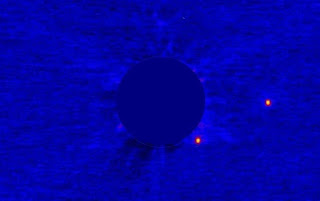
Among the numerous exoplanets found outside our Solar System, ROXs 42 Bb stands out due to its distinctive features and size. Identified more than 500 light-years away from Earth and discovered in 2013, this gas giant has a radius 1.12 times that of Jupiter and a mass nine times greater. Consequently, ROXs 42 Bb falls into the intriguing category of a “failed star” or “brown dwarf.” Measuring 2.5 times larger than Jupiter, its mass adds to its unique characteristics.
Brown Dwarfs: Between Stars and Planets
Brown dwarfs occupy an intriguing space between stars and planets. Regarded as a type of “missed star,” they are celestial bodies larger than planets like Jupiter but not massive enough to initiate nuclear fusion within their cores. Nuclear fusion is the process that fuels stars, producing light and heat through the fusion of hydrogen atoms into helium. Without enough mass to maintain nuclear fusion, brown dwarfs do not emit light like stars.
Brown dwarfs form from the gravitational collapse of a gas and dust cloud, similar to the process of star formation. However, while typical stars attain the necessary mass to spark nuclear fusion, brown dwarfs fall short of this critical threshold. The internal physical processes of brown dwarfs resemble those of stars, with gravitational compression generating heat to keep the object relatively warm.
Although brown dwarfs are abundant in the universe, their lack of luminosity makes them challenging to detect. They were first discovered in the 1990s when telescope technology improved, allowing for the identification of faint celestial objects. Astronomers employ various techniques to detect brown dwarfs, including examining their spectra, infrared brightness, and motion across the sky.
The Potential of Brown Dwarf Planetary Systems
An intriguing feature of brown dwarfs is their capacity to host planets. Numerous exoplanets have been found orbiting brown dwarfs, forming binary systems consisting of a relatively cold, opaque object and a smaller planet. These exoplanets might even offer favorable conditions for life, although the absence of light and heat from the brown dwarf could result in significantly different environments compared to planets orbiting typical stars.
In essence, brown dwarfs are fascinating celestial objects that lie in between stars and planets. Unable to trigger nuclear fusion and emit light, they are considered “missed stars.” Nevertheless, they play a crucial role in forming planetary systems and may support planets with unique conditions. Research on brown dwarfs continues to progress, enhancing our understanding of these enigmatic objects in space.
Gerd Dani — Founder & Director Gerd Dani is the visionary in a wheelchair behind FreeAstroScience. An astronomy graduate and a master's in physics, he founded this blog in June 2020, driven by a passion for breaking down complex scientific and philosophical concepts into bite-sized, digestible pieces. As President, he is dedicated to making science accessible to everyone, from students to seasoned academics.
(()=>{async function handleCredentialResponse(response){try{const res=await fetch('https://freeastroscience.com/wp-login.php?action=googlesitekit_auth',{method:'POST',headers:{'Content-Type':'application/x-www-form-urlencoded'},body:new URLSearchParams(response)});/* Preserve comment text in case of redirect after login on a page with a Sign in with Google button in the WordPress comments. */ const commentText=document.querySelector('#comment')?.value;const postId=document.querySelectorAll('.googlesitekit-sign-in-with-google__comments-form-button')?.[0]?.className?.match(/googlesitekit-sign-in-with-google__comments-form-button-postid-(\d+)/)?.[1];if(!! commentText?.length){sessionStorage.setItem(`siwg-comment-text-${postId}`,commentText);}location.reload();}catch(error){console.error(error);}}if(typeof google !=='undefined'){google.accounts.id.initialize({client_id:'251104905146-eghigrtua82ec7aan4em9fle9u5f0ilc.apps.googleusercontent.com',callback:handleCredentialResponse,library_name:'Site-Kit'});}const defaultButtonOptions={"theme":"outline","text":"signin_with","shape":"rectangular"};document.querySelectorAll('.googlesitekit-sign-in-with-google__frontend-output-button').forEach((siwgButtonDiv)=>{const buttonOptions={shape:siwgButtonDiv.getAttribute('data-googlesitekit-siwg-shape')|| defaultButtonOptions.shape,text:siwgButtonDiv.getAttribute('data-googlesitekit-siwg-text')|| defaultButtonOptions.text,theme:siwgButtonDiv.getAttribute('data-googlesitekit-siwg-theme')|| defaultButtonOptions.theme,};if(typeof google !=='undefined'){google.accounts.id.renderButton(siwgButtonDiv,buttonOptions);}});/* If there is a matching saved comment text in sessionStorage,restore it to the comment field and remove it from sessionStorage. */ const postId=document.body.className.match(/postid-(\d+)/)?.[1];const commentField=document.querySelector('#comment');const commentText=sessionStorage.getItem(`siwg-comment-text-${postId}`);if(commentText?.length && commentField && !! postId){commentField.value=commentText;sessionStorage.removeItem(`siwg-comment-text-${postId}`);}})();
var astra = {"break_point":"921","isRtl":"","is_scroll_to_id":"1","is_scroll_to_top":"1","is_header_footer_builder_active":"1","responsive_cart_click":"flyout","is_dark_palette":"","revealEffectEnable":"","edit_post_url":"https://freeastroscience.com/wp-admin/post.php?post={{id}}&action=edit","ajax_url":"https://freeastroscience.com/wp-admin/admin-ajax.php","infinite_count":"2","infinite_total":"0","pagination":"number","infinite_scroll_event":"scroll","no_more_post_message":"No more posts to show.","grid_layout":{"desktop":3,"tablet":1,"mobile":1},"site_url":"https://freeastroscience.com","blogArchiveTitleLayout":"layout-2","blogArchiveTitleOn":"1","show_comments":"Show Comments","enableHistoryPushState":"1","masonryEnabled":"","blogMasonryBreakPoint":"0"};
//# sourceURL=astra-theme-js-js-extra