Have you ever wondered what the oldest material on Earth looks like? Prepare to be amazed as we take you on a fascinating journey through time to explore ancient stardust that predates our Solar System. At FreeAstroScience.com, we’re thrilled to share groundbreaking research that will transform your understanding of cosmic history.
The Discovery of Ancient Stardust
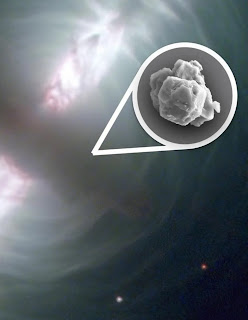
Scientists have made an extraordinary discovery within a meteorite that fell to Earth in the 1960s – dust grains dating back an astounding 7.5 billion years. These pre-solar grains represent the oldest known material ever found on our planet, far older than our 4.6-billion-year-old Solar System.
The Science Behind Stardust
Formation Process
When stars reach the end of their lives, they expel particles into space. These particles, known as pre-solar grains, become the building blocks for new cosmic structures, including stars, planets, and meteorites.
Analysis Methods
The research team employed an ingenious extraction process:
The meteorite is crushed into a fine powder
The resulting paste undergoes acid dissolution
Only the resilient stardust remains
Age Determination
Cosmic Ray Dating
We determine the age of these ancient grains through cosmic ray exposure analysis. These high-energy particles interact with matter, creating new elements that serve as cosmic timekeepers. Using neon-21 isotopes, scientists can measure exposure duration similar to measuring rainfall in a bucket.
Revolutionary Findings
Age Distribution
The analysis revealed fascinating patterns:
60% of grains are 4.6-4.9 billion years old
10% exceed 5.5 billion years
The oldest grain dates to 7.5 billion years
Star Formation Insights
This discovery provides concrete evidence of increased stellar formation in our galaxy approximately seven billion years ago. Even more intriguingly, these pre-solar grains often travel through space in cluster formations, challenging previous assumptions about their behavior.
Conclusion
Our exploration of these ancient stardust grains has opened a remarkable window into the cosmos’s past. Through cutting-edge research at FreeAstroScience.com, we’ve unveiled not just the oldest material on Earth, but also crucial insights into stellar evolution and galaxy formation. These tiny grains of stardust, older than our Solar System itself, continue to revolutionize our understanding of the universe’s history, proving that sometimes the biggest discoveries come in microscopic packages.

Gerd Dani — Founder & Director Gerd Dani is the visionary in a wheelchair behind FreeAstroScience. An astronomy graduate and a master's in physics, he founded this blog in June 2020, driven by a passion for breaking down complex scientific and philosophical concepts into bite-sized, digestible pieces. As President, he is dedicated to making science accessible to everyone, from students to seasoned academics.
(()=>{async function handleCredentialResponse(response){try{const res=await fetch('https://freeastroscience.com/wp-login.php?action=googlesitekit_auth',{method:'POST',headers:{'Content-Type':'application/x-www-form-urlencoded'},body:new URLSearchParams(response)});/* Preserve comment text in case of redirect after login on a page with a Sign in with Google button in the WordPress comments. */ const commentText=document.querySelector('#comment')?.value;const postId=document.querySelectorAll('.googlesitekit-sign-in-with-google__comments-form-button')?.[0]?.className?.match(/googlesitekit-sign-in-with-google__comments-form-button-postid-(\d+)/)?.[1];if(!! commentText?.length){sessionStorage.setItem(`siwg-comment-text-${postId}`,commentText);}location.reload();}catch(error){console.error(error);}}if(typeof google !=='undefined'){google.accounts.id.initialize({client_id:'251104905146-eghigrtua82ec7aan4em9fle9u5f0ilc.apps.googleusercontent.com',callback:handleCredentialResponse,library_name:'Site-Kit'});}const defaultButtonOptions={"theme":"outline","text":"signin_with","shape":"rectangular"};document.querySelectorAll('.googlesitekit-sign-in-with-google__frontend-output-button').forEach((siwgButtonDiv)=>{const buttonOptions={shape:siwgButtonDiv.getAttribute('data-googlesitekit-siwg-shape')|| defaultButtonOptions.shape,text:siwgButtonDiv.getAttribute('data-googlesitekit-siwg-text')|| defaultButtonOptions.text,theme:siwgButtonDiv.getAttribute('data-googlesitekit-siwg-theme')|| defaultButtonOptions.theme,};if(typeof google !=='undefined'){google.accounts.id.renderButton(siwgButtonDiv,buttonOptions);}});/* If there is a matching saved comment text in sessionStorage,restore it to the comment field and remove it from sessionStorage. */ const postId=document.body.className.match(/postid-(\d+)/)?.[1];const commentField=document.querySelector('#comment');const commentText=sessionStorage.getItem(`siwg-comment-text-${postId}`);if(commentText?.length && commentField && !! postId){commentField.value=commentText;sessionStorage.removeItem(`siwg-comment-text-${postId}`);}})();
var astra = {"break_point":"921","isRtl":"","is_scroll_to_id":"1","is_scroll_to_top":"1","is_header_footer_builder_active":"1","responsive_cart_click":"flyout","is_dark_palette":"","revealEffectEnable":"","edit_post_url":"https://freeastroscience.com/wp-admin/post.php?post={{id}}&action=edit","ajax_url":"https://freeastroscience.com/wp-admin/admin-ajax.php","infinite_count":"2","infinite_total":"0","pagination":"number","infinite_scroll_event":"scroll","no_more_post_message":"No more posts to show.","grid_layout":{"desktop":3,"tablet":1,"mobile":1},"site_url":"https://freeastroscience.com","blogArchiveTitleLayout":"layout-2","blogArchiveTitleOn":"1","show_comments":"Show Comments","enableHistoryPushState":"1","masonryEnabled":"","blogMasonryBreakPoint":"0"};
//# sourceURL=astra-theme-js-js-extra