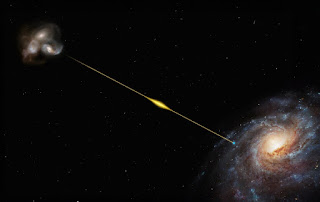
A very distant burst of cosmic radio waves lasting less than a millisecond has been detected by an international team. This “fast radio burst” (FRB) is the most distant ever detected. It originated in a galaxy so far away that its light took eight billion years to reach us, as detected by ESO’s Very Large Telescope (VLT). This FRB is also one of the most energetic ever observed: In a tiny fraction of a second, it released the equivalent of all the energy our Sun emits in 30 years.
Artist’s impression of a fast radio burst (FRB). Credit: ESO/M. Kornmesser
FRB 20220610A
The explosion, called FRB 20220610A, was detected last June by the ASKAP radio telescope in Australia. It beat the previous distance record set by the same group by 50 percent. The discovery confirms that FRBs can be used to measure the “missing” matter between galaxies, providing a new way to “weigh” the universe. Current methods for estimating the mass of the cosmos produce conflicting results and challenge the standard model of cosmology.
The importance of detection
Finding distant FRBs is critical to accurately measuring the missing matter in the universe, as demonstrated by the Australian astronomer Jean-Pierre (“J-P”) Macquart, who died in 2020. The result represents the limit of what telescopes can achieve today, although astronomers will soon have the tools to detect even older and more distant flashes, locate their sources, and measure the universe’s missing matter. The Square Kilometer Array Observatory (SKAO) organization is building two radio telescopes in South Africa and Australia that will find thousands of FRBs, including very distant ones that are undetectable with current instrumentation. ESO’s Extremely Large Telescope (ELT), a 39-meter telescope under construction in Chile’s Atacama Desert, will be one of the few telescopes capable of studying galaxies from which flashes even more distant than FRB 20220610A originate.
Gerd Dani — Founder & Director Gerd Dani is the visionary in a wheelchair behind FreeAstroScience. An astronomy graduate and a master's in physics, he founded this blog in June 2020, driven by a passion for breaking down complex scientific and philosophical concepts into bite-sized, digestible pieces. As President, he is dedicated to making science accessible to everyone, from students to seasoned academics.
(()=>{async function handleCredentialResponse(response){try{const res=await fetch('https://freeastroscience.com/wp-login.php?action=googlesitekit_auth',{method:'POST',headers:{'Content-Type':'application/x-www-form-urlencoded'},body:new URLSearchParams(response)});/* Preserve comment text in case of redirect after login on a page with a Sign in with Google button in the WordPress comments. */ const commentText=document.querySelector('#comment')?.value;const postId=document.querySelectorAll('.googlesitekit-sign-in-with-google__comments-form-button')?.[0]?.className?.match(/googlesitekit-sign-in-with-google__comments-form-button-postid-(\d+)/)?.[1];if(!! commentText?.length){sessionStorage.setItem(`siwg-comment-text-${postId}`,commentText);}location.reload();}catch(error){console.error(error);}}if(typeof google !=='undefined'){google.accounts.id.initialize({client_id:'251104905146-eghigrtua82ec7aan4em9fle9u5f0ilc.apps.googleusercontent.com',callback:handleCredentialResponse,library_name:'Site-Kit'});}const defaultButtonOptions={"theme":"outline","text":"signin_with","shape":"rectangular"};document.querySelectorAll('.googlesitekit-sign-in-with-google__frontend-output-button').forEach((siwgButtonDiv)=>{const buttonOptions={shape:siwgButtonDiv.getAttribute('data-googlesitekit-siwg-shape')|| defaultButtonOptions.shape,text:siwgButtonDiv.getAttribute('data-googlesitekit-siwg-text')|| defaultButtonOptions.text,theme:siwgButtonDiv.getAttribute('data-googlesitekit-siwg-theme')|| defaultButtonOptions.theme,};if(typeof google !=='undefined'){google.accounts.id.renderButton(siwgButtonDiv,buttonOptions);}});/* If there is a matching saved comment text in sessionStorage,restore it to the comment field and remove it from sessionStorage. */ const postId=document.body.className.match(/postid-(\d+)/)?.[1];const commentField=document.querySelector('#comment');const commentText=sessionStorage.getItem(`siwg-comment-text-${postId}`);if(commentText?.length && commentField && !! postId){commentField.value=commentText;sessionStorage.removeItem(`siwg-comment-text-${postId}`);}})();
var astra = {"break_point":"921","isRtl":"","is_scroll_to_id":"1","is_scroll_to_top":"1","is_header_footer_builder_active":"1","responsive_cart_click":"flyout","is_dark_palette":"","revealEffectEnable":"","edit_post_url":"https://freeastroscience.com/wp-admin/post.php?post={{id}}&action=edit","ajax_url":"https://freeastroscience.com/wp-admin/admin-ajax.php","infinite_count":"2","infinite_total":"0","pagination":"number","infinite_scroll_event":"scroll","no_more_post_message":"No more posts to show.","grid_layout":{"desktop":3,"tablet":1,"mobile":1},"site_url":"https://freeastroscience.com","blogArchiveTitleLayout":"layout-2","blogArchiveTitleOn":"1","show_comments":"Show Comments","enableHistoryPushState":"1","masonryEnabled":"","blogMasonryBreakPoint":"0"};
//# sourceURL=astra-theme-js-js-extra