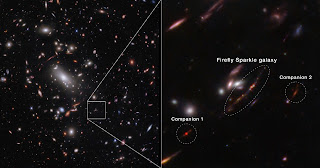

Welcome, stargazers and cosmic explorers! At FreeAstroScience.com, we’re thrilled to share a groundbreaking discovery that’s lighting up the astronomical community. The James Webb Space Telescope has captured something truly extraordinary – a galaxy that’s essentially showing us our own Milky Way’s baby photos. Let’s embark on this fascinating journey through space and time together.
The Cosmic Discovery
The James Webb Space Telescope has unveiled an ancient galaxy dubbed “Firefly Sparkle,” which existed a mere 600 million years after the Big Bang. This remarkable finding gives us an unprecedented glimpse into our universe’s early days, when the first galaxies were just beginning to take shape.
A Cosmic Christmas Light Show
The galaxy presents itself as ten distinct star clusters, resembling a celestial Christmas light display against the cosmic darkness. Each cluster shimmers at different intensities and colors, showcasing various stages of stellar evolution.
The Power of Cosmic Magnification
Einstein’s Legacy in Action
The observation of Firefly Sparkle was made possible through gravitational lensing, a phenomenon predicted by Einstein’s theory of general relativity. A massive galaxy cluster acts as a natural cosmic magnifying glass, bending and amplifying the light from this distant galaxy.
Technical Marvel
This gravitational lensing effect stretches the galaxy’s image into an arc, allowing astronomers to:
- Analyze individual star clusters
- Measure the galaxy’s mass
- Study its structural composition
Our Cosmic Family Album
A Young Milky Way Twin
Firefly Sparkle isn’t just any galaxy – it’s remarkably similar to what our Milky Way would have looked like in its youth. The galaxy’s mass and composition provide crucial insights into galactic evolution.
Cosmic Companions
The galaxy isn’t alone in its cosmic journey. Two neighboring galaxies, playfully named “Firefly-Best Friend” and “Firefly-New Best Friend,” orbit within 40,000 light-years of Firefly Sparkle.
Building Blocks of the Universe
Star Formation in Action
The ten distinct star clusters within Firefly Sparkle demonstrate that galaxy formation isn’t a simultaneous process. Each cluster represents a different phase of stellar evolution, providing a live demonstration of cosmic assembly.
Merger Scenario
The presence of companion galaxies suggests we’re witnessing a crucial stage in galactic evolution – the merging process that helped build larger galaxies in the early universe.
Scientific Significance
This discovery represents more than just a pretty picture – it’s a crucial piece in understanding cosmic evolution. The galaxy’s mass, approximately 10 million times that of our Sun, makes it one of the lowest-mass galaxies ever observed from this early epoch.
At FreeAstroScience.com, we believe that understanding our cosmic origins helps us appreciate our place in the universe. Firefly Sparkle isn’t just showing us how galaxies formed – it’s showing us our own cosmic heritage, one star cluster at a time. Keep watching the skies with us as we continue to uncover more celestial wonders!